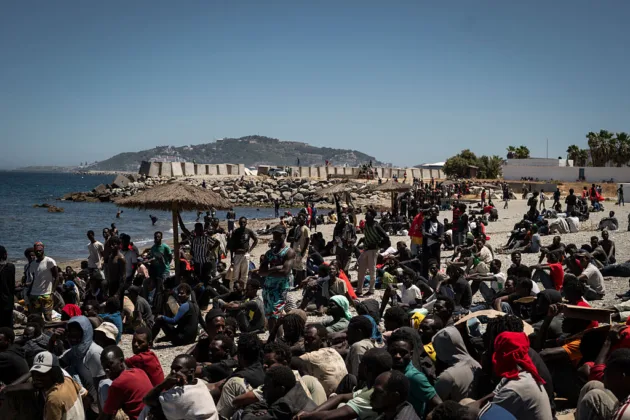




The centre-left government led by Prime Minister Donald Tusk has been keen to highlight how the number of attempted illegal crossings by illegal migrants, mainly from Africa and the Middle East over the border from Belarus fell from close to 15,500 in the first half of last year fell by 98 percent, and claimed a 100 percent success rate in apprehending the few migrants who managed to cross illegally.
However, at the same time the number of work permits issued to Africans was over 20,000 as Poland continued to be an attractive destination for foreign workers.
The interior ministry is boasting that “the effectiveness of border guard officers and the armed forces has effectively discouraged migrants from taking risks by attempting to cross the border.
There are however other forces at play such as the fact that Poland has suspended all asylum claims on its eastern border with Belarus and the fact that the Belarusian authorities have entered into a dialogue with the US which has included friendly gestures towards Poland such as the release of members of the Polish minority who were held as political prisoners.
This has created a political situation very different from that in 2021 when lager numbers of illegal migrants from Africal and Asia stormed the eastern border with the help and encouragement of the Belarusian government, leading to 40,000 attempted illegal crossings in that year alone.
In fact there is now evidence that Belarus has switched its focus to Latvia, another EU member state with which it shares a border.
Last week, Latvian interior minister Jānis Dombrava told Euronews that his country has now “become the main target” for Belarus’s migrant trafficking, instead of Poland and Lithuania.
On July 16 Latvia recorded 111 attempted illegal crossings from Belarus, compared to two in Lithuania on the same day and zero in Poland the previous day.
While Poland subsequently strengthened border infrastructure and sent thousands of additional officers to bolster security, attempted crossings remained high, around 30,000 in both 2024 and 2025.
Those figures have fallen dramatically in the first half of this year, when Poland’s border guard recorded only 235 crossings, compared to 15,500 in the equivalent period for 2025.
The number of migrants actually crossing without being apprehended is zero this year, down from 12,000 in 2023, 5,000 in 2024 and 1,700 last year.
“The statistics clearly show that the 700 million Euro investment in the security of the Polish-Belarusian border has delivered the intended results, we are effectively protecting our country from illegal migration organised by the Belarusian regime with the support of the Kremlin,” declared the ministry earlier this month.
Among the measures taken to protect the border are a 5.5-metre-high steel fence as well as an electronic monitoring system that detects attempts to cross and dispatches officers to the scene.
The effort at fortifying the border with Belarus had already been well under way during the time of the last Conservative (PiS) government, despite opposition to that policy from Tusk’s Civic Coalition (KO) and the Left.
When thousands were attempting to cross illegally into Poland in 2021 KO politicians and border activists accused the government of inhumane tactics and cast doubt on the wisdom of building a border fence.
However, on returning to office in 2023 Tusk and his party decided to strengthen the fortification of the border and to actually suspend processing asylum claims, moves which received support from PiS and the rest of the political right in Poland.
In 2024, following the killing of a Polish soldier stabbed by an illegal migrant attempting to cross the border, Poland also loosened the regulations on the use of firearms by officers posted there.
The government’s measures have met with approval from European Commission President Ursula von der Leyen who during a visit to Poland’s border with Belarus thanked the Polish authorities for defending Europe from “cynical hybrid attacks” allegedly orchestrated by Belarus and Russia.
She also promised EU financial support, which had not been forthcoming to the PiS administration that actually saw its EU funds frozen despite the fact the country was facing an illegal migration crisis and a refugee crisis in 2022 following the arrival of 2 million Ukrainians fleeing the full scale Russian invasion of that year.
The claim of zero successful crossings being made by the Tusk administration is hard to prove definitively since it does not account for any undetected crossings, though admittedly the electronic surveillance makes these increasingly hard to achieve.
Most of those who do manage to get across undetected are believed to head westward to Germany, with the Germans having already pushed back hundreds of illegal migrants following the re-introduction of border controls last year.
Tusk’s KO has consistently criticized the previous PiS administration for having issued hundreds of thousands of work permits to migrants from across the globe.
For six years running, between 2017 and 2022, Poland issued more first residence permits to migrants from outside of the EU than any other member state.
The number of foreigners was further bolstered by the mass arrival of refugees from neighbouring Ukraine in 2022.
Almost one million Ukrainian refugees remain in Poland, alongside hundreds of thousands of other Ukrainian migrants who arrived in the first two decades of this century.
However the process has continued under the Tusk government.
In 2025 21510 work permits were issued to Africans alone, 84 percent of them for men 77 percent for males in the 25-44 age range. Overall in the first half of 2025 nearly 150,000 work permits were issued, admittedly a reduction on 2024 and 2023.
The reduction has been explained by tightening of the rules but also by the slowing down in hiring on the domestic Polish labour market.
Nevertheless migration is continuing to be an issue as foreigners now make up a large proportion of the population in major Polish cities, including almost 15 percent in the capital, Warsaw, and 20 percent in Wrocław, Poland’s third-largest city.
300,000 foreign subjects are believed to be living in Warsaw and there is also a high concentration of foreign workers in small urban municipalities in central Poland which feature large industrial and logistic sectors reliant on migrant labour.
In the country as a whole, there were around 2.3 million foreign residents at the end of 2025, accounting for almost 6 percent of the population with Ukrainians making up 73% of that total.
The total number of foreigners as a proportion of those employed in Poland is now over a million, representing 7 percent of Poland’s workforce.
While Poland continues to be regarded as relatively safe, not having endured any terrorist attacks on its territory and because of the way its welfare system is structured it does not attract tourism nor allow in families of foreign workers, tensions around migrants already here are growing.
Even though there are no ghettos or no-go areas for police thus far the activities of Ukrainian, Georgian and Armenian organized criminals have caused the authorities some angst and the number of incidents involving violence with the participation of migrants is on the rise.
Nor is Poland free any longer of tensions with regard to Muslims. In recent weeks there have been protests outside an Islamic centre in Kraków, Poland’s second-largest city following a growing campaign against the centre, which is seeking to meet the needs of Kraków’s growing Muslim community.
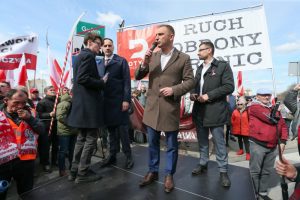
The protests were organized by the nationalist wing of the Confederation party, a political force averaging 15 percent in the polls who have campaigned consistently against the spread of the Muslim religion in a Christian country.
The Islamic centre in Kraków is run by the Al-Fajr Foundation, which describes itself as “an Islamic and cultural foundation based in Kraków, established to serve, support, and empower the Muslim community in Kraków and across Poland”.
Earlier this year, the foundation came to wider public attention when it began raising funds for a new cultural centre in the city that it said would be used for prayer as well as education and community support, claiming that the two current locations used by the city’s Muslim community “are stretched to their limits”.
While the foundation’s premises are not a mosque with minarets opponents have argued that it is becoming a mosque by stealth via prayers which are regularly held there.
“The illegal mosque in Kraków is still operating. The residents of the Podwawelskie estate have been deceived!” wrote the National Movement (RN) on Facebook. “Although we were told that it was a cultural centre and that we could always enter, this turned out to be untrue.”
The Al-Fair foundation claimed the information was a hostile act and accused the nationalists of recording visitors to its premise without consent and making threats against its community.
The local authority, controlled by Tusk’s Civic Coalition (KO), has said that the right to practice one’s religion is enshrined in the constitution but pledged to organize an open meeting between local residents and members of the Muslim community.
According to the municipality there are between 3,000 and 5,000 Muslims living in Kraków, with only 300-400 regularly practicing their religion. In Poland as a whole the number of Muslims is estimated to be between 40,000 and 80,000, accounting for 0,1-0,2 percent of the total population.
However, the number of foreign residents and workers shows that Poland has over the last decade stopped being a mono-ethnic society. Given the freedom of movement inside the EU and the needs of its growing economy and booming labour market that trend is only likely to grow, causing similar political tensions and social problems experienced in the countries of western Europe.