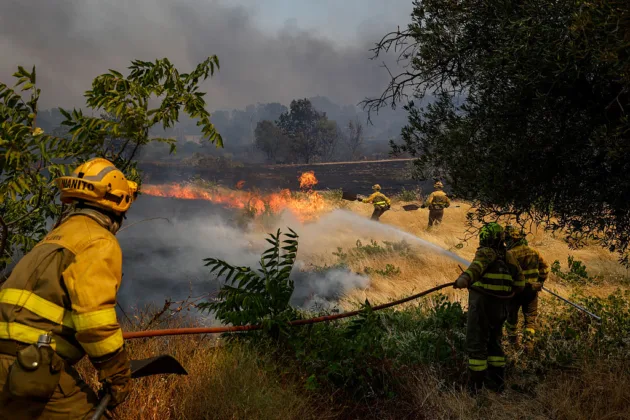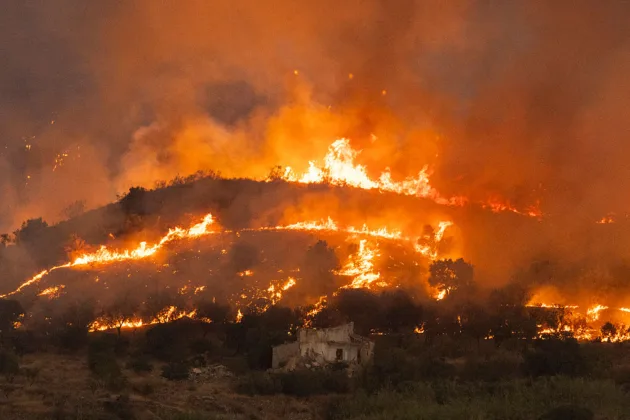






Spain’s worst fire season on record has overshadowed the end of Prime Minister Pedro Sánchez’s political year, with the last cabinet meeting before the summer break due on July 28, 2026 to declare the burnt areas disaster zones.
Government figures put the area destroyed since January 1 at 172,396 hectares, six times the total for the same period of 2025. The environment ministry has counted 35 large fires, against 11 a year earlier.
The blaze that began at Burgohondo in Ávila province, central Spain, on July 22 has burnt around 50,000 hectares and become the largest ever recorded in the country.
Almost 90,000 people have been evacuated or confined across the Madrid region and the provinces of Ávila and Toledo, according to the civil protection service.
A 78-year-old man died in a separate fire at Manises, near Valencia in eastern Spain, on July 25. Thirteen people were killed at Los Gallardos in Almería province, southeast Spain, in the deadliest fire in Andalusia’s history.
Spain activated the EU Civil Protection Mechanism on July 24 and asked for aerial support. Greece and Italy each sent two Canadair CL-415 amphibious aircraft, with Portuguese and Turkish crews joining afterwards.
The Guardia Civil, Spain’s national gendarmerie, said the record fire started with a spark thrown by heavy machinery. Its officers put the cause down to serious negligence.
The work was under way in a period when the regional Government of Castilla y León had banned the use of machinery capable of generating fire in woodland. Investigators said the operators held no administrative permit and lacked the extinguishing equipment required by a 2013 regional order.
One man has been arrested and a second placed under investigation, both on suspicion of a forest fire offence. The regional government said it would join the case as a private prosecutor.
At Los Gallardos, investigators are examining whether a fallen power cable started the blaze.
Sánchez proposed a state pact on what he calls the climate emergency on September 1, 2025, after the previous summer’s fires. He presented a text of 15 strands and 80 measures on December 17 and no agreement has followed.
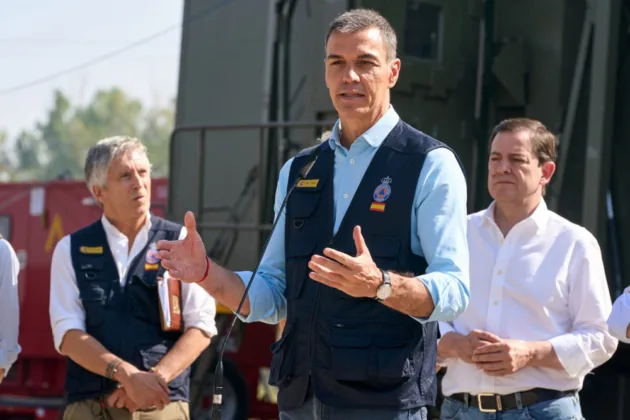
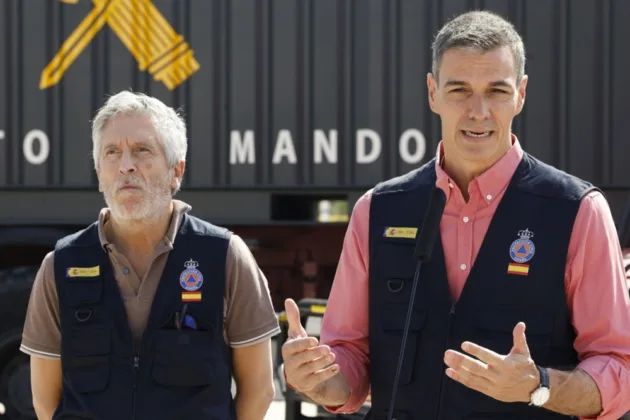
He returned to it on July 27, appearing with Sara Aagesen, third deputy prime minister and ecological transition minister, to launch a national network of climate shelters. The climate emergency killed, he said.
Aagesen told public broadcaster RNE the same day that fire prevention belonged to the regions and could not wait for the fire season. She also argued that governing alongside climate change deniers left the public unprotected, a reference to People’s Party (PP) coalitions with Vox.
Vox leader Santiago Abascal has blamed the fires on what he describes as the Government’s climate fanaticism.
Cuca Gamarra, the PP’s deputy secretary for institutional regeneration, said the Executive was producing announcements that were only marketing. The party has refused to sign a pact framed around the climate emergency and points instead to a civil protection plan of some 50 measures it tabled in 2025.
PP leader Alberto Núñez Feijoo has said Sánchez called for comparable agreements in 2018 and 2022 without result.
The Congress of Deputies rejected the Government’s deficit targets for a second time on July 23, with the PP, Vox, Junts per Catalunya and the Navarrese People’s Union (UPN) combining against them by 176 votes to 166, with five abstentions.
The 2023 budget has now been rolled over for a third year, making it the longest-serving in Spain’s democratic history. Ministers argue they can still draft a 2027 budget on the fiscal plan agreed with the European Commission.
Moncloa had intended to end the year with a housing decree agreed with junior coalition partner Sumar. The text was pulled from the cabinet agenda on July 27 for want of parliamentary support and is not expected before September.
The Government had spent 1 per cent of the money earmarked for housing in 2026 by the end of May.
Corruption cases have shadowed the whole term. José Luis Rodríguez Zapatero became the first former Spanish prime minister placed under formal investigation for corruption in May, while separate proceedings involve Sánchez’s wife, his brother and two former Socialist officials.
Feijoo was in Lima for the inauguration of Peru’s new president and left the response to his deputies in Madrid.
A Sigma Dos poll for El Mundo, with fieldwork carried out between July 6 and 20, put the PP on 138 to 143 seats and Vox on 58 to 61. The lower end of that range still clears the 176 seats needed for a majority.
Prevention, forest management and the enforcement of summer machinery bans sit with the regions, the courts and the Guardia Civil rather than with the weather. Sánchez returns on August 25 with the pact unsigned and the budget unwritten.