





Poland commemorated the anniversary of the second world war’s Volhynia massacre of over 100,000 of its citizens by Ukrainian nationalists on July 11 with the Polish Prime Minister Donald Tusk announcing a wall of remembrance for the victims and opposition Conservatives ( PiS) demanding legislation to mandate the government to stop Ukraine joining the EU unless it stops glorifying the nationalist Ukrainian Liberation Army (UPA).
July 11, 1943 is known in Poland as “Bloody Sunday”, the day which marked the height of the Volhynia massacre, when UPA, backed by parts of the local civilian population, attacked Polish villages in the Volhynia region.
In 2016, a parliamentary resolution declared 11 July a day of remembrance about Volhynia with Ukraine calling it a genocide. Ukraine protested the move saying that it “flies in the face of the spirit of good neighbourly relations” and “does not contribute to mutual understanding”.
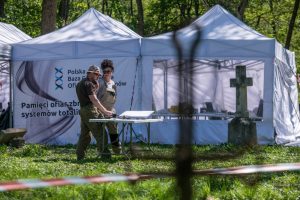
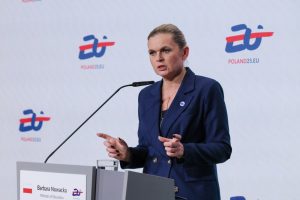
“Those who were murdered cannot remain nameless, they cannot go without a dignified burial. Remembering them is our shared duty to their families, to the nation and to the Polish state”, Tusk said announcing the construction of a memorial.
Tusk said the new monument would commemorate every victim found and identified. “That is why a Wall of Remembrance with an eternal flame will be built in Warsaw, bearing the name of every victim found and identified. Poland will not forget a single one of them”, he said.
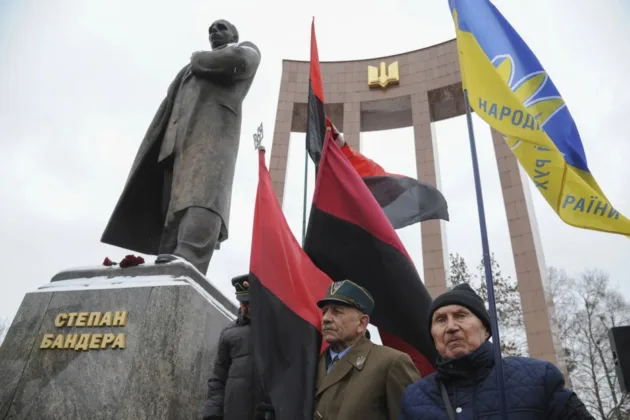
The Polish PM’s move is being interpreted in Warsaw as a response to the announcement by Ukraine that it is to establish a pantheon of heroes in Ukraine, a move the Poles fear will include the UPA and nationalist leaders such as Bandera.
But he added that “the answer to nationalism cannot be more nationalism”, and that truth, remembrance and hope should form the foundation of future relations and referring to relations with Ukraine, Tusk said Europe’s peace and reconciliation had been built on truth, and that any country seeking to belong to that Europe must be ready to accept it.
Polish President Karol Nawrocki was more forthright in his remarks condemning the “evil ideology” of Ukrainian nationalism
He visited the small village of Radruż in southeast Poland, less than a kilometre from the Ukrainian border. During the Volhynia massacres, Radruż was one of many villages where the UPA and the Organisation of Ukrainian Nationalists (OUN), another nationalist group, massacred Polish civilians.
“We refuse to allow the 120,000 Poles – civilians, women and children – brutally murdered by Ukrainian nationalists to be forgotten,” declared Nawrocki.
Nawrocki has been at the heart of the recent dispute when in response to Ukrainian President Volodymyr Zelensky’s decision to name a unit after the UPA, he decided to strip the Ukrainian head of state of Poland’s highest honour, the Order of the White Eagle.
The snub led to tit-for-tat diplomatic moves that saw many high-profile political figures on both sides return state honours.
Nawrocki has also submitted legislation to Parliament which would outlaw Ukrainian nationalism as propagated by its nationalist leader Stepan Bandera and UPA, putting it on a par with totalitarian ideologies of fascism and communism which are already outlawed in Poland
Poland’s main opposition PiS has in turn proposed a bill opposing Ukraine’s future EU membership unless Kyiv stops “the glorification” of a military group linked to a World War II-era massacre of Poles.
The draft legislation was announced by Przemysław Czarnek, a PiS prime ministerial candidate in next year’s parliamentary elections.
Speaking to reporters in the eastern Polish city of Lublin by a monument commemorating the killings, Czarnek said that Ukraine “will not enter the EU while glorifying the perpetrators of genocide, responsible for exceptionally brutal killings against the Polish nation.”
“The EU cannot be based on an ideology that contradicts Christian, European values,” declared Czarnek. “It cannot have among its members a country that openly invokes the worst possible legacy.”
Czarnek said that the Ukrainian people have other figures they can honor. “They have many heroes. I am thinking of the current war caused by Russia, but also of heroes from earlier periods.”
The Polish People’s Party (PSL), a centre-right party which is part of Tusk’s ruling centre-left coalition, tends to agree with PiS on Ukraine.
Władysław Kosiniak-Kamysz, Poland’s defence minister and PSL leader said on Wednesday that Ukraine’s path to the EU cannot ignore the core values on which the bloc was founded.
“It is not possible to enter the European Union while bypassing the principles on which the Union is built,” he said, adding that those include historical truth, respect for partners and building good neighborly relations.
Ukraine applied to join the EU in February 2022, days after Russia launched its full-scale invasion, and its bid requires unanimous backing from all 27 EU member states including Poland.
Ewa Zajączkowska-Hernik, MEP from the libertarian nationalist Confederation party, spoke last week in the European Parliament and tore up the flag used by Ukrainian nationalists, an act for which she was placed on the list of enemies of the Ukraine by a Ukrainian organization connected with Ukraine’s military.
It later emerged that this list of Ukraine’s enemies now includes President Nawrocki’s chief of staff Zbigniew Bogucki and one of the best known conservative commentators in Poland Rafał Ziemkiewicz.
Meanwhile the most anti-Ukrainian of all the parties, the far right Confederation of the Polish Crown led by Grzegorz Braun MEP which has torn down Ukrainian flags and called for the stemming of Ukrainian migration into Poland, has been active in trying to discover evidence of Ukrainians in Poland supporting the Bandera ideology that President Mawrocki wishes to outlaw.
Two of its activists have been charged over an incident in which they confronted a Ukrainian woman who runs a business that provides services to immigrants with regard to obtaining residence and work permits.
A recording of the incident went viral on social media last week showed two men knocking of the door of the offices of the company.
The manager of the office, Natalya Fedoryuk, a Ukrainian who has lived in Poland for a decade, came into the corridor to speak with the two men, who said they “want to see what the office looks like because we know that Ukraine is currently hostile to the Polish nation”.
They repeatedly asked her if she “supports Stepan Bandera”, and claimed that Fedoryuk’s business is responsible for “bringing foreigners here” and “mixing up ethnic structures” in Poland.
Fedoryuk refused to allow the group to enter her offices, informed them that all her activities are legal, and suggested that, if they had any doubts, they should go to the police. She also said that she “supports and respects Poles very much”.
‼️ Aktywiści wspierający Grzegorza Brauna i Korwin-Mikkego chodzą po biurach ukraińskich firm w Polsce i domagają się wejścia do środka z kamerą. W ten sposób chcą sprawdzać czy w środku potajemnie nie wspiera się… Stepana Bandery i zbrodniarzy z UPA, którzy mordowali Polaków. pic.twitter.com/kxd6uV2hkK
— Goniec.pl (@GoniecPL) July 7, 2026
The confrontation was slammed by figures from the ruling Tusk coalition with interior minister Marcin Kierwiński stating that “there is no consent for hatred and aggression,” and pledging that “the police will react decisively”.
Polish media also reported that one of the two men has recently been charged with espionage for Russia, but was released by a court which determined that there was insufficient evidence for him to be detained.
The police later announced that they had detained two men in relation to the incident and prosecutors informed that the pair had been charged with criminal defamation against Fedoryuk, an offence punishable by up to one year in prison.
The two men have pleaded their innocence, denying that they had threatened Fedoryuk but merely expressed an opinion about her business and behaviour of some Ukrainians. They were not charged with any physical violence or making threats.
The fact that defamation is a criminal offence in Poland has been criticized by the European Commission in its rule of law reports on Poland as a threat to the freedom of speech. It is viewed by journalists as a means of gagging the media.
Opinion polls indicate that support for Ukraine and Ukrainians has waned in Poland with support for parties that have taken positions critical of Ukraine and Ukrainians rising in popularity.
This contrasts starkly with 2022 in the immediate aftermath of the Russian invasion of Ukraine when there was an outpouring of support and sympathy for Ukraine and the Ukrainians.
In that year Poland became a hub for military and humanitarian aid for Ukraine, gifted nearly 300 tanks and a dozen MIG fighter planes as well as other weapons and hosted two million Ukrainian refugees granting them full labour, welfare, education and healthcare rights.
But Ukraine has continued to restrict Polish exhumation of Volhynia victims, criticized Poland over restriction on Ukrainian grain exports and accelerated the process of honouring UPA and its nationalist backers.