French President Emmanuel Macron has instructed the government to draw up a plan to protect France’s critical infrastructure and its most sensitive defence-industry sites from Russian drone and cyber attacks, and has said France would convene a G7 meeting on energy in the coming weeks.
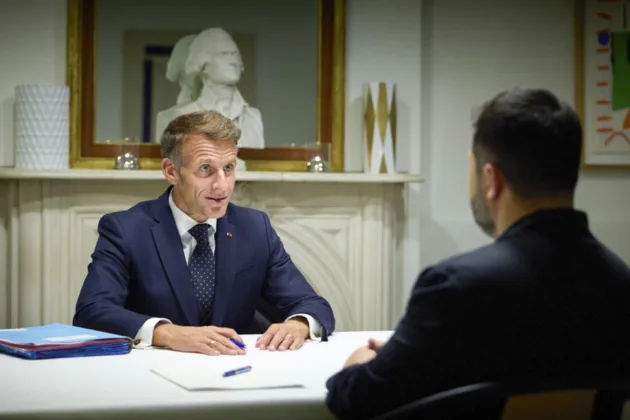
He spoke at a press conference at the Élysée on September 18 after an unusual meeting with parliamentary party leaders and candidates for next year’s presidential election, which he cannot contest after two consecutive terms.
The meeting began at 10.30am and was attended by Prime Minister Sébastien Lecornu and by senior military and intelligence officers, the presidency said.
Macron said the intelligence services had briefed them on Russia’s hybrid campaign and on the wars in Ukraine and the Middle East, with the spy services describing drone flights, cyber operations and airspace incursions as “shadow operations” intended to frighten Europeans into easing support for Kyiv.
The “nature of Russian aggression and threats in Europe is changing,” the French President warned. The plan to protect against “drone attacks” and “cyber attacks” will also concern the “most sensitive sites of our defence industrial and technological base,” the head of state said.
“The Russian hybrid threat against Europeans and against France has intensified,” he said.
Radical Party of the Left (PRG) president Guillaume Lacroix said of the meeting on X: “From the height of my 50 years, I rarely felt such a vertigo,” he wrote after “3h of briefing and exchanges”.
“Dizzy for the gravity of situations in the Middle East and Ukraine, from the predatory madness that leads the world to chaos. Vertigo of risks and consequences on our security, our economy, our purchasing power. Vertigo of all those candidates who dream, without restraint, sure of their fact and their postures, to govern France in this time and this historical and serious situation,” he wrote.
Macron listed a series of incidents since the summer. A Russian drone hit the locomotive of a Kyiv-Warsaw passenger train in western Ukraine on September 13, about 2km from the Polish border, with its 206 passengers evacuated some 15 minutes earlier after an air-raid alert.
In early August a drone attack on a Ukrainian cargo aircraft at Leipzig-Halle airport in Germany was foiled. On September 14 a Russian frigate fired two flares at a Danish air force Fennec helicopter off Gedser, in international waters, and Copenhagen summoned the Russian ambassador. He also cited incursions into European airspace.
Interior minister Laurent Nuñez had already told prefects to raise vigilance.
The new plan is to cover critical infrastructure and the defence industrial and technological base.
Macron said the attacks would “not go unanswered” and that France would continue to support Ukraine. Russia would be in “error” if it carried on “acting in this way”, he said.
He also said Europe should not “enter a state of belligerence” with Russia.
Former prime minister Édouard Philippe, now a declared candidate for the presidency, said on leaving the Élysée that the level of threat to France from the war in Ukraine was rising.
He leaves next week for the United Nations General Assembly in New York.
Separately, as holder of the G7 presidency, he said a meeting devoted to energy would be held in the coming weeks “to strengthen cooperation and avoid unnecessary tensions between the G7 countries and our main partners” and “to consider options for a possible release or unlocking of strategic reserves,” as members had done earlier this year with the International Energy Agency (IEA). He said the meeting should also improve coordination on stock levels.
IEA members have already released more than 300 million barrels, part of the 400 million agreed by the agency’s 32 members on March 11 in the largest such release in its history.
European diesel this week rose above $200 a barrel for the first time since April. Brent crude reached $108.30 on September 16, its highest since May, while the average price of diesel at French pumps stood at €2.34 a litre that day.
Macron blamed the wars in Ukraine and between the United States and Iran, including disruption around the Strait of Hormuz, not domestic policy.
He said he had discussed oil and gas supply with Saudi Arabia, Iraq, Qatar and the United Arab Emirates and would raise petroleum products and liquefied natural gas (LNG) with Canada’s Prime Minister Mark Carney on Sunday.
In Europe he wants faster gas storage, more flexible markets, maintained import and refining capacity, and biofuels where technically possible.
At home the government will review stocks and logistics.
He warned against large-scale fuel subsidies that would mean a bigger deficit or higher taxes, and said targeted help was being prepared. He ruled out blocking prices, a step National Rally leader Jordan Bardella had pressed for in the form of lower fuel taxes.