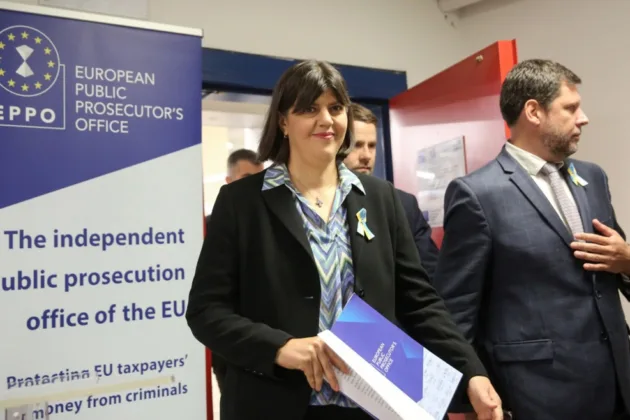











The European Public Prosecutor’s Office (EPPO) has filed an indictment in Sofia against a company representative accused of defrauding the European Union over a €213.7 million railway modernisation project.
In a statement on November 19, the EPPO confirmed that its Sofia office had submitted the indictment to the Sofia City Court following an investigation into upgrades along parts of the railway section between Sofia and Plovdiv, Bulgaria’s second-largest city.
According to prosecutors, the contract was awarded in 2019 to a consortium of three companies.
The accused, who served as the legal representative of one of the firms in the consortium, is alleged to have concealed the fact that his company had already been declared insolvent in 2012.
Investigators say the suspect used the consortium’s manager, who was unaware of the criminal circumstances, to submit a declaration stating that the company was not subject to insolvency proceedings.
That misrepresentation enabled the consortium to meet the tender’s eligibility criteria and secure an EU-funded grant agreement worth €213,714,235.14.
Between 2019 and 2024, Bulgaria’s National Railway Infrastructure Company (NRIC) paid out €68,213,186.03 to the consortium, co-financed by the EU’s Connecting Europe Facility (CEF) and the Bulgarian national budget.
The case began with an initial crime report from the European Anti-Fraud Office (OLAF), which also conducted a complementary probe.
The EPPO’s investigation was supported by Bulgaria’s National Police General Directorate and the State Agency for National Security (DANS), involving multiple searches and seizures at company headquarters and private residences across the country.
Documents relating to the tender procedure and its implementation were seized, the EPPO said.
The EPPO said the defendant is presumed innocent until proven guilty in a Bulgarian court of law.
The Luxembourg-based office is the EU’s independent public prosecution body, responsible for investigating and prosecuting crimes against the bloc’s financial interests.
The indictment is the latest development in a wider investigation into how EU transport funds have been spent on Bulgaria’s rail network, particularly along the Sofia–Plovdiv–Burgas corridor, the country’s main east-west rail axis.
In June, The Rail Agenda reported that the EPPO and OLAF were examining 19 Bulgarian rail contracts, exposing Sofia to potential financial clawbacks from Brussels of up to €400 million if violations are confirmed.
Of those, 17 infrastructure contracts are with the EPPO and two rolling stock contracts with OLAF, according to Bulgarian transport minister Georgi Peev.
Earlier inquiries along the same corridor led to EPPO raids at 28 locations in August 2023 and fraud charges in January 2025 against four individuals, including a former NRIC director, over a €94.5 million signalling and telecommunications contract on the Plovdiv–Burgas section.
OLAF had also recommended in 2023 that more than €38 million be recovered from a separate project on the Sofia–Plovdiv line.
Alongside the criminal probes, Bulgarian authorities have been conducting an internal clean-up at NRIC.
A transport ministry audit presented by Peev earlier this year identified roughly €765 million in contracts committed without secured financing, as well as €30.5 million in advance payments made between 2024 and 2026 on projects with no completed work.
In October, Bulgarian financial outlet Investor.bg reported that procurement procedures worth more than €350 million and existing contracts exceeding €20 million had been terminated at the state-owned rail infrastructure manager as a result of the audit.
The European Public Prosecutor’s Office (EPPO) has launched a second criminal investigation into suspected fraud involving European Union funds earmarked for the modernisation and safety systems of Spain’s Madrid–Seville high-speed rail corridor. https://t.co/UF4a7dCJH2
— Brussels Signal (@brusselssignal) November 7, 2026