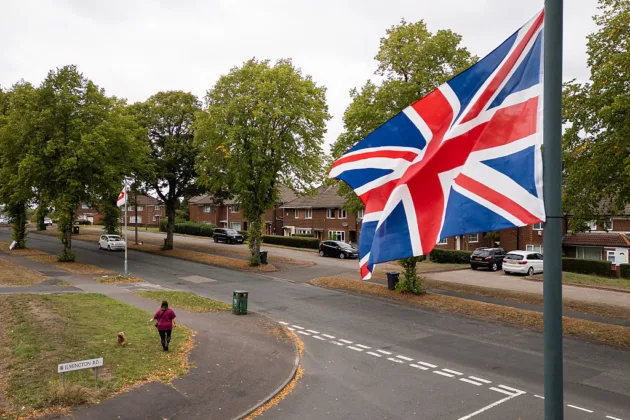




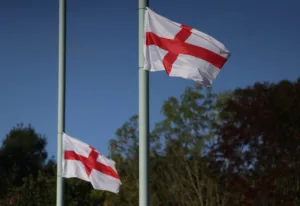





Birmingham City Council has secured an interim High Court injunction prohibiting the unauthorised attachment of flags to lamp-posts, bridges, roundabouts and other highway infrastructure across the city.
In a written ruling published on November 18, Judge Emma Kelly granted the interim prohibitory order against “persons unknown”, as well as Ryan Bridge, co-founder of the “Raise the Colours” campaign, and Ben Cullen, who is associated with it.
The injunction bars the placing of any flags on council-owned street furniture without prior permission.
It carries a power of arrest against Bridge and “persons unknown”, allowing police to arrest without a warrant anyone they reasonably suspect of breaching the order.
The council said breaches could lead to up to two years in prison, a fine or the seizure of assets for contempt of court.
The local authority had applied to the High Court in August for an injunction, including a power of arrest, following months of disputes over Union Jacks and St George’s Crosses being hung across the city.
The case was adjourned in September after the judge asked the council to clarify its claims against the individual defendants.
A further hearing in the case is scheduled to take place today.
Birmingham City Council: Sorry mate, you can’t put the St George’s flag on the lamppost since it’s a safety hazard. pic.twitter.com/Vrr51wDsSu
— Chris Rose (@ArchRose90) November 18, 2026
The legal action follows a nationwide campaign to hoist England and Union flags on public infrastructure, which began in Birmingham during the summer of 2025.
While organisers and supporters described the effort as an expression of national pride, some residents and council officials raised concerns over highway safety, damage to street furniture and the use of national symbols to intimidate minority communities.
Bridge opposed the injunction, arguing it would breach his rights to freedom of expression and protest under the European Convention on Human Rights.
His lawyer Liam Wells told the court the order would have a “chilling effect” on those rights. After the ruling, Bridge said he was “gutted”.
The anti-racism group Brummies United Against Racism said it was “firmly opposed to those who seek to use the flag to further an agenda of hate and who dress up racism as patriotism”.
In August 2025, the then Labour-run council drew criticism after removing Union Jacks and St George’s Crosses in Birmingham neighbourhoods such as Weoley Castle and Northfield, citing safety concerns.
Critics, including local Conservatives and senior Tory figures, accused the administration of applying double standards, arguing that British national flags were swiftly taken down while Palestinian flags — and, in other municipal disputes across the UK, rainbow Pride flags — were routinely tolerated or left in place.
The controversy intensified following reports of a leaked internal email in which council officials reportedly stated that Palestinian flags could not be removed from lamp-posts without police protection.
At the time, the then Conservative shadow justice secretary Robert Jenrick described the disparity as “blatant two-tier bias against the British people”, claiming the council appeared “ashamed of our country”.
Birmingham Conservatives similarly argued that the authority was inconsistent in enforcing its own rules on political symbols.
Birmingham City Council has consistently rejected allegations of political bias, maintaining that its removal policy applies equally to all unauthorised attachments.
Officials previously stated that approximately 200 unauthorised flags and banners of various types had been removed across the city in 2025, including Palestinian flags, though they noted that some were quickly replaced after being taken down.
Following complaints from community groups such as UK Lawyers for Israel in 2024, the council had also pledged to clear Palestinian flags that had remained on street furniture for several months.
Under the terms of Kelly’s interim order, the ban applies to all unauthorised flags placed on council-owned highway infrastructure, regardless of the symbol or cause represented.
Birmingham City Council has won a High Court injunction to prevent St George and Union flags from being flown on lamp-posts.
This sends out the wrong message. This was Birmingham several months ago. The same council didn’t condemn this or the many Palestine flags around the city… pic.twitter.com/jhxfHLVTeA
— Chris Rose (@ArchRose90) November 18, 2026