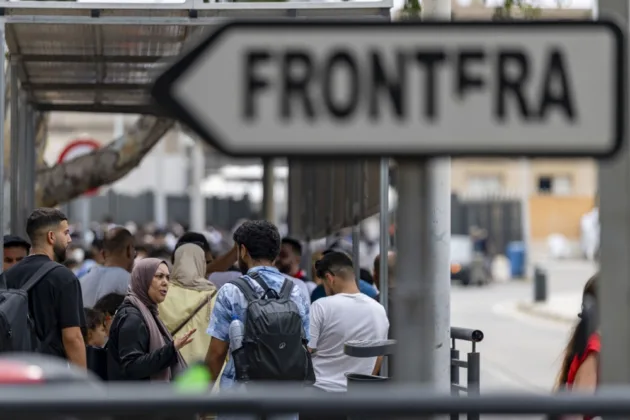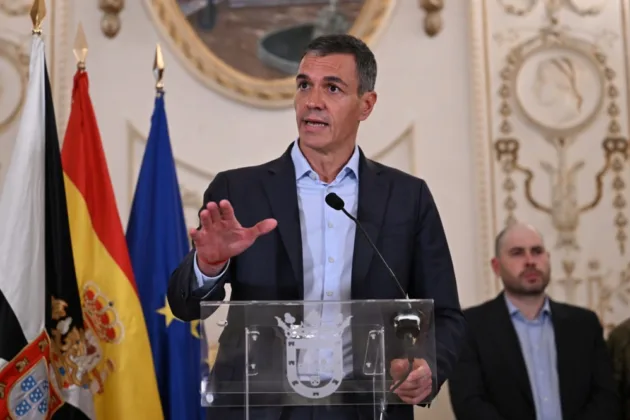



Breaking news: A month after the invasion of Ceuta (up to 80,000 people, on the Ceuta government’s count, pouring into a city of 84,000 inhabitants, with at least 86 confirmed deaths), Pedro Sánchez has finished his holidays. He spent August walled up in a State residence in Lanzarote, where he went diving and watched the August 12 solar eclipse, and did not return to the peninsula until August 24. In Ceuta, meanwhile, the situation has deteriorated: According to local authorities, up to 10,000 illegal migrants are still on site and only a third have been identified, though the interior minister now puts the figure at 5,000; rapes and other crimes are soaring; the Ceuta medical association is warning of epidemic risks while the hospital management, which answers to the health ministry, threatens to sanction doctors if they speak to journalists; illegal migrants occupy the beaches; some have reached the Schengen area; the courts and emergency services are overwhelmed; and residents and local authorities feel helpless. Even the local Socialist Party bitterly reproaches Sánchez for his passivity. For a monolithic organisation totally subservient to its leader, that is more than revealing.
At the international level, the picture is equally dismaying: 22 EU member states signed a joint letter on August 1 against Sánchez’s massive regularisation (1.2 million people eligible for family reunification), terrified at the idea of reproducing another Merkel moment that would have incalculable electoral consequences. Rome and Madrid have reintroduced border controls on each other, Italy from August 1 and Spain from August 8, and are in open conflict, while Washington sharply rebukes the Spanish Government and makes it pay the price of Sánchez’s diplomatic frivolities on NATO and Palestine.
Suicidal empathy, shameless cynicism, ineptitude or capitulation? Beyond the migratory aspects, the invasion of Ceuta has laid bare two aspects that are as crucial as they are neglected: Spain’s extreme vulnerability after eight years of Sánchez government and its extraordinary servility toward Morocco.
Domestically, let us recall that Sánchez rose to power thanks to an improbable coalition that places Spain’s destiny in the hands of those who want to destroy it: The radical Left and Catalan and Basque independents, including the heirs of ETA terrorists. An original sin that is an existential threat to the country. Since 2023, this Frankenstein coalition has been so rickety that the government has not passed a budget since December 2022 and legislates only in dribs and drabs. Sánchez occupies power but does not exercise it; he presides over a country but does not govern it. He solves nothing and, faced with crises, distinguishes himself by staggering nonchalance and an insulting lack of empathy: The national power blackout, floods in Valencia, a railway accident, forest fires. His record is disastrous and his reaction is always the same: Wash his hands of it. Ceuta was no exception: It took the end of his holidays for Sánchez to convene the National Security Council on August 25, something the local government had been demanding from day one.
Moreover, Sánchez is up to his neck in corruption scandals that, like a fragmentation bomb, explode one after another and point the finger at him mercilessly. Bribes, influence peddling, false invoices, dirty tricks against judges and police, murky ties with Venezuela and China. No fewer than a hundred people have been implicated by the justice system, including Sánchez’s wife and brother, his two right-hand men, his attorney general and former prime minister José Luis Rodríguez Zapatero. The Spanish Government is brain-dead and hanging by a thread: The particular interests of the parties that support it.
And yet the most alarming aspect is the Spanish prime minister’s extraordinary servility toward Morocco. After a violation of territorial sovereignty that the Moroccan authorities at the very least allowed to happen, and while Rabat uses the crisis to advance its expansionist agenda, Sánchez and his government praise Morocco’s “loyalty and reliability”, thank it for its cooperation and, in the interior minister’s words, recall that this kind of invasion, you see, is “just one of those things that happen”. With the exception of the defence minister, Margarita Robles, neither Sánchez nor anyone else has recalled that Ceuta and Melilla are as Spanish and European as Seville and Valencia. Why such apathy?
The Spanish Government’s political precariousness has not gone unnoticed by Morocco, a “loyal neighbour” that sniffed out Sánchez’s amateurism early enough to trap him as far back as 2021. In April 2021, Sánchez received the Polisario Front leader, Brahim Ghali, without informing Rabat, so that he could receive treatment in a Spanish hospital. Moroccan services detected the trip, the diplomatic crisis was served, and it ended a month later with the orchestrated invasion of… Ceuta on May 17-18 by “only” 10,000 illegal migrants and the wiretapping of several members of the Spanish government, including Sánchez, with the Pegasus software. “What does Sánchez owe Morocco?” Melilla President Juan José Imbroda asked again on August 3. That is the question millions of Spaniards are asking themselves, because since his phone was hacked, Sánchez has behaved like a vassal of Mohammed VI. In particular, he made an about-face on Western Sahara and endorsed Morocco’s autonomy plan on a whim, in a private letter leaked by the Moroccan Royal Cabinet, changing Spain’s diplomatic position of half a century without any counterpart, not even a few assurances on Ceuta and Melilla. Geostrategic madness or blackmail? Given the corruption surrounding Sánchez and his unsavoury circles, Moroccan intelligence probably had an embarrassment of riches with which to blackmail him. Does it still do so? Hard to say, but in the meantime, in yet another gesture of submission, the Spanish interior minister, Fernando Grande-Marlaska, decorated Abdellatif Hammouchi, who heads both Morocco’s internal intelligence service and its national police, with the Grand Cross of the Order of Merit of the Guardia Civil in November 2025. And on August 27 a Spanish minister, Félix Bolaños, accused the opposition of being “disrespectful” to Morocco. Stockholm syndrome?
The problem is that through Sánchez it is all of Spain that is trapped: The EU distrusts it, it is on the Trump administration’s blacklist, and it appears to be at the mercy of a much poorer, autocratic neighbour whose youth is desperate, to be sure, but which is confident, cunning and emboldened by its proximity to Washington. Moreover, Rabat notes that its provocations go unanswered and takes advantage of the passivity of a Spain that is hostage to its own prime minister. Latest episode: The Moroccan minister of Islamic affairs, Ahmed Toufiq, allowed himself to demand the “liberation” of Ceuta and Melilla in front of Mohammed VI on August 24 without Madrid reacting.
Checkmate? To put it more directly: Will Morocco dare to stage another “Green March” as in 1975 while Franco was dying? That is the real question. The July 30-31 invasion of Ceuta could well have been a dress rehearsal, and Sánchez’s infamous passivity the definitive signal that such madness is conceivable. Madness, because one does not change 500-year-old borders without triggering a geopolitical earthquake, and an invasion of Ceuta and Melilla would be a frontal attack on the territorial integrity of the European Union. Could Spain, moreover, count on the European Union and NATO as Denmark could when Trump was eyeing Greenland? That would still require Sánchez to request it, which he curiously refrains from doing while Morocco keeps advancing its pawns.
In the meantime, thousands of illegal migrants are still in Ceuta, the atmosphere is poisonous, residents are at the end of their tether with the school year due to start in September, the situation is bogged down, tension is at its peak, the government only gesticulates and dares speak of “normality”; in Congress on August 25 the defence minister said the intelligence services had passed on warnings before the mass entry, while the interior minister denied any such alert existed. One month later, Ceuta is sinking into chaos: The crisis is not over; it has barely begun. But let us be reassured: After finally setting up a national steering committee, Sánchez went off on holiday again, this time to Andorra, before agreeing to explain himself to Congress on September 3.