
Russia has demanded that Armenia choose between the European Union and continued membership in the Moscow-led Eurasian Economic Union (EAEU), putting increasing pressure on Yerevan to abandon its attempt to pursue both paths simultaneously.
Russian deputy foreign minister Mikhail Galuzin said on August 11 that Armenia should decide by December whether to hold a nationwide referendum on joining the EU or remaining in the EAEU. He said the issue would return to the agenda of the Supreme Eurasian Economic Council in December, which is also to receive a report on the consequences of suspending the EAEU treaty for Armenia.
“It is obvious that if the call for a referendum is not heard by that time, the leaders will take this fact into account when deciding on further appropriate joint steps,” Galuzin told TASS.
He was referring to a joint statement adopted by the leaders of Russia, Belarus, Kazakhstan and Kyrgyzstan at an EAEU summit in Astana on May 29, calling on Armenia to put the question to a nationwide vote.
The Eurasian Economic Union is a Russian-led economic bloc created in 2015 by Russia, Belarus and Kazakhstan, later joined by Armenia and Kyrgyzstan. It provides a common economic space and customs framework.
Armenia joined on January 2, 2015, after then Armenian president Serzh Sargsyan abandoned negotiations for an EU association agreement in 2013. Membership gave Armenia preferential access to the EAEU market and reinforced its economic relationship with Russia.
Moscow’s importance to Yerevan goes far beyond trade. Russia remains Armenia’s principal economic partner and a major energy supplier, while the two countries have traditionally maintained close military and security ties. Armenia is still formally a member of the Russian-led Collective Security Treaty Organisation (CSTO), although Yerevan has frozen its participation in the alliance’s political activities since February 2024.
Armenia’s relationship with the EU has nevertheless deepened. The two sides signed the Comprehensive and Enhanced Partnership Agreement (CEPA) in 2017, which entered into force in 2021. After the 2018 Velvet Revolution, Prime Minister Nikol Pashinyan’s government increasingly emphasised democratic reforms and closer relations with Western institutions.
On March 26, 2025, Armenia’s parliament adopted a law setting the country on a formal path towards possible EU membership. The legislation did not make Armenia an EU candidate or automatically launch accession negotiations. Instead, it gave political backing to the government’s goal of bringing the country closer to the EU and preparing for a possible future membership bid. Under the Armenian constitution, any accession decision requires a referendum.
That shift accelerated in 2026. On May 4-5, Yerevan hosted the first-ever EU-Armenia summit, attended by European Commission President Ursula von der Leyen, European Council President António Costa and EU foreign policy chief Kaja Kallas. It followed the eighth European Political Community summit, held in the Armenian capital on May 4.
The geopolitical dimension of the rapprochement has been acknowledged by European leaders. French President Emmanuel Macron, who visited Armenia from May 3 to 5, said the country had chosen a path “towards Europe”.
Pashinyan’s Civil Contract party then won the parliamentary election of June 7, 2026. Speaking after a Foreign Affairs Council meeting on June 15, Kallas said Armenian voters had chosen “peace, sovereignty and closer ties with Europe”, while Russian pressure and economic coercion had failed to change that direction.
The vote was preceded by a series of Russian trade measures. From May 22, the Russian agricultural regulator Rosselkhoznadzor restricted imports of Armenian flowers, later extending the bans to vegetables, grapes, stone fruit and dried fruit. From June 12 it suspended all Armenian quarantine-controlled produce, citing phytosanitary breaches. Yerevan complained to the Eurasian Economic Commission.
Brussels has backed the political shift with financial support. Von der Leyen announced a €52 million package in early June, taking total EU support for Armenia to €288 million.
On July 2, on her second visit to Yerevan in two months, von der Leyen said the remaining €18 million would help Armenia “strengthen and diversify its trade” and proposed Autonomous Trade Measures liberalising almost 80 per cent of Armenian exports to the EU. The measures require adoption by the European Parliament and the Council of the European Union.
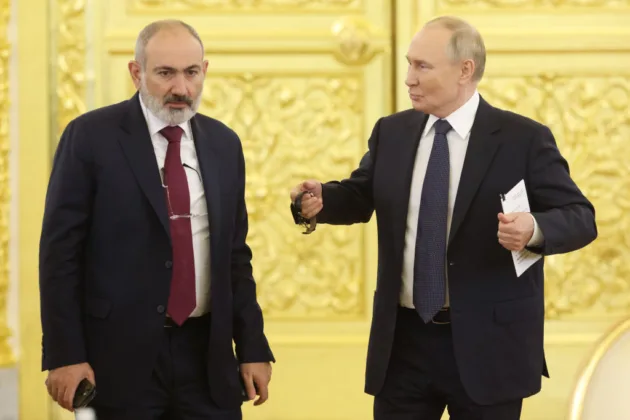
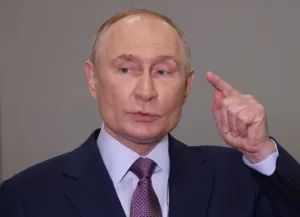
Russian President Vladimir Putin addressed the issue directly during a meeting with Pashinyan at the Kremlin on April 1, 2026. While saying Moscow was calm about Armenia developing relations with the EU, Putin warned: “Being in a customs union with the European Union and being in the EAEU is impossible. It is simply impossible.” He added that the issue was “not even political, but purely economic in nature”, citing differences in customs, market-access and phytosanitary rules.
Pashinyan acknowledged the contradiction, saying Armenia understood that “membership in two unions is incompatible”, but argued that the country could continue combining the two agendas for the time being. He said that if the process eventually reached the point where a choice became necessary, Armenian citizens would make that decision.
He has since rejected Moscow’s timetable. On August 7 he said a referendum was impossible for now because there was no subject for one, and on August 13 that a vote would certainly be held once Armenia formally applied for EU membership.
For Moscow, the accelerating European presence in Armenia threatens a long-standing sphere of economic, political and security influence.