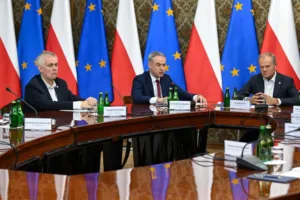






The Polish security services coordinator Tomasz Siemoniak has claimed that Ukrainian attacks on Russian data centres have dramatically reduced Russian AI bot and troll activity, in remarks that fact-checkers have traced to an AI-generated graph circulating online.
Following a series of Ukrainian drone strikes on the data centres of the Russian tech giant Yandex, claims have emerged that the activity of Russian bots and trolls spreading disinformation online has fallen sharply. Specialist research centres have tempered enthusiasm for such messages, pointing out that there is no hard statistical data to support this, and that data published by companies such as Cloudflare does not cover trolling on social media.
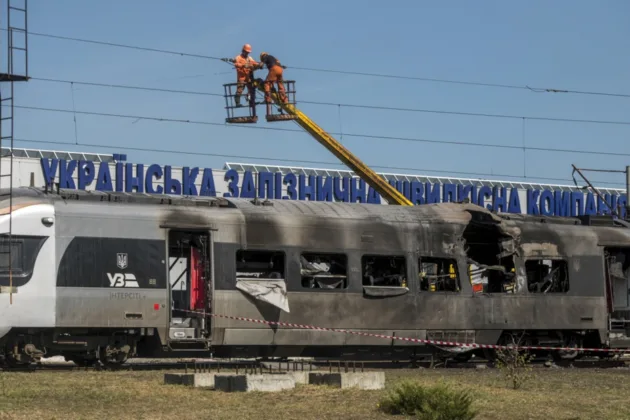
Ukrainian drones have been attacking data centres of Russia’s largest technology company and search engine, Yandex, for several days. Facilities in the Ryazan, Kaluga and Vladimir regions have, among others, been hit, on October 8, 9 and 11.
These attacks led to disruptions in the functioning of Yandex’s services. The company itself reported that following the attack on October 10-11, its data centre in the Vladimir region was suspended and dozens of services across Russia were down. Yandex also said operations at its Sasovo site in Ryazan region had been completely halted and part of the Kaluga infrastructure left unusable, with some taxi drivers advised to switch to rival mapping applications.
There have also been suggestions that these strikes have impacted the activity of so-called troll farms spreading Russian propaganda. This was stated, among others, by Ukrainian President Volodymyr Zelensky during the Warsaw Security Forum.
“When our attacks reached Yandex, many social media platforms suddenly became calmer, and many people in Europe noticed,” claimed Zelensky**, who said there was less divisive content, disinformation and provocation because there were fewer Russian bots**.
After the attack on Yandex, graphics with charts appeared on the internet suggesting a decline in the activity of Russian bots.
That led the security services coordinator Tomasz Siemoniak to make a bold claim on October 12, during a government meeting chaired by Prime Minister Donald Tusk.
“The Internal Security Agency (ABW) is observing a significant, radical decline in Russian bot activity online. This is a global phenomenon. After the bombing of three data centres and the shutdown of three Russian supercomputers, Russian bot activity has virtually ceased worldwide,” Siemoniak said.
Questions were immediately asked about what the minister was basing his conclusions on. Adrian Zandberg, co-leader of the left-wing party Razem, asked on X where the information had come from, saying he hoped the source was not a random picture on the platform. Sławomir Mentzen, leader of the right-wing Konfederacja, accused the minister of passing off an internet image as an ABW finding.
The minister’s words appeared to echo a post published by Polish military analyst Jarosław Wolski that drew on a German graph marked as AI-generated. The post went viral but was immediately questioned by specialists. It claimed a 56 per cent fall in bot traffic around the German party Alternative for Germany (AfD).
The conclusions of that post were refuted by German organisations monitoring internet activity such as Cemas, the Hasso Plattner Institute and the think tank Polisphere, which all reported no significant downturn in bot activity or in the generation of AI bots.
Polish fact-checking watchdog Demagog also questioned the boldness of the Polish minister’s claims and whether it was wise to have made them.
“We don’t rule out that the activity of Russian bots has indeed decreased. However, without appropriate evidence, it’s impossible to declare success in the fight against disinformation. Such messages can actually lend credibility to propaganda and create a false sense of security [ … ] Russia doesn’t have to create every fake news item, it’s enough to exploit existing divisions, stoke emotions, and increase the reach of false messages,” pointed out Demagog.
Poland’s state research institute NASK reached a similar conclusion. Its disinformation analysis centre examined 12 days of monitored accounts on X, from September 30 to October 11, and found no significant fall in their overall activity. The drop in traffic, it said, affected robots that index web pages rather than accounts spreading disinformation in Poland.
Specialised media remain cautious. Cloudflare, an American corporation specialising in internet security, did note that the activity of bots, so-called crawlers, ie programmes that index pages or serve customers, dropped close to zero in the Yandex network. The company counts as a bot any traffic not generated by a human and does not track troll accounts on social media.
The Verge’s technology expert Richard Lawler noted on October 12 that the charts showing the decline in bot traffic published by Cloudflare are not related to bots posting on social media, but to automated web crawlers operated by Yandex.
Czech MEP Tomáš Zdechovský’s claim about internet activity having dropped since the attacks on Yandex has also been questioned.
More light is shed on the chart posted by the Czech politician in a text published by the German portal Capital, which was extensively discussed by the Polish industry portal Niebezpiecznik. There is no credible evidence of a connection between the AfD’s activities and a decline in bot activity caused by the attacks on Yandex facilities.
Capital points out that the distributed chart is originally titled “AfD entries since the attack on Russian data centers”, and that no statistical evidence supports the claim that the party’s online activity has declined. The supposedly original post was marked as “AI content” and the curve runs to October 15, ie Thursday. Its reporter Jan Vollmer traced the image to an account presenting itself as that of a 24-year-old flight attendant, posting on Threads with the platform’s AI label attached.
Richard Schwenn from the Polisphere think tank, quoted by the portal, noted that across the monitoring centre’s 10,000 social media accounts “they did not observe statistically significant declines in activity in German-speaking countries”.
Wolski later posted an apology for having based his claims on an AI generated fake, admitting that he had unwittingly caused disinformation and that the post had reached millions.
Siemoniak has rejected the suggestion that he relied on the graphic. “I used publicly only information received from the ABW, which I could speak about publicly,” he said on October 13, adding that he had not been aware of any “fake graphics” and that he trusted the agency’s internet specialists. The ABW has not published any data of its own.
Questions remain about how and why the Polish minister made his remarks.
According to conservative portal wPolityce: “Doubts must arise regarding the quality of reports reaching the Prime Minister’s desk. If the coordinator of the secret services at the official headquarters presents online misinterpretations and viral myths as operational facts, the question arises: on what basis are strategic decisions regarding defence and cyberspace being made?”
Other commentators have also pointed to the Tusk centre-left government’s excessive desire for publicity at the expense of fact checking.