



Népszabadság (“People’s Freedom”) has relaunched as an online site (nszo.hu) plus a weekly print edition on October 8, 2026, exactly ten years after it was shut down.
The newspaper was originally founded on November 2, 1956 as the successor to Szabad Nép and served as the central daily of the Hungarian Socialist Workers’ Party (MSZMP) until 1989. After the transition from Communism to democracy, it was privatised.
A foundation linked to the Hungarian Socialist Party (MSZP) held a stake for years, selling out to the publisher Mediaworks in 2015. Editorially it was left-leaning, generally pro-EU and critical of Fidesz.
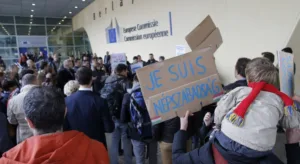
By 2016 it was Hungary’s largest opposition daily, with an audited circulation of 37,164 in the second quarter of that year. Staff then said the closure was political. Its owner, Mediaworks, cited losses.
Mediaworks was soon bought by a firm linked to Lőrinc Mészáros, a Hungarian billionaire businessman and former mayor of Felcsút, Viktor Orbán’s home village.
Its new front page immediately chronicled the downfall of Mészáros as he is being banned from all future state railway projects, and the EU pulling up to 320 billion forints (€875 million) in funding.
Transport and investment minister Dávid Vitézy announced the exclusion on October 9, saying Brussels had told Budapest a fortnight earlier that it would withdraw support for the southern railway ring in the capital over suspected collusion in the tender. Mészáros’s V-Híd won the largest package in 2021, two weeks after buying the design firm that had drawn up the state’s cost estimates.
The new newsroom is built mainly on the staff of Népszava, another long-running left/social-democratic daily, together with many former Népszabadság journalists. It employs about 90 people.
Népszava stopped printing in late May after its printing and distribution company ended the contract over debt. Its masthead and the Szép Szó supplement are to survive inside the new 64-page weekly.
Editor-in-chief Ákos Tóth, a former deputy editor, told Reuters they want “classic, news-based journalism” that asks questions rather than states opinions.
Deputies include the progressive political scientist Zoltán Lakner, who regularly collaborates with green and progressive publications like the Green European Journal and frequently lectures or writes on social solidarity, wealth redistribution and LGBTQ+ rights.
Ownership is Liberty Press Kft., a publishing house that also holds the rights to other prominent left-leaning and critical Hungarian publications, namely Jelen and Népszava.
Ninety per cent goes to the newly formed 4Sight Media Group Zrt.; Tóth holds 10 per cent. 4Sight has pledged two years of funding, aiming later at ads and subscriptions.
Tóth described the backers as four Hungarian businessmen who mainly did real-estate investment abroad under Orbán and who saw a commercial opening after Orbán lost the April 2026 election, in which Péter Magyar’s Tisza took 141 of the 199 seats in parliament.
Company filings reported by Hungarian media name the people behind the four shareholder firms (LaboCorp Group, Well Management, L és K Holding and Fisherman’s OÜ of Estonia) as Sándor Laborc, Gábor Wonschina, Péter Pál Krnács and Balázs Vető.
Laborc, born in 1989, is the son of the Soviet-trained former National Security Office (NBH) director-general of the same name.
During the left-wing Ferenc Gyurcsány government in the late 2000s, the senior Laborc ran the NBH from 2007 to 2009 and was later accused by prosecutors and political rivals of weaponising Hungary’s domestic intelligence apparatus against the Fidesz opposition.
His agency compiled digital files on top opposition figures, codenamed the “Ovi–Bajusz” papers, where “Ovi” was a derogatory shorthand for Orbán and “Bajusz” (“moustache”) targeted László Kövér, later speaker of the National Assembly.
Laborc senior also faced political and legal backlash for holding unauthorised, secretive meetings with Tamás Portik, an underworld figure linked to 1990s organised crime, allegedly seeking compromising data or coordination to discredit Fidesz leadership.
The Budapest Court of Appeal fined him in May 2013 for unauthorised information-gathering over the Orbán and Kövér files, while acquitting him on four other counts. A separate information-gathering case ended in acquittal in January 2015 and a breach-of-trust case was finally dismissed in September 2014.
That has pulled national security and intelligence history into the argument over who is backing the new left-leaning title.
Vető, chief executive of XXI. század Média Zrt., the company that publishes Népszava, and Krnács are linked to the Forrás social-research institute, which has published polling favourable to Tisza narratives.
Some of the holding companies are thin (low capital, foreign registration, prior tax enforcement). LaboCorp’s co-owner is a British firm registered with £1 of capital, Fisherman’s OÜ was set up about two months ago with €1 and L és K Holding has negative equity. Liberty Press itself lost 150 million forints (€410,000) in 2024 and entered forced-deletion proceedings in January 2025 after the tax authority struck off its tax number.
Right-leaning outlets have stressed those links and the opaque financing.
An investigation published by Magyar Nemzet outlines a complex network of British, Slovakian and Estonian corporate ties behind the relaunch of the daily. The report also links the media group’s management to the political circle of former prime minister Gordon Bajnai.
Commentators said the reborn daily is Péter Magyar’s unofficial party mouthpiece, paid for by sympathetic oligarchs.
The publishers say the structure is transparent and not party-controlled. Tóth told Reuters the owners were not hiding behind complicated company structures. Ágnes Urbán of the Mérték Media Monitor think tank said the market would be a tough one for a start-up, as commercial advertising had not replaced state money.