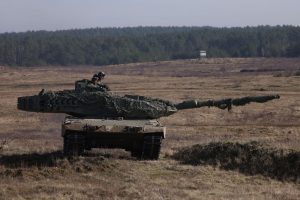




Berlin has pulled out of the Main Ground Combat System (MGCS), the long-delayed Franco-German programme intended to produce a common successor to the Leopard 2 and Leclerc main battle tanks, France’s chief of the defence staff has told the French parliament.
The industrial offer for the shared system cannot deliver a tank when France needs one. Paris is now describing what remains as a technology project.
The common battle tank agreed in 2017 is, on the published record, no longer the plan.
General Fabien Mandon said on October 8 that Germany had decided to leave the project.
“The outcome isn’t good. We had hoped to build a future tank in cooperation with the Germans, but unfortunately, we have to acknowledge that the Germans have withdrawn from the project,” Mandon told the National Assembly during a hearing on the 2027 defence budget.
The French army said the industrial proposal submitted at the start of 2026 was “incompatible with the replacement of current tanks, necessary around the horizon of 2037”.
He resisted describing the outcome as a total failure.
Joint staff work over several years had clarified what a future main battle tank should look like, he said, and that effort “wasn’t a waste of time”.
From an industrial point of view, though, “this isn’t good news.”
🇫🇷🇩🇪 "Malheureusement, les Allemands ont décidé de quitter le projet #MGCS."
Dix ans, des sommets, des communiqués, et au final la découverte que Paris et Berlin ne voulaient pas le même char.
Pendant ce temps, le Leclerc vieillit, le Leopard 3 avance, et nos deux pays, qui se… pic.twitter.com/w6jYg7Wh9y
— OpexNews (@OpexNews) October 8, 2026
In a note from the French General Staff, it was claimed that the programme “is being pursued and retains a major interest,” now limited to connectivity, collaborative combat, automation and robotisation, and that the joint work on requirements “has not been in vain.”
The programme was launched in 2017 under Emmanuel Macron and Angela Merkel, with the aim of fielding a networked family of manned and unmanned ground systems by the early to mid-2040s. Entry into service was originally pencilled in for around 2045.
Industrial partners included KNDS France, KNDS Germany, Rheinmetall and Thales, organised into work-share “pillars” meant to balance national interests. That structure was agreed only in April 2024, seven years after the project began, in a document signed by German defence minister Boris Pistorius and his French counterpart at the time, Sébastien Lecornu.
Progress was repeatedly slowed by disagreements over requirements, leadership of key subsystems and funding.
Signs of a reduced ambition had already appeared.
After the Franco-German defence and security council in Brühl, western Germany, on July 17, the German defence ministry described the remaining co-operation as the development of “platform-independent technology” for future armoured vehicles and their interaction with battle tanks, rather than a single jointly procured chassis. The conclusions of that meeting committed the two countries to studying an approach to collaborative combat, and to nothing more.
Defence minister Boris Pistorius had earlier questioned whether the two countries would “actually stick to shared platforms.”
Germany has in parallel moved ahead with an interim heavy tank, often referred to in the trade press as a Leopard 3, developed by Rheinmetall and KNDS Germany and expected in the early 2030s. The work is run through PSM, a joint venture of the two firms, and the vehicle is based on the Leopard 2 A8 hull and turret, with an automatic loader replacing the human loader, a 360-degree vision system and a short-range counter-drone capability. Deliveries are expected from 2032, initially to replace 88 tanks still below the German army’s current standard.
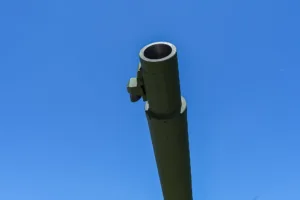
France, whose Leclerc fleet is due to begin leaving service from 2038, has funded studies for its own interim solution, reported to involve a French turret on a German-built hull. KNDS France presented the vehicle, named CAPINT, at the Eurosatory arms fair near Paris on June 15: a remotely operated turret carrying a 120mm ASCALON gun with a 22-round autoloader, mounted on a modified Leopard 2A8 hull, weighing about 50 tonnes and crewed by three.
The French army expects to have 200 Leclercs brought up to the upgraded XLR standard by 2035. The French Senate has said the type cannot be kept in service beyond 2038.
General Mandon said studies for France’s longer-term replacement should begin in 2027.
The announcement follows the collapse, in June, of the fighter element of the Future Combat Air System (FCAS).
Berlin and Paris agreed to develop separate combat aircraft after industrial talks between Dassault and Airbus failed to settle work-share and design authority; France requires a carrier-capable, nuclear-capable aircraft, Germany does not. Officials on both sides said other elements of the air-combat architecture might continue. Of that programme’s three pillars, only the combat cloud remains a joint effort; the engine work between Safran and MTU lapsed with the aircraft itself.
France and Germany have abandoned plans to jointly build a next-generation fighter jet, scrapping the centrepiece of Europe’s most ambitious defence project after years of industrial deadlock. https://t.co/ojoK5W0odY
— Brussels Signal (@brusselssignal) June 9, 2026