

On September 1, Germany and France received attention for having signed onto a letter to the European Union’s policy chief, Kaja Kallas, which would allow for foreign policy decisions to be made with qualified majority voting instead of unanimity. Lesser noted was that Austria was among the nine other signatories. The Alpine Republic’s inclusion is particularly noteworthy as it is, legally speaking, supposed to be a neutral country. By removing its ability to veto EU-foreign policymaking decisions, Vienna is effectively calling for a de facto end to that neutrality.
Which would be a mistake. Neutrality helped make Austria what it is today: extremely trusted and very wealthy. After the Second World War, the country was treated as the “first victim” of the Third Reich, and as such was not treated as harshly as Germany. Still though, it was occupied for 10 years and, in that time, divided amongst the Allied Powers.
The 10-year occupation gave way to an agreement: the State Treaty of 1955. This allowed for an independent Austria, freeing it from Allied control (particularly Soviet control, which was vicious and often violent toward Austrians). But in exchange, the country agreed to several policies, including making it illegal for the country to join Germany and to become one of the world’s few truly neutral countries.
This paid off in spades during the Cold War, where the country became a trusted sort of “neutral zone” between East and West. It was, similar to Switzerland, a place where you could do business. As such, emerging from a post-war wreck, Austria today has some of the highest GDP per capita in the entire European Union.
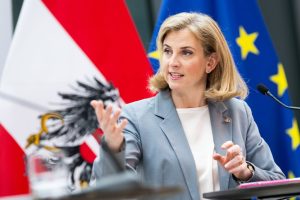
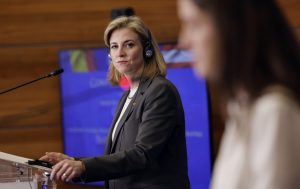
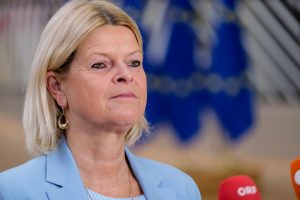
But recent Austrian governments and leaders have pulled away from that neutrality. President Alexander Van der Bellen repeatedly called on the federal government to give more aid to Ukraine. And Austria’s current foreign minister, Beate Meinl-Reisinger of the NEOS party, has likewise sought to shift Austria away from its historical neutrality.
In a meeting with her on August 11, American Secretary of State Marco Rubio complimented Vienna on its status as a potential negotiating location. While the meeting was private, Meinl-Reisinger said Rubio had made the comments. She also clarified that they stayed away from any issues that they would disagree on, such as Rubio’s war on the International Criminal Court. Meinl-Reisinger’s visit was not random; as an incoming member of the United Nations Security Council, where Austria takes a non-permanent seat on January 1, 2027, Austria’s foreign minister is taking trips to meet with other governments on the council, including China’s.
Except, it seems, for one: there will be no visit to Moscow, something one would expect from a neutral state.
Part of this may come from the appeal of being on the “right side of history”. For particularly ambitious European politicians – those who may hope to one day have a role in Brussels – it is not all that appealing to remain studiously neutral. Being able to say the right things gets you in with the right crowds. Being seen as the one slowing everything down will not enable people like Meinl-Reisinger to move upwards.
But that appeal is short-sighted. Austria, which is severely over-regulated, is not a great place to start a new business. US News & World Report recently placed it at 67 in the listing of countries with a friendly business climate, lower than South Africa and Greece. Another report by TMF Group ranks 81 jurisdictions from most to least complex to do business in and places Austria at 36, in the more complex half of the table and behind Switzerland at 48, Ireland at 59 and the Netherlands at 77. While Austria was always famous for mass bureaucracy going back to the times of the Habsburg emperors, the economic boom provided for by neutrality helped to override that aspect. But as Austria becomes less neutral, people are trusting it less to be a neutral arbiter.
Austria as a neutral arbiter is also not just good for economics. It’s also good for the country. Vienna’s military budget is about 1 per cent of its total GDP, or €4.8 billion in 2026, according to figures from the Austrian parliament. While they do not need to abide by any NATO member state agreements – as they are not in the military alliance – 1 per cent is simply not enough to defend the country. And if NATO does continue to weaken as the United States moves elsewhere and member states refuse to make real contributions, Austria may, for the first time in nearly 100 years, need to think about being able to defend itself. While its neighbourhood is not as dangerous as the region to its southeast, it is surrounded by countries which, if the old order truly evaporates, could become powder kegs once again.
It’s also good for the European Union itself. If most countries adopt a Kaja Kallas-type mentality – constant “right side of history” arguments and seeking to turn “mic drop” moments into foreign policy victories – then the European Union, already seen as a weak player on the international stage, will be placed into an even poorer position. It helps the Union to have some member states which operate as a brake, not a gas pedal – and Austria, being neutral, is perfectly placed to play that role.
It is hard to see Vienna as de facto neutral, at this point in time. But it is de jure. And if its leaders have the courage to do what’s best for their nation, instead of what’s best for their careers and getting likes on social media, they’ll focus on making Austrian neutrality a reality once again.