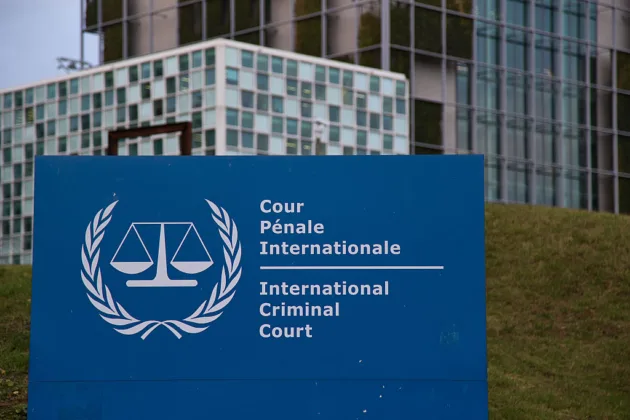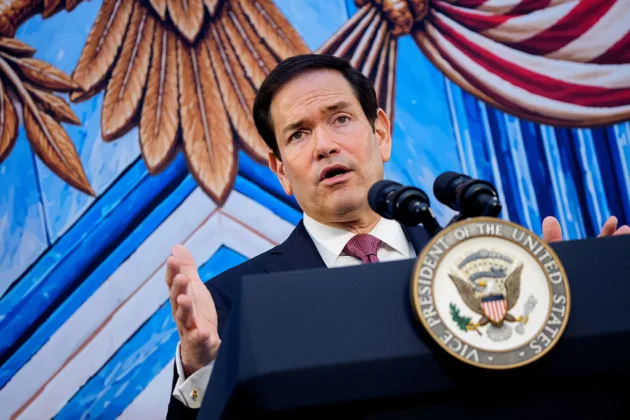







US secretary of state Marco Rubio sent shockwaves across the world, or more specifically the Atlantic, on July 13, 2026, when he announced the Trump administration was going to make the destruction of the International Criminal Court a major goal. Writing in the Wall Street Journal, Rubio declared that Washington would “dismantle the ICC—brick by brick, if necessary”.
European leaders were aghast at Rubio’s barrage. A European Union spokesperson responded that “attacks or threats against the Court, its elected officials, its staff or those who cooperate with it are simply unacceptable,” and vowed to do all in its power to protect the ICC.
In truth, there is very little they can do. If the United States government throws its full weight behind the measure, it could effectively freeze the ICC from being able to access any funds, travel easily or operate. But this is all beside the point, because it is unclear why the European Union would think it’s a good idea to push back so hard against the United States in the first place on this issue.
America has a long history of disdaining the ICC. Though president Bill Clinton signed the Rome Statute, the treaty which created the ICC, his successor, president George W. Bush, clarified that the signature was non-binding (even had he not, there was little chance of the treaty receiving two-thirds of Senate support, mandatory for ratification). Underlining America’s distaste, Congress passed, and Bush signed, the American Service-Members’ Protection Act. Jokingly referred to as the Invade the Hague Act, the bill effectively allows the United States to do just that: It authorises the president to use military force to retrieve American officials or military personnel or allies who have been arrested by the ICC. That bill is still on the books.
In recent years, there has been reason to assume that it may be tested, with investigations into American troops’ actions in Afghanistan.
The ICC has not responded well to criticism. When a dozen United States senators wrote to the body in April 2024, critiquing it for threatening to have Israeli Prime Minister Benjamin Netanyahu arrested, and threatening to withhold funding as a result, the ICC prosecutor responded by implying that they may have already been guilty of violating Article 70 of the Rome Statute and, therefore, that those senators could be liable for arrest. This was a baffling over-reaction, as it underlined American concerns over the ICC too broadly interpreting its mandate.
Europe, though, has had an equally baffling response, with their aforementioned strong defence of the ICC. The ICC is not the European Court of Human Rights, a deeply flawed court but a European court nonetheless. Nor is it the Court of Justice, which deals with interpreting EU law. The ICC is entirely separate, an attempt at creating a global court which can arrest and imprison individuals, be they national leaders, soldiers or other “criminals”.
Which is to say that Europe does not gain anything from defending the ICC; if anything, Europe is threatened by it. The ICC is, in truth, not much of a global court: A plurality of its membership comes from Europe itself (44 countries), followed by 30 from Africa and 28 from the Americas, and 19 from Asia. These seemingly high numbers cover for large gaps in the map, including effectively all of the Middle East.
The court itself exists to enforce what, in the 1990s, seemed like the permanent state: The liberal international order. But as events revealed, that order was precariously placed, and is now, a few decades later, in full collapse. But its organs, including the ICC, still exist, and still have “power” so long as national governments allow for it.
Only one-third of the sitting judges are from European countries, which means that they are effectively allowing liberally minded citizens of other countries to have the power to arrest their own leaders and even themselves. The ICC’s threats to American senators have already made clear that the court vastly overstates its own powers, as they would threaten elected American representatives, a country which does not even recognise the ICC, with arrest over a simple letter.
So why would any European conservative wish for the ICC to have any power? It may be because the populist-right is too new to the European policy space: Undoing a nearly 80-year-old establishment takes some time. But undoing the ICC should be at the top of their To Do list. This is the ultimate fallback for establishmentarians who are seeking to ward off the growing populist-right. If nationally based lawfare does not work, they can fall back on a supranational entity which is answerable effectively to no one.
Aside from its donors, the member states which have signed the Rome Statute. This is entirely a European problem: African states are not going to rush to fill the gap if European states start to leave.
Conservatives and anti-establishment figures in Europe should therefore make pulling out of the ICC a major priority. Those in power, such as in Italy or Slovakia, should do so. And those out of power should promise to do so upon getting power. It would make them and their movements safer, and help to end one of the anachronisms of the liberal international order.