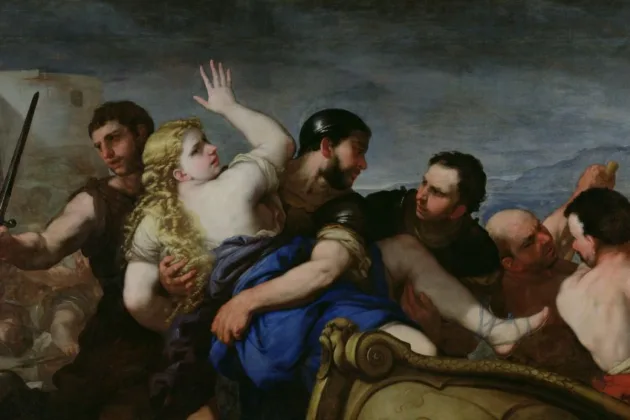






I have not yet seen the new Odyssey film by Christopher Nolan, so I will not review it here today. I am sure it is an entertaining piece of art, and one that created more outrage before its first screening than any other film I can remember. While I am in no position to judge the “wokeness” of the film, I was struck by an interview Christopher Nolan gave in Beijing on July 31 to Zhong Shu, a young doctoral student and lecturer in political philosophy who runs a podcast on classical thought in China. She put to him a proposition that for me epitomises so much in the West: “We live in an age that demands apology from greatness,” she said, before asking how, as one of the great storytellers of our age, he approaches greatness. And Nolan gave the very answer you would expect from a contemporary Western artist: “Do we have to apologize for that greatness? And the answer is yes, we do. Or the audience rejects the greatness.” To be honest, I think he was not entirely honest. As the success of films from The Lord of the Rings to Top Gun: Maverick has demonstrated time and again over the past 25 years, the audience loves greatness. The problem is more that the circle in which Nolan spends most of his time would demand an apology or, even better, a declaration that there never was any greatness in Western civilisation to begin with.
Ironically, while the West likes to deny its own greatness, the rest of the world would beg to differ. Asia, and China in particular, holds the Western classics in very high esteem and instead of apologising for them studies them with great interest. On November 7, 2024 the first World Conference of Classics opened in Beijing under the theme “Classical Civilizations and the Modern World”, with more than 600 participants from more than 30 countries and regions and a congratulatory letter from none other than Xi Jinping, the current leader of the People’s Republic of China. The Greek President at the time, Katerina Sakellaropoulou, sent one too. According to Chinese students of the Western classics, engaging with ancient Greece and Rome instils a sense of humility and prepares a country for the future. This, by the way, is also the difference between real and fake humility: The Chinese student understands the dimension and magnitude of Homer’s works, and sees the greatness of the past as a motivation for the future. The fake humility expressed by Nolan is characterised by diminishing the achievements of the past and thereby artificially elevating the present: The ancients were not that great, but we are amazing for realising their limitations. To put it differently, you no longer have to create greatness today if you claim that it also never existed in the past, and you can make yourself look good by doing nothing but looking down on those who came before you.
I am not exaggerating when writing that there is a strong likelihood that it will be the Chinese who are going to preserve the inheritance of Western civilisation. While we drop Greek and Latin from our schools, Latin has been making its way back into Chinese universities since 2006, when Li Yongyi introduced the first Latin course at Beijing Normal University; by 2011 the country had held its first conference on Latin teaching and opened its first Center for Studies in Western Classics, at Peking University, showing an appreciation of European thought at a level that we hardly encounter in the West anymore. Where we fund chairs in gender studies, they fund chairs in Greek and Roman philosophy. I might be a bit polemical, but I have a feeling that one will prepare a country better for the future than the other.
Now, of course, the Chinese reading is neither disinterested nor impartial but organised to shore up the regime, which is why the Plato taught in Beijing turns out with some regularity to have anticipated something not unlike the present Chinese order. Yet this still strikes me as entirely legitimate, and as a form of respect: They are not saying our philosophers were fools, they are saying that Socrates, were he alive, would approve of what they have built and I am quite proud that apparently the Chinese elite views the hypothetical approval by Greek philosophers as something worthy of aspiration. As far as I am aware, no similar movement exists in the West, where historical figures of foreign lands are inquired as to what they would think of our current political system.
A reader is entitled to say that I might be reading too much into the Chinese fascination with the Western classics, but I would counter that Beijing is not just aware of the benefits of our traditions, but also the threats connected to potentially losing them. First of all, the ridiculousness of “wokeness” has not escaped Chinese commentators and researchers: The word “woke” itself does not travel into Chinese, but there is a homegrown term of abuse that does mean the same thing, and I would say it is even more precise: baizuo, which literally translates as “white left”. The political scientist Chenchen Zhang, working through more than 400 answers to a single thread on Zhihu, the Chinese question-and-answer platform often compared to Quora, found it applied primarily to those who “only care about topics such as immigration, minorities, LGBT and the environment” and who “have no sense of real problems in the real world”, to “hypocritical humanitarians” who advocate peace and equality “only to satisfy their own feeling of moral superiority”, and to “ignorant and arrogant westerners” who “pity the rest of the world and think they are saviours”.
Let me add immediately that the Chinese model is not my model and I am not propagandising on behalf of the Chinese Government. I generally believe that every country should find its own path, but I do find it interesting that Beijing is not simply joining the post-colonial movement, but actively asking what made the West powerful in the first place. Even more impressively, China actively uses social media to undermine Western self-confidence, pushing content on TikTok and other platforms and, according to a July 2025 study by George Washington University’s Program on Extremism, sitting behind a funding network that channels money to US pro-Palestinian activist groups carrying an anti-Western message. All of this is quite clever: You ingest the best of Western civilisation, while simultaneously supporting its derision where it originally came from. We are often told to learn from other civilisations, and I am more than happy to do so. Which means if China tells us that the Western inheritance is not only worth preserving but also an element of strength, maybe we should start listening?