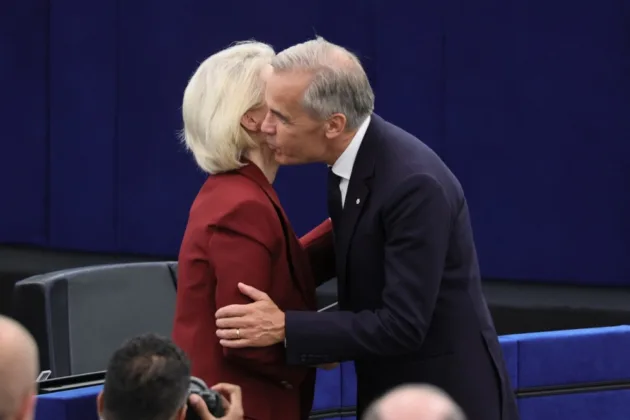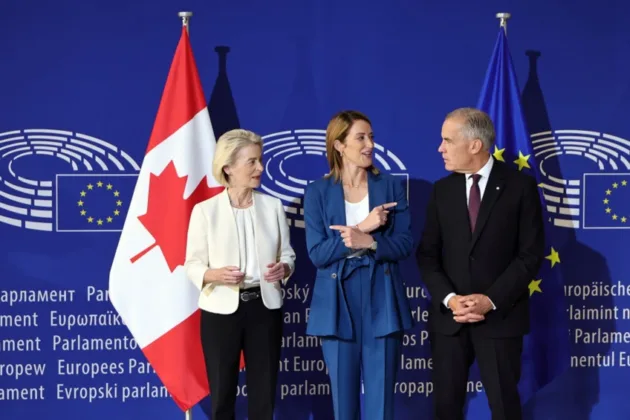





The response to Canadian Prime Minister Mark Carney’s address at the European Parliament in Strasbourg on September 17, a day after European Commission President Ursula von der Leyen opened the door to Canada becoming the EU’s first “associate member”, has reflected and aggravated the public policy and psychology gap between Western Europe and the United States. The federal European institutions began as an admirable attempt by Jean Monnet and others to bury once and for all the profound and sanguinary hostility between the principal European states. These were tariff reductions in the facilitation of cooperation at the economic level, especially between France, Germany and Italy. The original six-nation group, including Benelux, gradually intensified cooperation to a political union and expanded steadily to 28 states, from which the United Kingdom has withdrawn.
It was far from a smooth and constant progress. Several countries required consecutive referenda to accede to the goal that was defined as “an ever closer union”, which clearly indicated ultimately a single senior government for all of Western and much of Central Europe. Britain had only voted for a common market and never to have the political institutions that it had developed fairly consistently for nearly 800 years subsumed into the well-intentioned but comparatively untried government machinery of Europe in Brussels. And when finally consulted, the British voted “no”. This was the first major post-Cold War geopolitical abrasion between Europe and America. President Trump offered the British a fast-track into the North American free-trade area, but Theresa May chose to define leaving Europe as in fact confirming its adhesion to it. Boris Johnson was more receptive but too disorganised and preoccupied with resolving the status of Northern Ireland in Europe to address Trump’s invitation, and soon found himself dealing with the irresolute Biden administration.
Trump, like previous Republican presidents Richard Nixon and Ronald Reagan, saw that a federal Europe was in some measure a revolt against the primacy of the United States in the West, based on the romantic delusion that the European powers, having squandered their world leadership in the world wars and totalitarian movements that Europe inflicted upon the world, could now stand on each other’s shoulders and regain the headship of the planet. American Democratic presidents have tended to view Europe more positively as potentially a welcome equal partner in Western leadership.
Carney has moved Canada past Britain as another important country purporting to straddle between Europe and the United States. When he was the governor of the Bank of England, he made short work of any notion of an independent central bank by joining the fear-mongering campaign of the British government to the effect that if Britain seceded from the European Union, grass would grow in the streets of the City of London. Having returned to his native Canada and become prime minister, he won an upset re-election victory for the Liberal Party which under Justin Trudeau had scandalously misgoverned the country as it tumbled down the comparative tables of the world’s most prosperous states, hobbled by an obsession with climate change and generating discontent through excessive but almost entirely legal immigration. (This is a relatively simple matter for Canada since its only substantial land border is with the United States, a country that almost nobody ever flees away from, and illegal entry by sea requires crossing a great ocean.)
The usual anti-American or naïvely globalist organs of the European and British media, such as The Guardian and The Economist, have grappled Carney to their bosoms as someone who validates the beleaguered European project. The United States economy has been growing more than twice as fast as the European Union’s for 20 years, and where Trump has been somewhat bumptious, he has been effective in reducing absurd trade deficits and warning inconstant allies. The principal European powers have floundered and only Italy can now be said to have a serious government. Germany, France and Spain, as well as the United Kingdom, are waiting for firm government from the civilised Right as Prime Minister Giorgia Meloni is asserting in Rome.
In Strasbourg, Carney revealed more vividly than he has to his own countrymen his authoritarian, Davosian leftist biases. He flattered his audience by rewriting modern history and current economic statistics. Freedom was won in Europe “thanks to the heroism of the European resistance during the war”. Of course, this is rubbish: Europe was liberated by the Americans and British and Canadians and protected by the United States until the Soviet Union, under the American containment strategy, disintegrated. Europe is wallowing economically and its enfeebled response to the Chinese penetration of more than a third of its hybrid car market is to ask, unsuccessfully, for China voluntarily to restrain its presence to 15 per cent. Anyone, including apparently the majority of the citizens of the major European countries, can see that a sharp policy change is called for, and the insane climate change bugbear is being put to death at last.
Carney did not mention in Strasbourg that Canadian exports to the United States are 10 times as much as its exports to Europe, or that the United States represents more than a third of the entire economy of Canada which is more than 10 times the percentage that Canadian trade represents in the US economy. In Strasbourg, both speaker and audience were dreaming and to this end Carney quoted Goethe misleadingly and inflicted a number of hollow bucolic metaphors on his listeners to promote the notion of a reciprocal magnetic interest between Canada and Europe. It is a complete fantasy and it will not last long.