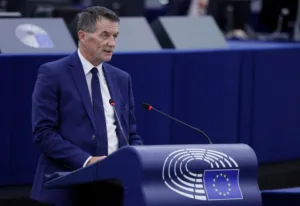
Krzysztof Bosak, one of the leaders of Poland’s libertarian nationalist Confederation party and a deputy speaker of the Sejm, has gone on the record saying that his party is contemplating the idea of Poland leaving the European Union to pursue an arrangement with it of the kind enjoyed by countries such as Norway, Switzerland and Iceland.
In an interview with Poland’s popular YouTube broadcaster Kanał Zero, published on September 2, Bosak argued that Poland could adopt a status similar to Norway, Switzerland or Iceland, remaining economically integrated with Europe without being caught inside what he called the Brussels “bureaucratic colossus”.
Bosak made the same case on social media platform X, writing that Iceland, Norway and Switzerland do not belong to the EU but take part in European economic cooperation and enjoy access to its market. Discussion of such a model should not be a taboo subject in Poland, he added.
This is significant because thus far no one on the Polish right has set out to describe what Poland might aim for on leaving the EU.
Grzegorz Braun’s Confederation of the Polish Crown (KKP) is the only party which actually is campaigning for Poland to leave the EU immediately, whereas both Confederation and Law and Justice (PiS), the largest opposition party, have expressed frustration with Brussels over the Green Deal, migration and EU institutions grabbing power away from member states but have not thus far campaigned for Poland to leave the community.
A CBOS survey carried out on July 7-9 put Confederation on 12 per cent and KKP on 8 per cent.
Polling by CBOS conducted in January and published on February 17 found 82 per cent of Poles supported membership of the EU and 14 per cent opposed it. There is much less enthusiasm for further integration, with 23 per cent of respondents favouring a reduction in integration and a greater role for nation states, 5 per cent backing withdrawal, 32 per cent the status quo and 26 per cent deeper integration.
Some 38 per cent said membership restricted Polish sovereignty excessively, six percentage points fewer than two years earlier, while 50 per cent disagreed. Those who saw sovereignty as constrained pointed above all to agriculture and farm policy, environmental and climate rules and the energy transition, CBOS said.
Other polls have shown the public consistently opposed to Poland adopting the single European currency and dislike of both the EU’s migration and climate policies.
Bosak during his interview stressed that his idea would not require France, Germany or anyone else to reconstruct the EU in a way which has been proposed by politicians such as Marine Le Pen from the French National Rally and Polish President Karol Nawrocki, who have called for redefining and reforming the EU so that much less power remains in Brussels and is handed back to the member states.
In his view, Poland could leave while retaining full access to the European Union’s markets through the European Economic Area (EEA).
He said such an arrangement would “probably be more advantageous” for Poland and stressed that this was an idea his political camp had been discussing for some time.
Iceland, Norway and Switzerland did not obtain their current status by leaving the EU, though, as they were never members of it.
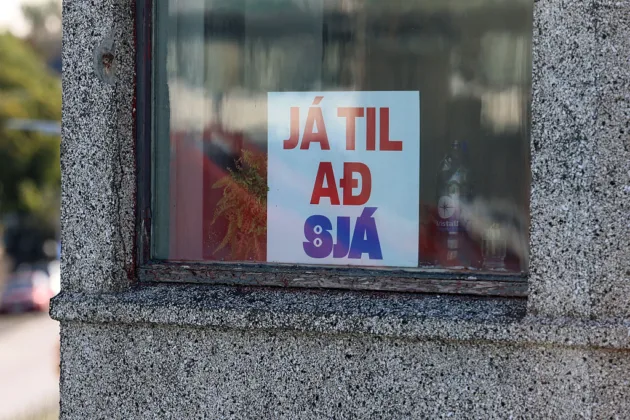
Icelandic voters have just reaffirmed that position. In a referendum on August 29, 52.8 per cent rejected reopening accession negotiations with the EU and 47.2 per cent were in favour, on a turnout of 82.5 per cent, the public broadcaster RÚV reported.
Prime Minister Kristrún Frostadóttir said afterwards that the question of further negotiations with the EU would not be pursued.
Iceland and Norway are members of the EEA but Switzerland is not and has instead created its own network of bilateral agreements with Brussels. Liechtenstein is the third EEA state from the European Free Trade Association (EFTA).
Norway is a wealthy oil and gas exporter with a sovereign wealth fund worth €2.07 trillion at the end of June, according to Norges Bank Investment Management, and Iceland is a small economy where marine products accounted for 38.9 per cent of goods export value in 2025 and fisheries contribute between 8 and 10 per cent of GDP, therefore remaining outside the EU’s Common Fisheries Policy is perceived as being highly beneficial for it.
Switzerland is highly developed, very wealthy and politically committed to its independence, and does not have borders with countries outside the European single market.
Poland is different as 74.8 per cent of its goods exports went to EU member states in 2025, out of a total of €366.2 billion, according to the national statistics office GUS. Its production is highly dependent on European supply chains, it hosts external borders of the EU with Russia, Belarus and Ukraine and in addition the country is a major beneficiary of both the Common Agricultural Policy (CAP) and EU cohesion and structural funding.
It is also a far larger country than the states in the EEA and one which has up until now viewed membership of the EU as an enhancement of its economic and diplomatic potential.
Bosak’s views were strongly criticised by foreign minister Radosław Sikorski, who took to social media platform X to oppose the idea.
Sikorski, who serves in the coalition government led by Prime Minister Donald Tusk, wrote that countries such as Norway, Switzerland and Iceland “have to pay for access to the market and implement all EU regulations without having any influence over them”. He asked whether that was what nationalists wanted for Poland.
Government spokesman Adam Szłapka said Bosak was proposing that Poland should pay, apply EU law and hand over any say in writing it.
The Polish foreign minister’s intervention was not fully accurate because Norway does not implement all EU regulations.
The EEA excludes areas including the customs union, the Common Agricultural Policy, fisheries, common trade policy and monetary union.
It is a fact, though, that Norway accepts a large body of single-market legislation covering the four freedoms, competition, State aid, environmental standards and consumer regulations.
It is also a fact that when legislation is made in Brussels, Norway has no vote in the Council of the European Union and no MEPs in the European Parliament.
Sikorski and Bosak take two divergent views of the meaning of sovereignty. For Sikorski it means being represented at the place where the rules governing Poland’s main economic market are written whereas for Bosak it consists of retaining the right to refuse decisions that are taken.
The Tusk administration is much more susceptible to accepting the pressures towards deeper integration which EU institutions have drawn from the war in Ukraine and the tension in relations with the US.
The problem is that voters are increasingly backing parties which want to move in the opposite direction. In 2027 four major EU states — France, Spain, Italy and Poland — are all due to hold national elections, which could bring with them right-wing governments inclined to protect rather than concede sovereignty.
There are important differences among the parties of the right in their approach to the EU, though.
PiS and their ally President Karol Nawrocki are committed to remaining in the EU in order to reform it via the return of powers to member states. France’s National Rally shares a similar position with its idea of an “Alliance of European Nations”.
The German Alternative for Germany (AfD) goes far further, though, and argues that its programme “cannot be realised in this EU”. It therefore advocates leaving the EU and replacing it with a new economic and political association of sovereign states.
Alice Weidel said in an interview with ZDF broadcast on August 23 that an AfD-led federal government would abolish the euro, which she called an unstable and weak currency, close Germany’s borders and withdraw from the Schengen agreement.
Her remarks came ahead of state elections in Saxony-Anhalt on September 6 and in Berlin and Mecklenburg-Vorpommern on September 20. Germany’s leaving of both Schengen and the euro would be a massive blow to the integrationist project.
Germany is the biggest EU state and economy and borders Poland, Czechia, Austria, Switzerland, France, Luxembourg, Belgium, the Netherlands and Denmark. It was always a crucial element of the EU project, seen as a way of channelling its ambitions towards common European goals rather than its own self-interest and desire for domination.
Since its reunification, though, it has arguably been far more assertive over a wide range of issues and has replaced France as being the heart of the whole project and has increasingly become its banker.
It is hard to see the EU surviving in its present form if Germany left but any alternative structure would in all probability mean more rather than less German influence, a prospect which would not be welcomed by Poland, France or Southern Europe.
Bosak’s Confederation idea of a velvet parting with the EU via Poland choosing an EEA-style arrangement with the community is a third way, allowing countries who want to remain to integrate further while allowing others to leave in such a way which does not disrupt the European economy for either.
Unlike Nawrocki and the French National Rally, Bosak does not feel the EU can be rebuilt around stronger sovereign states, but unlike Weidel and the AfD he does not feel it would be in Poland’s interests to see it fall apart and be replaced by something totally new.
The EU is currently being pulled in two opposite directions. The economic and security pressures are pushing it towards integration but electoral and national pressures are prodding it towards returning control to the member states.
The debate taking place on the right is a reflection of that and Bosak is the first senior Polish politician to have actually offered a concrete idea of what Polexit might look like rather than simply arguing for resisting the Brussels trend towards centralisation or just leaving the EU without any plan for what follows.