
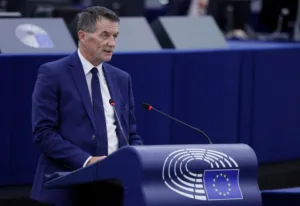



Ferat Koçak has stepped back from the Bundestag interior committee after chats with a member of the Remmo crime family became public. It has now emerged that the Die Linke (the Left) MP asked for very specific information about police actions against so-called “clan crime”.
As a Die Linke specialist on police and “clan crime” in the Berlin House of Representatives, where he sat from 2021 to 2025, he and colleague Niklas Schrader put unusually precise questions to the Senate, the city-state’s government, about how, when and with what weapons the police ran anti-clan operations.
On February 25, 2022, Koçak and Schrader filed a written question entitled “Organised crime – police operations in the field of so-called ‘clan crime’ 2022”.
They asked which operations had taken place, at which places, on which days and at which hours. They also asked which units took part, how many officers and how many officer-hours, and on which dates and at which locations officers had carried submachine guns or other rapid-fire weapons openly.
The Senate listed 46 such operations across Berlin and 11 joint operations in Neukölln, a district in south Berlin, since late November 2021. For each Neukölln raid it gave the date, hours, postcodes, partner agencies, police units and officer-hours, though it said no statistics were kept on officers openly carrying submachine guns.
A follow-up from the same pair produced tables of 104 priority and control operations in the first nine months of that year, each with date, clock time, postcode, partner agencies and police hours.
In December 2022 the Die Linke group in the House, then part of the city’s governing coalition with the Social Democrats (SPD) and the Greens, voted to take commercial inspections out of the Landeskriminalamt (LKA), Berlin’s state criminal police office.
Joint raids against “clan crime”, the resolution said, mixed trade-law checks with criminal process in a way that was “legally problematic”, “stigmatising” and “discriminating”.
The stated aim was moving state tasks off the police while leaving ordinary criminal investigation and customs work in place.
Schrader told taz in August 2023 that the yield from the big joint operations was “pretty thin” beside the effort and that the label itself was “hair-raising from a rule-of-law point of view”.
Berlin’s 2022 situation report on clan crime still counted 872 offences and 303 suspects in the phenomenon, and 783 police measures. The suspects represented about 0.2 per cent of all those recorded in the city that year.
Now, people are wondering if the questioning by the politician might have served other goals than fighting alleged discrimination.
The Remmo family, an extended family of Lebanese origin, has for years featured in inquiries into robbery, money-laundering and property. Authorities seized 77 properties in 2018.
Relatives were convicted over high-profile thefts such as the 2017 Bode Museum gold-coin theft in Berlin and the 2019 Green Vault burglary in Dresden, eastern Germany.
In February 2026 Koçak wrote to Firas Remmo, a son of Issa Remmo, whom police describe as a leading figure in that family. Issa Remmo has no criminal convictions, according to Bild.
Screenshots published by Firas on Instagram show Koçak calling him “brother”, asking him to circulate a Bundestag clip from January 29 in which Koçak calls the debate on “clan crime” “hysterical” and the term a political combat term with a racist history. They also show him sending “greetings with respect” to the father and asking when he could call at the office.
After Issa Remmo appeared at two Die Linke election parties following the party’s first-place finish in the September 20 Berlin vote, the chat became public.
Koçak apologised. He said he first wrote as he writes to hundreds of Neukölln residents and did not know who the father was. He later called it a mistake to have continued once he did.
“Contacts by office-holders with people attributed to organised crime are justifiable by nothing,” he wrote.
According to Sören Pellmann, co-leader of Die Linke’s Bundestag group, he would stay off the interior committee “until full transparency is established”.
Green chief whip Irene Mihalic, a former police officer, told him to resign the mandate. She said expelling him from the Die Linke group would be the minimum.
Alexander Throm, interior affairs spokesman for the Christian Democratic Union (CDU) in the Bundestag, called Die Linke a security risk. He said anyone sending clan bosses greetings with respect should have no access to sensitive security information.
Pellmann said further consequences would be discussed “in solidarity”.
Die Linke also distanced itself from the controversy. The district association emphasised that there were “neither political nor personal relationships”. The party said Issa Remmo had not been invited and was sent away once he was recognised.
Ibrahim Ibrahim, a controversial figure who accompanied Remmo when going to the election parties of Die Linke, did not want to speak to the media afterwards, as one journalist discovered.
Nachdem mehrere Medien Ibrahim in den vergangenen Tagen als „Terror-Unterstützer“ bezeichnet hatten, wollte ich ihn heute lediglich fragen, in welchem Umfang er die Partei @dielinkeberlin im Berliner Wahlkampf unterstützt hat. Eine Antwort bekam ich nicht – stattdessen wurde ich… pic.twitter.com/p4pA9QfUHE
— Iman Sefati (@ISefati) September 23, 2026