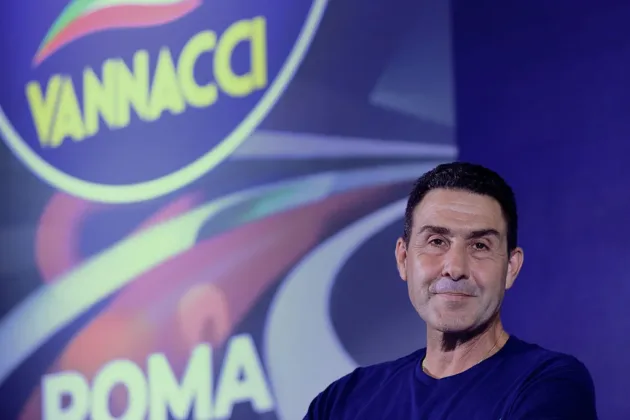

The European Union Intellectual Property Office (EUIPO) has declared admissible an opposition against the trademark of Futuro Nazionale (National Future), the party founded by Italian MEP Roberto Vannacci. The move opens the way for a legal battle that could ultimately force him to change his party’s name or symbol.
The decision was made public on September 22. Nazione Futura, an Italian conservative think tank close to the political world around Giorgia Meloni’s government, filed its opposition in February, when Vannacci launched his party.
It argues that the two names and logos are sufficiently similar to create a risk of confusion. It also claims prior rights over its name, which it says it has used since it was founded in 2017.
EUIPO is the EU agency responsible for registering and protecting EU-wide trademarks and designs. Based in Alicante, Spain, it handles applications and disputes over intellectual property rights across the bloc, although its decisions can be challenged before the EU courts.
Vannacci has not been ordered to change the name. EUIPO has only accepted the opposition for examination, allowing the proceedings to move to their substantive phase, where both sides can present arguments and evidence before a final decision.
Vannacci has said he will fight the challenge. “Giubilei is celebrating too early,” he told Italian news agency Adnkronos, insisting the office had “not upheld” the opposition but had “simply declared it admissible”.
The trademark dispute comes amid increasingly tense relations between Vannacci and Italy’s governing centre-right.
A former senior Italian Army general and former deputy federal secretary of the League, one of the four parties in Meloni’s governing coalition, Vannacci left the party in February 2026 to pursue his own political project. He has positioned himself as a right-wing opposition force to the government.
He has presented himself as more uncompromising than the government on immigration, national sovereignty and relations with the EU, while opposing its support for Ukraine. After leaving the League, he moved in the European Parliament from the Patriots for Europe group to the Europe of Sovereign Nations (ESN), led by Alternative for Germany (AfD).
Futuro Nazionale rapidly attracted eight deputies who had previously belonged to all three main parties of the governing coalition: Five from the League, two from Forza Italia and one from Brothers of Italy (FdI). The movement has also built a substantial organisation in a short period, with Vannacci claiming more than 100,000 members at its June constituent assembly.
Its polling numbers have also grown rapidly. A YouTrend poll for broadcaster Sky TG24, conducted between August 31 and September 3, put Futuro Nazionale at 7.9 per cent, ahead of Forza Italia at 7.1 per cent and the League at 4.4 per cent. FdI, Meloni’s party, stood at 26.5 per cent.
In June, the same pollster had put Futuro Nazionale at 5.9 per cent.
The figures have fuelled concerns about the electoral arithmetic of the centre-right ahead of the September 2027 general election. In the same poll, FdI, Forza Italia, the League, the smaller Noi Moderati (Us Moderates) and Futuro Nazionale together reached 46.8 per cent.
Without Vannacci, the four governing parties stood at 38.9 per cent, while the centre-left bloc of the Democratic Party, the Five Star Movement and the Greens and Left Alliance reached 40.6 per cent.
The political arithmetic leaves the government with two broad options: Seek to bring Vannacci and his supporters back into the centre-right coalition, or try to contain the growth of Futuro Nazionale and prevent it from drawing further support away from the governing parties.
Sources close to the Prime Minister who spoke to Brussels Signal say that Meloni has, for the time being, given the green light to the second approach.
Although there has been no public confirmation of such a strategy, Meloni recently appeared to rule out Vannacci’s inclusion in the coalition indirectly. In a September 12 interview with Il Foglio, she said she would not form an alliance with anyone who votes against support for Ukraine.
“I am a serious person and I am not good for all seasons,” she told the newspaper’s editor Claudio Cerasa. The statement was widely understood as referring to Vannacci, although she did not mention him by name.
Following Meloni’s remarks, criticism of Vannacci has intensified among politicians, organisations and media outlets associated with the governing right.
Il Giornale, a newspaper generally regarded as close to the Italian centre-right, has recently published a series of investigations into Vannacci. They have focused on alleged links to pro-Russian circles, his time in Moscow and questions surrounding the funding and financial networks behind Futuro Nazionale.
Vannacci served as military attaché at the Italian embassy in Moscow from February 2021 until May 2022. Russia then expelled him along with 23 other Italian diplomatic and military staff, in retaliation for Rome’s expulsion of Russian diplomats after the invasion of Ukraine.
The coverage has drawn a strong reaction from Vannacci, who rejected the allegations. The newspaper itself acknowledged that some of its readers had been angered by the investigations.
The attacks escalated at the League’s September 20 Pontida rally, the party’s historic annual gathering in Bergamo province, northern Italy.
Riccardo Molinari, who leads the League in the Chamber of Deputies, attacked Vannacci without naming him. He said that his programme “could have been written in a Munich beer hall in the 1920s” and “reminds us of the Fascist era”.
Dismissing Vannacci’s proposals on abortion and the so-called “Mediterranean patriarchy” as “bullshit”, Molinari also accused him of presenting himself as an anti-establishment figure while ultimately having “the sole purpose of making the League and the centre-right lose and bringing the left back into government”.
Nazione Futura’s trademark challenge is particularly notable. The think tank is headed by Francesco Giubilei, a former adviser to then culture minister Gennaro Sangiuliano and a contributor to Il Giornale.
Some analysts have viewed him as an unofficial voice for positions close to those of the government. They see the challenge as part of a broader strategy of mounting political pressure on Vannacci in an effort to contain the growth of his movement.
Ultimately, though, the decisive choices will be made before the next general election. It remains unclear whether the confrontation will deepen or whether the two sides will eventually seek to mend relations, potentially paving the way for Vannacci to be brought back into the centre-right coalition.