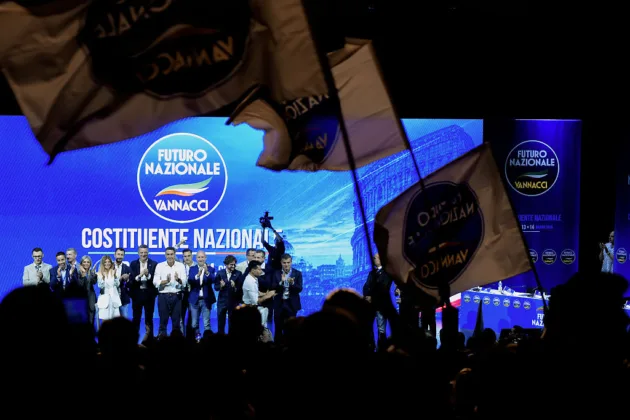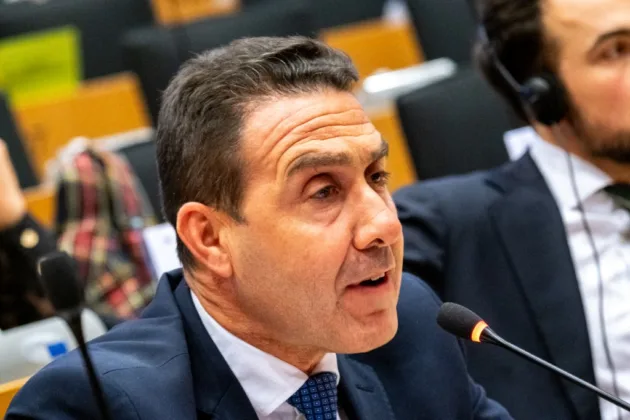





Italian MEP Roberto Vannacci has officially launched Futuro Nazionale (National Future), transforming the movement he founded earlier this year into a fully-fledged political party positioned to the Right of Italy’s governing centre-right coalition led by Prime Minister Giorgia Meloni.
The formal establishment of the party, which will culminate in a constituent congress in Rome on June 13-14, has been accompanied by a wave of defections from MPs belonging to the governing parties, prompting growing debate among political observers over whether the new political force could become decisive for the future stability of the centre-right coalition ahead of Italy’s next general election in 2027.
By exerting pressure from the right, Futuro Nazionale could force Meloni and her allies to resist the centripetal pull of government that Vannacci accuses them of having partly embraced.
Vannacci, a former army general and veteran of several international military missions, emerged as a national political figure in 2023 following the publication of his bestselling and controversial book Il mondo al contrario (The World Upside Down), which criticised immigration, multiculturalism and progressive social policies.
The book turned him into a prominent voice within Italy’s conservative camp and paved the way for his entry into politics. He was elected to the European Parliament on the League ticket in the 2024 European elections, becoming one of Matteo Salvini’s most recognisable allies. However, tensions with the party leadership intensified over the following months and, in February 2026, he left the League to establish Futuro Nazionale, a movement that has now formally become a political party.
Vannacci founded Futuro Nazionale after leaving Salvini’s League and breaking with the Patriots for Europe group in the European Parliament to join the Europe of Sovereign Nations (ESN) group, effectively making Futuro Nazionale the Italian political reference point for the parliamentary alliance.
He has presented the new party as a nationalist alternative to a government he argues has become too moderate on key issues, particularly foreign policy, national sovereignty and security. The movement is expected to contest the 2027 general election, where many observers believe its performance could prove decisive in determining whether the Italian right retains power.
The party’s launch has been accompanied by a growing wave of defections from within Meloni’s coalition. Eight MPs from governing parties have already joined or aligned themselves with Futuro Nazionale, underlining the movement’s appeal among politicians dissatisfied with the current direction of the Italian right.
Most of the parliamentary recruits come from Salvini’s League, including MPs Domenico Furgiuele, Gianangelo Bof, Rossano Sasso, Laura Ravetto, Edoardo Ziello, Attilio Pierro and Davide Bergamini. The movement has also attracted Emanuele Pozzolo, elected with Brothers of Italy. Former MEP Antonio Maria Rinaldi, a prominent Eurosceptic previously associated with the League, has joined the project as well. The defections suggest growing unease among sections of the governing right over what they regard as an increasingly pragmatic and moderate approach from coalition leaders.
Futuro Nazionale positions itself to the right of Meloni’s government on several key issues. Its platform combines opposition to illegal immigration, a strong emphasis on national sovereignty, criticism of further European integration, defence of traditional values and scepticism towards continued Western military support for Ukraine. Vannacci argues that both Meloni and Salvini have moderated their positions since entering government, leaving political space for a more uncompromising nationalist force.
The parliamentarians joining Futuro Nazionale have largely justified their move by arguing that the current coalition no longer adequately represents conservative voters seeking tougher policies on migration, national identity and relations with Brussels. Their support also reflects expectations that Vannacci could become a significant player on the Italian Right ahead of the next election.
With Italy expected to vote in 2027, Futuro Nazionale could play a pivotal role in reshaping the balance of power within the centre-right. An SWG poll published in June placed the party at 4.6 per cent, making it one of the most significant emerging political forces in the country. While still well behind Meloni’s party Brothers of Italy, such support could prove decisive in determining the future composition of Italy’s right-wing bloc and potentially influence the strategic direction of the broader conservative camp.