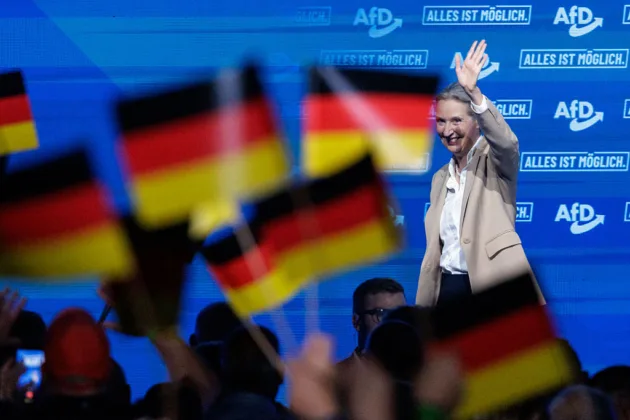




Sovereigntist and national-conservative leaders across Europe have congratulated the Alternative for Germany (AfD) after the party won the Saxony-Anhalt State election with its strongest result anywhere in Germany.
Projections for public broadcaster ARD put the AfD at about 44 per cent in the September 6 vote, more than twice the 17.8 per cent taken by the governing Christian Democratic Union (CDU) of Chancellor Friedrich Merz. The party won 20.8 per cent in the State in 2021.
Vox leader Santiago Abascal congratulated AfD co-leader Alice Weidel and its Saxony-Anhalt candidate Ulrich Siegmund on X, describing the outcome as spectacular and as a source of hope for Germany and for Europe.
André Ventura, leader of Portugal’s Chega, called the result historic and said German voters were opening their eyes to uncontrolled illegal immigration, corruption and threats to national identity.
Geert Wilders, leader of the Dutch Freedom Party (PVV), posted a one-word message in capital letters, “CONGRATULATIONS”, alongside a screenshot of the projected result.
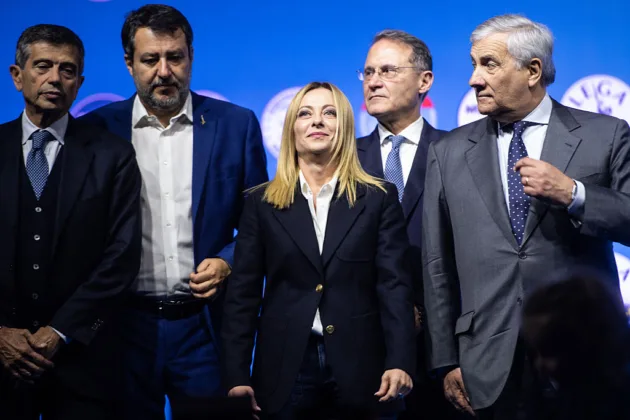
Italian Deputy Prime Minister Matteo Salvini, who leads the League, said the result showed how strong the demand was for change, security and jobs, and dismissed left-wing warnings about an AfD win as scaremongering. He said another Europe was possible.
Former Hungarian prime minister Viktor Orbán congratulated Weidel, Siegmund and the party as a whole on what he called a landslide, adding on X: “Buckle up. This is just the beginning!”
Reconquête leader Eric Zemmour said the result was an hour of truth, arguing that European politics had long treated the desire of peoples to remain themselves as an offence. Sarah Knafo, an MEP for the same party, called it a historic victory.
The messages crossed group lines in the European Parliament. The AfD sits in the Europe of Sovereign Nations group, while Vox, Chega, the PVV, the League and Orbán’s Fidesz all belong to Patriots for Europe.
Weidel said on X that voters had handed her party a mandate to govern and that the AfD was now more than twice as strong as the CDU. Siegmund said the party had achieved what it set out to achieve and had made history in the State.
The AfD is projected to take 39 of the 83 seats in the Magdeburg parliament, three short of a majority. The other parties have refused to work with it, and in April they amended the State constitution to loosen the strongest party’s hold on parliamentary posts and constitutional court appointments.
Two more State elections follow on September 20, in Mecklenburg-Western Pomerania and in Berlin.