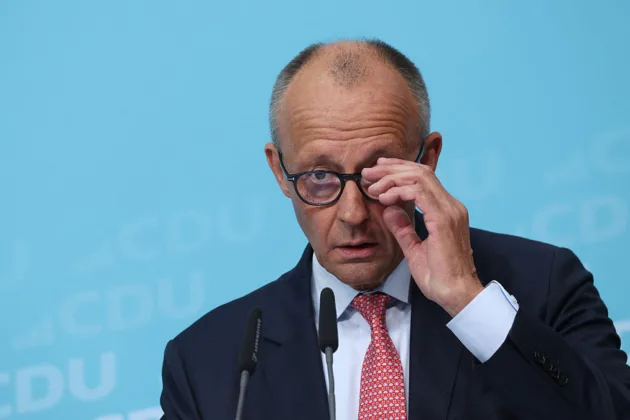







The September 20 state elections in Mecklenburg-Vorpommern and Berlin pushed Chancellor Friedrich Merz’s Christian Democratic Union (CDU) even further into the political ditch. The CDU’s failure to enter Mecklenburg-Vorpommern’s Landtag with 4.9 per cent of the vote – the first time the CDU has failed to enter a state parliament since the Federal Republic’s creation in 1949 – means the CDU and its Bavarian partner, the Christian Social Union (CSU), are on the verge of losing their historical political pre-eminence.
The question is whether the party that now dominates Germany’s political right, the Alternative for Germany (AfD), wants to win power or merely protest. Its leaders’ comments suggest it might prefer the latter, which could paradoxically push Germany even further to the left.
That fact means even a weakened Merz has room for manoeuvre. He has banked on the so-called “firewall” against cooperation with the AfD to keep the conservative-populist rival out of power, hoping that his economic reforms and rearmament will pay off by the end of his term and reattract the conservative voters his party is haemorrhaging to the AfD. The disastrous results in September’s state elections, combined with his record low approval ratings, mean that course is no longer viable. While CDU and CSU leaders remain behind him, that’s not likely to be the case in a year if Merz’s and the CDU’s fortunes don’t improve.
Merz could enhance his and his party’s political viability if he effectively calls the AfD’s bluff and sanctions state CDU leaders to talk with the populists about forming a government in the eastern state of Saxony-Anhalt. Many of the former CDU voters who now back the AfD want change, not slogans. Reaching out to the AfD shows those voters that the CDU is willing to entertain that idea, showing its defectors that they need not lose all hope for their former party.
This would place the AfD in a bind, though, as its leaders have proclaimed they will not compromise in their search for power. The AfD’s lead candidate in Saxony-Anhalt, Ulrich Siegmund, declared as much when he said “there will be no bending on my part, no compromises” after his party won 44 per cent of the vote on September 6.
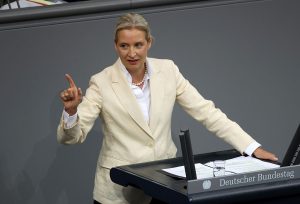
The problem with that, though, is that it is extremely rare for any party to win an absolute majority at the state or federal level under Germany’s proportional representation election system. The legendary CDU Chancellor Konrad Adenauer won a majority in 1957, but no other party before or since has been able to copy that achievement. The AfD would still need a governing partner even if it won the 40 per cent its co-leader, Alice Weidel, aspires to. One must still compromise with even small governing partners if one wants power.
Offering the AfD that chance in Saxony-Anhalt would give the CDU the chance to test the AfD’s resolve, and test whether it really wants to be part of a Germany centred solidly within the West. The AfD wants to restart imports of oil and natural gas from Russia, something that all mainstream parties reject on national security grounds. It also harbours strong anti-American and anti-NATO sentiments, a stance that is the polar opposite of the traditionally pro-NATO, pro-America CDU/CSU. Even holding power in a state government implicates these stances given the powerful role state governments play in Germany’s upper house, the Bundesrat.
A CDU offer of potential power, then, could force the AfD to choose how strongly it is attached to this aspect of its platform. The CDU and AfD share many goals with respect to fiscal and cultural conservatism. One can imagine the two parties reaching a concordat on these issues, but it’s impossible to imagine the CDU countenancing a state government that adopts anti-Western sentiments.
Such a manoeuvre could be a win-win for the CDU. If the AfD is willing to ignore its anti-Western elements and crafts a solid domestic reform agenda, the CDU can show its voters that it is willing to work for serious change. This, in turn, sends a message to his Social Democratic Party (SPD) partners in Berlin: Stay the reform course we have agreed upon for the country, or we might strike a similar deal for the nation. This could both give Merz’s reforms and rearmament time to show some successes and staunch the flow of CDU voters to the AfD.
Merz and the CDU also win if the AfD refuses to join hands, provided the CDU has shown it is willing to adopt many of their shared conservative economic and cultural goals. Many former CDU voters would likely see this as a genuine opportunity to enact their priorities. If the AfD refused its opportunity, they could easily reconsider whether the AfD is really the change agent it campaigns as.
This would be especially potent if the AfD refused to join a reasonable coalition because of its pro-Russia and anti-American views. Whatever may be true of AfD activists, the voters they have gained nationally and in state elections over the last 18 months are largely pro-Western conservatives upset that Merz and the CDU have to govern more from the centre because of its coalition with the SPD. An AfD decision to choose its pro-Russia wing over its new converts would reveal its true colours and likely make it much less attractive to people who only recently started to back it.
It’s said that the definition of insanity is doing the same thing over and over again and expecting different results. Merz and the CDU have tried for a decade to cordon off the AfD and rely on alliances with the SPD. That has only fuelled the AfD’s rise. It’s time for Merz to change course and try something different, for his sake and for Germany’s.