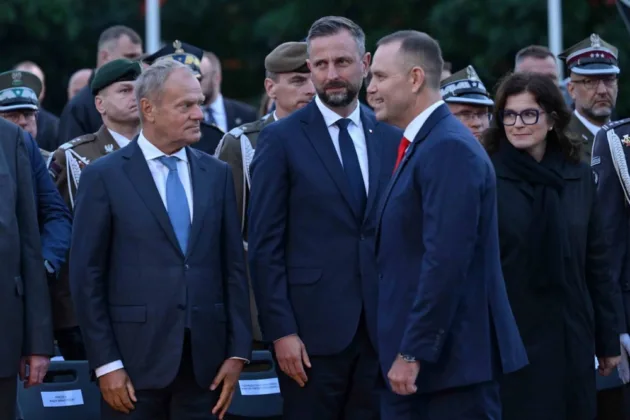

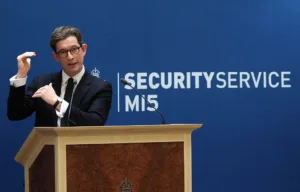

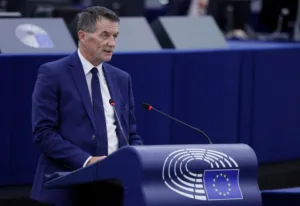

Aleksandra Dulkiewicz, mayor of Poland’s Gdańsk and a figure of the governing Civic Coalition, used her address at Westerplatte to describe a war that is “blind and deaf” and arrives “uninvited”, without ever naming the country that invaded Poland in 1939. From the same lectern in 2019, she named the German battleship herself.
The mayor of Gdańsk marked the 87th anniversary of the German invasion of Poland on September 1 by devoting much of her speech to the suffering of Russian civilians in the siege of Leningrad. At no point did Aleksandra Dulkiewicz say who had attacked her country, or who had attacked it again 16 days later from the east.
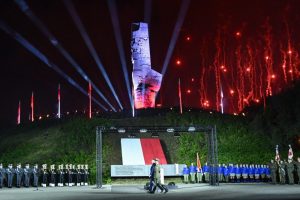
She was speaking at Westerplatte, the spit of land at the mouth of Gdańsk harbour where the German battleship Schleswig-Holstein opened fire on a Polish garrison of some two hundred men at 4.45am on September 1, 1939. They were expected to hold out for 12 hours. They held for seven days.
Poland has assembled there before dawn every year since, and the ceremony is as close as the country comes to a sacred rite.
Dulkiewicz, who hosts it, came up through Donald Tusk’s Civic Platform and was re-elected in 2024 on the joint ticket of the governing Civic Coalition and her own local movement, with 57.95 per cent of the vote in a single round. President Karol Nawrocki, elected in 2025 with the backing of the opposition Law and Justice party, and Prime Minister Tusk both spoke at the same ceremony.
She began well enough, invoking “the heroic defenders of Westerplatte and of the Polish Post Office in the Free City of Gdańsk”. Then the speech turned.
“War is unfortunately not only a man’s business,” she said. “War knows neither sex nor age; it is blind and deaf.” War, she went on, can come to civilians “uninvited, unexpectedly, at 4.45”.
And from there to Russia. “Nearly 900 days, people trapped in their own homes struggled with extreme deprivation and frost,” she said of the siege of Leningrad. “As many as a million civilians lost their lives.”
The reaction from the Polish Right was immediate. Michał Rachoń, of the broadcaster TV Republika, accused her of “presenting a vision of history inconsistent with the Polish national interest”. One opposition MP, Bartłomiej Pejo of the Confederation (Konfederacja), needed six words: “This is Westerplatte, not Red Square.”
Fairness requires the full record, because it is more damaging than the summary.
Her address did name perpetrators. She spoke of the German camp at Kulmhof (Chełmno), of Soviet deportations of Poles to Kazakhstan and of rape as a weapon of war: “The women in Gdańsk, as it was being liberated by the Red Army, knew this, and today the women at the front in Ukraine know it.” The Polish word she chose for what the Red Army was doing to the city was wyzwalanym — being liberated — in a sentence about mass rape.
So perpetrators appear in the speech. They appear everywhere except in one place. No sentence says who attacked Poland at 4.45am on September 1, 1939. No sentence mentions September 17, when the Soviet Union invaded from the east under its pact with Berlin.
Her defenders have a point worth answering. Leningrad was besieged by the Germans, so recalling it is, on its face, recalling a German crime. True.
But the choice of illustration is itself a statement. Standing at Westerplatte, on the anniversary of the invasion of Poland, more than four years into Russia’s full-scale war against Ukraine, and reaching for an image of civilian suffering — to find it on the Neva is not a meteorological accident. Imagine the mayor of St Petersburg, on June 22, the anniversary of Hitler’s invasion of the Soviet Union, dwelling on the fate of Dresden under the bombs. One suspects it would not be received in Russia as an exercise in universal compassion.
The most damaging witness against this speech is one Aleksandra Dulkiewicz gave herself.
“Eighty years ago, here on Westerplatte, at 4.45, the silence was torn apart by salvoes from the German battleship Schleswig-Holstein,” she said on September 1, 2019, in a text still posted on the city’s own website.
One sentence: An hour, an aggressor, the name of the ship. Nobody had to guess who started it.
So this is not a failure of knowledge or of vocabulary. It is a choice. What has changed in seven years? Not the facts, and not the name of the battleship.
What has changed is the politics around the sentence.
Poland’s governing coalition has staked a great deal on repairing relations with Berlin, and reparations are the most awkward object in the room. The previous government valued Poland’s wartime losses at 6.2 trillion złoty, some €1.3 trillion at the exchange rate at the time, and sent Berlin a formal note on October 3, 2022. Germany replied in January 2023 that it considered the matter closed.
Tusk’s government has stopped pressing the claim, seeking instead German money for the surviving victims, whose number fell from around 60,000 to around 50,000 in a single year. When President Nawrocki took the old demand to Berlin in September 2025 and was refused, Poland’s own foreign minister Radosław Sikorski mocked him online: “Regarding reparations, the president achieved a moral victory in Berlin [ … ] Foreign policy is more difficult than it seems.” A survey by SW Research for Rzeczpospolita in July 2024 found 58 per cent of Poles in favour of pursuing reparations, against 20 per cent opposed.
Reasonable people can support that policy in full. Poland and Germany face the same threat from the east, and a working alliance is worth more than an unenforceable invoice.
But a policy has a vocabulary, and vocabularies travel downwards. If the diplomatic task is to make the German question comfortable, the sentence “the Germans attacked us” becomes, by small degrees, an awkward one, not forbidden, merely unhelpful, the sort of thing left out of a speech that is trying to be about peace. That is exactly what a war which is “blind and deaf” and arrives “uninvited” is for. A war with no author presents no bill.
The same sanding-down is visible in Germany, which is the surest sign that this is not a Polish parish quarrel.
The Bundestag endorsed a memorial to the Polish victims of German occupation in October 2020. By 2023 the project had become the German-Polish House, a museum and centre for dialogue in which commemoration survived as an “artistic element”. The protest came from the initiative’s own German authors, including a former ambassador to Warsaw, who complained that what was owed in Berlin was a public admission of guilt, not an exhibition about bilateral relations.
A temporary marker went up in June 2025: A boulder of nearly 30 tonnes on the site of the Kroll Opera House, where Hitler announced the invasion of Poland to the Reichstag. A design competition is now running. A jury chooses the winner in December 2026 and construction begins in 2027, with €5 million set aside for the competition and the monument.
German minister of state for culture and media Wolfram Weimer announced that timetable on September 1 this year, the same morning the sirens sounded at Westerplatte.
Eighty-seven years after the invasion, Berlin has a boulder, a competition and a promise.
Two men who agree about almost nothing else managed the missing sentence on September 1. Nawrocki appealed to the German chancellor — “Let us settle the matter of reparations and redress” — and said that “remembrance of 1 September demands truth and responsibility from us”. Tusk, no ally of his, stated plainly that responsibility for the catastrophe lay with Hitler’s Germany and Soviet Russia, and that there could be no ambiguity about it.
Nobody is asking the mayor of Gdańsk to withhold sympathy from the dead of Leningrad, who deserve it. The objection is about proportion and address.
Remembering other people’s victims is a virtue only when it does not stand in for remembering one’s own, and only when it leaves intact the line between the country invaded and the countries that invaded it. Erase that line and what remains is not peace. It is an amnesty nobody voted for.
Poland once understood this at the level of instinct.
Admiral Józef Unrug was born near Berlin into the Prussian nobility, served the Kaiser as a submarine officer and in 1919 joined the navy of a Poland just restored to the map. He commanded the coastal defence in 1939 and held the Hel peninsula until October 2, the last coastal garrison to surrender.
In captivity the Germans offered him citizenship of the Reich and a command in the Kriegsmarine. One of the men sent to persuade him was his own cousin, a German general. Unrug answered him in French, through an interpreter. Don’t be ridiculous, the cousin said, you speak German.
“On the first of September I forgot how to speak German,” Unrug replied.
He kept it up for five and a half years and seven camps. His biographer counted more than 400 books the admiral read behind the wire, in English and in French. Not one was in German.
Nobody asks that much of a mayor. One sentence would do, the one she delivered herself in 2019, about the salvoes from the German battleship. Is it really so hard to remember, there of all places, at 4.45am?