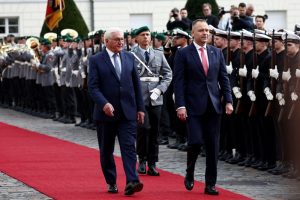

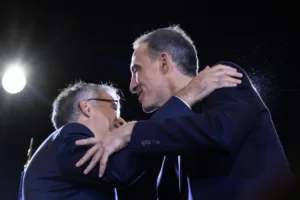

Poland’s President Karol Nawrocki, an ally of the opposition Right, has used the 87th anniversary of the start of the Second World War to repeat his belief that for Poland’s relations with Germany to be normal justice must be done in the shape of the Germans paying the Poles reparations for Second World War damages.
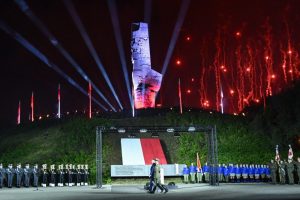
The commemoration of the start of the Second World War began, as it does every year, at 4.45am, the time on September 1, 1939 when the German battleship Schleswig-Holstein opened fire on a Polish military depot at Westerplatte, marking the start of the first battle between Polish and German soldiers in the war. Sirens sounded moments before the hour. Ceremonies were also held at Wieluń, the central Polish town bombed by the Luftwaffe at around 4.40am the same morning.
A small force of around 200 Polish soldiers commanded by Major Henryk Sucharski defended the outpost near the Free City of Danzig (today Gdańsk) for one week rather than surrender. The garrison repelled 13 assaults from sea, land and air before capitulating on September 7. Fifteen Polish soldiers were killed. The men involved are regarded as heroes in Poland and the “spirit of Westerplatte” is cited as an example of a fight for honour against insurmountable odds.
Nearly 6 million Polish citizens, including about 3 million Polish Jews, were killed during the Second World War and the country emerged from the conflict devastated, looted and with its economy in ruins.
Poland lost nearly a fifth of its pre-war population with 90 per cent of those who were killed being civilians. Nawrocki put the losses at 17 per cent of the citizens of the pre-war Second Polish Republic, close to 90 per cent of them civilians.
Nawrocki, who himself was born and lived in Gdańsk, honoured the defenders of Westerplatte at the ceremony, which takes place in the early hours of the morning every year.
He told the gathering that “remembering September 1 demands truth and responsibility” and called on “the German chancellor and the German people” to “resolve the issue of reparations and compensation for the Second World War with both historical justice and the future in mind.”
The President appealed to the Germans to address the reparations issue which thus far they have refused to do and have argued that Poland renounced its reparations claim in favour of the USSR back in the 1950s. Berlin maintains the question is legally closed, pointing to the declaration made by the communist authorities in Warsaw in 1953.
“Let us settle the issue of reparations and compensation with historical justice in mind, but also with the future in mind,” Nawrocki appealed, arguing that any compensation received should be used to expand the Polish Armed Forces and strengthen Poland’s defence industry.
He questioned whether Germany, “beyond round words, fine gestures and grand declarations”, was treating Poland any differently from the way the Weimar Republic had done, and asked whether Berlin would “start doing business with the Russian Federation” again. He also called for the full implementation of the Polish-German treaty on good neighbourliness signed 35 years ago, in June 1991.
“Reparations and compensation should be paid to Poland. Not only for the sake of historical justice, but also for the future. So we do not have to take out loans from the West, and so we receive what is owed to us. Today, these reparations can serve our security. Let us stand together in this endeavour.”
Nawrocki also called on the German Government to commemorate Polish victims of the Second World War in Berlin.
He pointed to what he described as a lack of reciprocity between the rights enjoyed by the Polish minority in Germany and those of the German minority in Poland, and the absence of a monument in Berlin dedicated to Polish victims of the Second World War, where only a memorial stone currently stands.
“This is not a real alliance if we cannot put up such a monument in Berlin,” he said, adding that it was hard to talk of normal relations when neither reparations nor the honouring of Polish victims has been settled.
The Polish President was frank about how he sees the deep historical roots of German anti-Polish sentiment having led to the crimes committed during the Second World War.
Addressing the origins of German aggression, the President argued that hostility towards Poland had existed long before the National Socialists came to power.
He recalled that as early as in the 19th century, liberal Prussian writers had written contemptuously about Poland, referring to Poles as the “Iroquois of the East”, while during the democratic Weimar Republic anti-Polish sentiment united left-wing, right-wing and liberal circles.
“We must all repeat, painful as it may be, that Germany did not need Adolf Hitler to despise Poles and Polishness. There are far too many examples of this. As early as the 19th century, they wrote about us with contempt. Anti-Polish sentiment was what united them,” the President said. He cited the Reichswehr commander Hans von Seeckt, who wrote that if the devil wished to take Poland, Germany should help him do it.
He also highlighted the close economic and political cooperation between the Weimar Republic and Bolshevik Russia, which preceded the later Molotov-Ribbentrop Pact and Adolf Hitler’s order.
“Be merciless, be brutal. The destruction of Poland is your primary task” was what Hitler said when making the decision to invade Poland, in his address to Wehrmacht commanders at the Obersalzberg on August 22, 1939.
Nawrocki made an analogy between the interwar period and developments in the 21st century. He recalled that despite warnings from Poland, including those issued by the late president Lech Kaczyński, Western countries continued investing in the Russian Federation in the hope that they could influence it.
The fact that Germany chose to develop the Nord Stream gas pipelines with Russia, bypassing Poland via the Baltic Sea, was a source of great irritation to Warsaw and was also disapproved of by the US.
The President also felt he had to appeal to the centre-left government led by Prime Minister Donald Tusk which has since coming to power decided not to pursue direct efforts at securing reparations from Germany, despite the 6,220,609,000,000 złoty (about €1.46 trillion) assessment of the damages made and presented by the last Law and Justice (PiS) government on September 1, 2022. The sum was reported at the time as roughly $1.3 trillion.
“I ask the Polish government to support efforts to secure reparations. This is the appeal coming from Westerplatte,” Nawrocki said in his closing remarks.
Tusk took a different line preferring to concentrate on the wider lessons from the Second World War rather than Polish-German relations.
He said the lessons of the Second World War “must influence the decisions and attitudes of the leaders of the free world” today.
“We must draw lessons from the horrors of the Second World War and focus on building solidarity and unity, both at home and across the free world,” Tusk said, adding that the NATO alliance “cannot be an alliance on paper.”
The PM also suggested that there was a danger of history repeating itself.
“We must not allow the brown wave of aggression and contempt to ever repeat itself,” he told the gathering, referring to the Nazi Brownshirts, Adolf Hitler’s paramilitary street force. He named Poland, Europe and the United States as the places where it must not be permitted to return.
While calling upon Germany to take actions to recompense Poland for the damages suffered during the Second World War Tusk and his government have prepared to concentrate on extracting more support from Germany on the eastern flank of NATO.
So far, though, neither have the Germans made any significant moves on the issue of compensation nor with regard to boosting Poland’s defences.
Tusk himself has expressed irritation at a German proposal to pay €200 million to the remaining living victims of the Second World War which has still not materialised with regard to the actual transfer of funds. The offer was made by the then chancellor Olaf Scholz in 2024 and rejected by Warsaw as symbolic. Poland has since proposed paying each of the roughly 50,000 surviving victims 10,000 złoty (€2,353) a year through the Polish-German Reconciliation Foundation, at an estimated cost of about €300 million, with first payments no earlier than 2027.
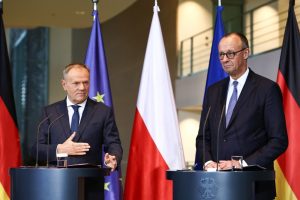
During a meeting with German Chancellor Friedrich Merz in Berlin in December 2025 Tusk commented wryly that the Germans need to hurry up before all the remaining living victims pass away.
Poland has signed a defence agreement between the two ministries which critics say concentrates on German needs without giving Poland any guarantees of German support. Władysław Kosiniak-Kamysz and his German counterpart Boris Pistorius signed the accord in Warsaw on June 17, 2026, replacing a framework agreement dating from 2011. The full text appeared first in the German federal gazette. Bartosz Grodecki, head of the National Security Bureau, called the document “rather asymmetrical”.
The attitude of the former PiS administration and Nawrocki to Germany is totally different from that of the Tusk administration. They believe that the reparations issue should be kept on the table in discussion with Germany to be used to leverage concessions in other areas.
Former PiS PM Mateusz Morawiecki, who is now the leader of a break-away Development Plus grouping, told a debate marking the anniversary on September 1 that Poland needed to work with New York law firms, which he described as Jewish, to press the German case.
The Polish Right is traditionally suspicious that Germany wishes to dominate Europe and to limit Polish sovereignty and development. They point not only to Germany’s desire for a closer relationship with Russia but also the way Germany has been active in opposing Poland’s nuclear power programme and other investments on environmental grounds.
The reparations issue is certain to feature in the 2027 parliamentary elections with the Right accusing the Tusk government of being accommodating to Germany while the ruling party hits back arguing that pursuing a hopeless reparations claim is a blind alley that cannot help Poland in securing cooperation from the Germans.