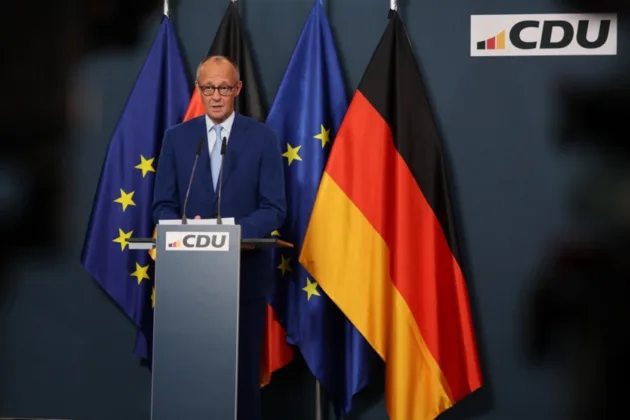




Senior Christian Democratic Union (CDU) politician Hendrik Wüst has called for the first concrete step towards examining a possible ban of the Alternative for Germany (AfD), following the party’s historic election victory in Saxony-Anhalt, eastern Germany.
Wüst, the premier of North Rhine-Westphalia, Germany’s most populous state, is one of the CDU’s most prominent figures and is widely regarded as a potential future challenger to Chancellor Friedrich Merz. His intervention came on September 7, one day after the Saxony-Anhalt election, where the AfD won 43.8 per cent and the CDU 17.2 per cent on a record turnout of 77.8 per cent.
The AfD more than doubled its 2021 score and the CDU more than halved its own.
Speaking at a public event in Berlin on September 7, moderated by the political economist Maja Göpel, Wüst called for a joint federal and state working group to examine the AfD and the possible legal consequences. As reported by Welt on September 8, he stressed that the process should not begin with a predetermined objective:
“Not with the politically predetermined goal that you now have to examine a ban, but to examine this party and the possible legal consequences. That could be a ban, but it could also be something else.”
Wüst added that if the examination concluded that the AfD could legally be banned, proceedings should follow “step by step”. He said he believed no CDU politician had publicly called for such a group before.
Speaking separately to German press agency dpa, he warned against rushing, saying a ban could only be a last resort, that the review had to be open-ended and that the group should bring in the domestic intelligence service and constitutional lawyers.
Germany faces another state election on September 20 in Mecklenburg-Vorpommern, in the country’s northeast, where the latest Infratest dimap poll, published on September 3, puts the AfD at 35 per cent, ahead of the Social Democratic Party (SPD) at 32 per cent. The CDU is polling at 8 per cent, which would be its worst result in the state since 1990.
The AfD’s rise is not confined to the states. In the ARD-DeutschlandTrend poll published on September 3, it emerged as Germany’s strongest political force with 27 per cent, ahead of the CDU/CSU at 21 per cent. The same survey put satisfaction with the CDU/CSU-SPD coalition at 15 per cent.
This has prompted some political observers to view calls for an AfD ban not only as a constitutional question, but also as an attempt by the CDU to eliminate a political competitor it has so far been unable to defeat at the ballot box.
Harald Martenstein, a journalist and columnist who spent years at Die Zeit and now writes for Bild, has argued against an AfD ban. He put the criticism bluntly in a speech at the Thalia Theatre in Hamburg on February 13, 2026: “You know that you are not preventing a Fourth Reich, but merely seeking to eliminate your political competition.”
Germany’s Basic Law explicitly provides for party bans. Under Article 21, parties seeking to undermine or abolish the free democratic basic order can be declared unconstitutional.
Only the Federal Constitutional Court can impose such a ban. Applications can be submitted by the Bundestag, the lower house of parliament, the federal government or the Bundesrat, the chamber representing the 16 states.
The CDU itself therefore cannot file a case. Wüst, as head of the North Rhine-Westphalia government, sits in the Bundesrat himself and could press for a move there.
The threshold is deliberately high. The court would have to establish not merely that the AfD is extremist, but that it actively seeks to undermine or abolish the free democratic basic order.
Even a lower hurdle has proved hard to clear. On February 26, 2026, the Cologne Administrative Court barred the Federal Office for the Protection of the Constitution from classifying the AfD as a confirmed extremist organisation until the main proceedings conclude, ruling that the evidence submitted did not support the designation.
Wüst’s proposed working group would therefore collect and assess evidence before any formal application.
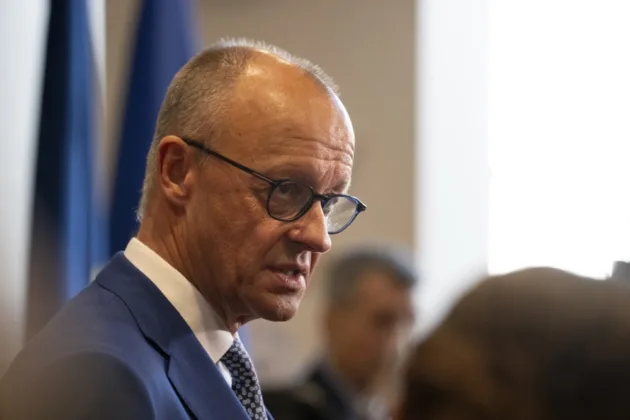
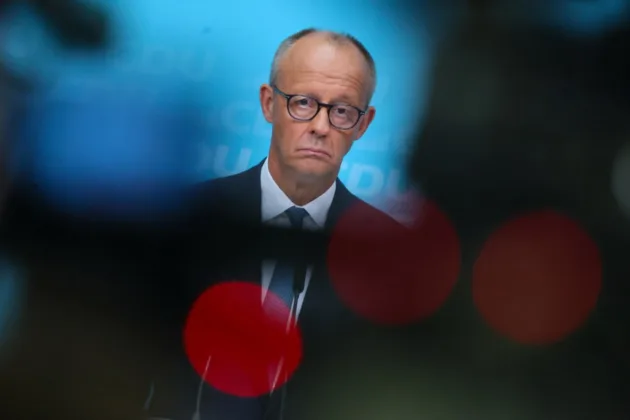
Merz has meanwhile drawn a clear line against cooperation with the AfD, describing himself and his party as deeply shocked and calling the outcome the CDU’s heaviest election defeat in decades. But the scale of the AfD’s advance is exposing growing tensions within the party.
While Merz insists on political separation, figures such as Wüst are pushing for a more forceful response. Christian Social Union (CSU) leader Markus Söder said the AfD should instead be confronted on policy, arguing a purely formal debate about the “firewall” did not help.