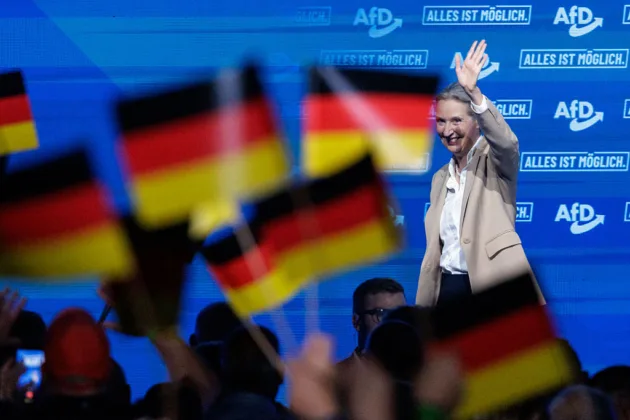





Russia’s 2022 invasion of Ukraine prompted then-German Chancellor Olaf Scholz to declare a Zeitenwende — a turning point — in Germany’s approaches to Russia and national defence. The Alternative for Germany (AfD) party’s landslide victory in the September 6 regional election in Saxony-Anhalt will likely prompt the ruling Christian Democratic Union (CDU) to make a similar turn with respect to its relations with other parties.
The AfD, led in the state by Ulrich Siegmund, outperformed pre-election polls to capture nearly 44 per cent of the vote and 39 seats in the state’s 83-member parliament, on a record turnout of 77.8 per cent. That’s not enough for it to govern on its own, but the CDU’s collapse — it received only 17 per cent, less than half what it polled five years ago — means that only a coalition of every other parliamentary party can stop the AfD from forming its first-ever state government.
That’s not something many CDU politicians or voters will stomach because it would involve formal cooperation with two left-wing parties descended from the former East German Communists, Die Linke (the Left) and the Sahra Wagenknecht Alliance (BSW). Polls regularly show that CDU voters do not want to ally with elements they view as anti-Western, and many CDU leaders agree. Such an alliance would go down especially poorly with the CDU’s Bavarian sister party, the Christian Social Union (CSU), which is traditionally more right-leaning than the CDU.
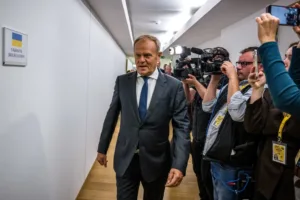
This places CDU Chancellor Friedrich Merz in a no-win situation. He has ruled out allying with either Die Linke or the AfD, but has previously winked at an alliance with the BSW. Indeed, the CDU leads a government in Thuringia because of support from deputies elected on the BSW slate, many of whom have recently left the party rather than obey Wagenknecht’s demand that they stop supporting the conservatives. Ten of the 12 BSW deputies still sitting in Erfurt quit the party on September 4, among them every BSW minister, while pledging to keep Minister-President Mario Voigt in office. One might think that he will tacitly back the CDU in Saxony-Anhalt to pursue a similar arrangement to keep the AfD from power.
Sanctioning this, though, would place him at odds with a growing number of CDU leaders who are openly calling for an end to the so-called Brandmauer, or firewall, against cooperating with the AfD. They have seen that this policy has led to the CDU’s decline as conservative voters decide that the AfD is the only consistently conservative party left. They sensibly want to stop the political bleeding before it kills the CDU.
Merz and his CDU predecessors, Angela Merkel, Annegret Kramp-Karrenbauer and Armin Laschet, have long tried to prevent the AfD’s rise and keep the party’s traditional role as the most rightward party in German politics. Nearly a decade after the AfD’s first entry into the Bundestag, though, it is clear this only helps the AfD. The CDU/CSU alliance received nearly 42 per cent of the vote as recently as 2013 but now receives only around 21 per cent in recent polling. The AfD, which won no seats in 2013, leads nationwide with about 28 per cent.
Nor can Merz rely on Germany’s non-voters to turn out and save his party if faced with the prospect of an AfD national victory. That’s what happened in the most recent French and Romanian elections, but non-voters in the Saxony-Anhalt contest were overwhelmingly for the AfD. Recent polls in France and Romania suggest that the grand coalitions’ failures in both countries to address their nations’ problems have cost the establishment parties their reservoir of goodwill there too.
This means the CDU must now turn. It must either decisively turn to its right, opening up potential cooperation with the AfD in an effort to stem the tide, or it must decisively turn to the left and agree that the former Communist parties are suitable partners in government.
Neither choice comes without risks. A move to the right could cost the CDU votes from its remaining moderate voters, who might prefer the Greens or the liberal Free Democrats. A move to the left might cost more conservative voters, strengthening the AfD’s hand and making the CDU a mere handmaiden of a left-dominated coalition.
That is precisely the choice virtually all of Western Europe’s once dominant centre-right parties have had to face in the last decade. Recent polls suggest that pre-populist centre-right parties can govern as the dominant partner in a coalition in Spain and Greece. Everywhere else they must either ally on nearly equal terms with the populist right or the social democratic left and liberal centre. Rather than lead Germany into a new future, Merz’s lacklustre time in office has brought Germany’s centre-right in line with the rest of the continent.
Merz will not want to make this choice and thus may continue to pursue his increasingly untenable “a pox on both your houses” policy regarding the two political extremes. He might not have much time left to continue to call the party’s shots, though.
Polls in former West German states holding elections next year also show the AfD gaining ground at the expense of the CDU and the Social Democratic Party (SPD). It’s one thing for the CDU to be rejected in the former East, even though it has ruled many states there since reunification. Losing ground in its Western heartland, even if that means it can retain some power through coalitions, might prove to be a bridge too far for the CDU rank and file or hierarchy. Uneasy lies the head that wears the crown.
It’s said in America there are only two things in the middle of a road: Lines and dead animals. Merz should get the CDU out of the middle of the road before the speeding AfD car squashes it.