
Matteo Salvini has faced an open revolt within his own party, a crisis that could have wider implications for Prime Minister Giorgia Meloni’s centre-right governing coalition.
The League leader, who also serves as Italy’s Minister of Infrastructure and Transport and Deputy Prime Minister, is under growing pressure from senior figures in the party’s northern stronghold. They are now openly calling for him to step aside and accusing him of taking the party in a political direction that has left it at its lowest point in history.
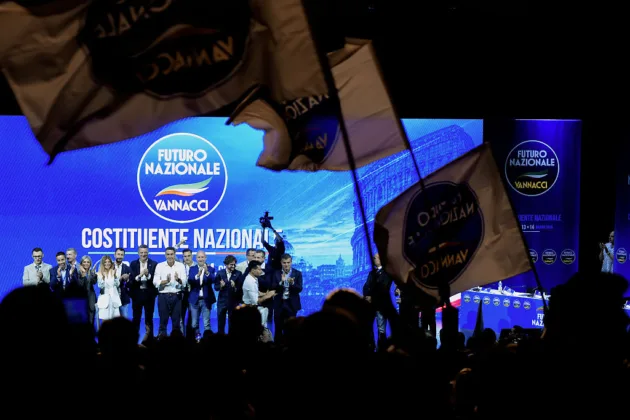
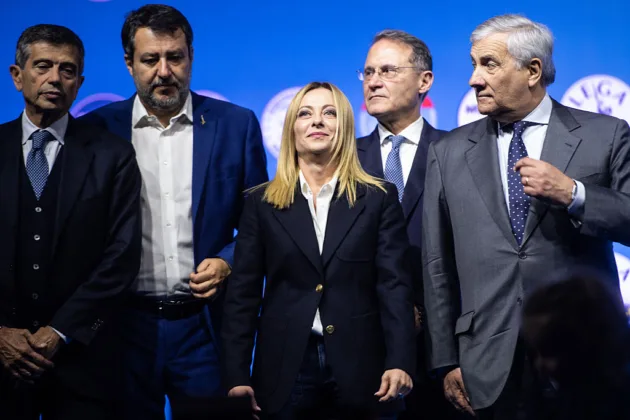
The League is experiencing a steady loss of support to Roberto Vannacci’s Futuro Nazionale (National Future), which is emerging as a potential opposition force on the right of the centre-right coalition. The weakening of the League, one of the three main parties in Meloni’s governing alliance, alongside her Brothers of Italy and Antonio Tajani’s Forza Italia, is increasingly becoming a concern for the entire coalition.
If Futuro Nazionale remains outside the alliance, it could split the right-wing vote and prove fatal to the coalition’s chances of holding on to power in the 2027 national elections.
The challenge is coming from Lombardy, the League’s historic heartland in northern Italy, where some of the party’s most influential figures are openly telling Salvini to go.
The revolt erupted during a meeting of the Lombardy League regional executive at the party’s headquarters in Via Bellerio in Milan on August 7. The meeting lasted more than four hours, with around 20 of roughly 30 interventions reportedly critical of Salvini. La Repubblica reported that five members went as far as explicitly calling for his resignation.
Those five were named as Daniele Belotti, a veteran League politician from Bergamo, the party’s provincial secretaries in Bergamo and Brescia, Fabrizio Sala and Roberta Sisti, and two mayors, Giovanmaria Flocchini of Pertica Alta and Renato Pasinetti of Travagliato.
Attilio Fontana, the president of Lombardy and one of the League’s most powerful institutional figures, stopped short of calling for Salvini to resign. He urged him instead to move “to the side” and argued that the League had to become once again a party of “struggle and government”, meaning a political force that both fights for its own positions and governs effectively, rather than simply adapting itself to the broader centre-right coalition.
Fontana also told the meeting that the party had not been created in order to flatten itself onto the centre-right, and called for a return to the League’s historic causes of federalism and autonomy.
Other figures were more direct. According to Il Foglio, Belotti told Salvini to leave, while Flocchini told him that his political cycle was over.
Alongside Fontana stands Massimiliano Romeo, the League’s Lombardy secretary and its group leader in the Senate, who has called for a broader leadership team drawing on the party’s northern governors and local administrators.
The revolt is not, though, simply about Salvini personally. At its heart is a much bigger question: What has the League become, and what should it be in the future?
When Salvini became leader of the League in December 2013, he inherited a very different party.
The League had been founded by Umberto Bossi in 1991 as a northern autonomist movement, built around the political and economic interests of the northern regions of Lombardy and Veneto. Its historic agenda centred on federalism, regional autonomy and, at its most radical, the idea of independence from Rome.
Salvini moved the League away from its traditional northern focus and turned it into a national right-wing force, campaigning on immigration, security, nationalism, opposition to the European Union and conservative cultural issues. The shift also allowed Salvini to build alliances with like-minded forces across Europe, including Marine Le Pen’s National Rally in France.
Today, League MEPs sit in the European Parliament’s Patriots for Europe group alongside other nationalist and right-wing parties.
The strategy initially worked. The League won 17.4 per cent in the 2018 general election, making Salvini deputy prime minister and interior minister.
In the 2019 European elections the party reached 34.3 per cent, its highest result under Salvini and the strongest performance by any party on the Italian right at the time.
But there was a contradiction at the heart of that success. The League became national, while its political and organisational roots remained firmly in the north.
Lombardy and Veneto continued to provide the party with its strongest local organisations, governors and territorial networks. For many of those figures, autonomy and the interests of northern Italy remained central to the League’s identity.
As long as Salvini was winning votes, the contradiction was manageable. Now, with the League at historic lows, it has returned to the centre of the internal debate.
The northern revolt is, in effect, an argument that Salvini’s nationalisation of the League may have made the party bigger but also less distinctive.
The change in the League’s fortunes has also transformed its position inside the centre-right.
At the height of Salvini’s power, the League was the dominant force in the coalition. Today, that role belongs to Brothers of Italy, while the League has become a much smaller junior partner.
The reversal was already clear in the 2022 general election, when the League fell to 8.8 per cent as Brothers of Italy surged to 26 per cent. Much of Meloni’s growth came from voters who had previously supported Salvini.
The shift was helped by the fact that Salvini joined Mario Draghi’s broad governing coalition in 2021, while Meloni kept Brothers of Italy in opposition. This allowed her to present her party as the uncompromised alternative on the right, while Salvini became increasingly associated with government compromises and a more moderate approach to governing.
Since 2022, Salvini has tried to recover ground by repositioning himself as the more uncompromising figure on the right of the coalition. But the strategy has failed to revive the League.
An Ipsos Doxa poll for Corriere della Sera published on July 25 put Brothers of Italy at 26.5 per cent, while the League had fallen to just 5.1 per cent. Roberto Vannacci’s Futuro Nazionale was at 7.1 per cent, already two points ahead of Salvini’s party.
The same survey put Forza Italia at 8.3 per cent, leaving the League fourth among the four parties of the wider right.
The result is a reversal: The party that once set the agenda of the Italian right now risks becoming permanently subordinate to Meloni, while losing voters from its right to a new competitor.
The demand of the northern establishment is more straightforward: give the north greater political weight inside a party that, under Salvini, has become increasingly national and increasingly dependent on its leader.
Roberto Vannacci, a former army general and former League MEP, was initially brought into the party because Salvini saw him as a strong right-wing profile, known for his nationalist views, hard-line positions on immigration and security, and conservative stance on cultural issues. His candidacy was intended to strengthen the League’s appeal among voters further to the right of the centre-right coalition.
Salvini backed Vannacci as a League candidate in the 2024 European elections, helping turn him into one of the party’s most recognisable figures, and later appointed him deputy federal secretary. The move was part of Salvini’s attempt to reclaim voters further to the right, but it also generated unease among some of the League’s old northern establishment, which feared that the party was moving even further away from its traditional autonomist identity.
The strategy backfired. Vannacci left the League in February 2026 and founded Futuro Nazionale, turning himself from Salvini’s electoral weapon into one of his most serious political competitors.
That leaves Salvini squeezed from two directions. The north is telling him that he has taken the League too far away from its traditional identity, while Vannacci is now competing for the national right-wing electorate that Salvini spent years building.
The revolt in Lombardy is therefore about more than Salvini’s leadership. It is a challenge to the political model he has built: A nationalised League that has lost ground to Meloni on one side and Vannacci on the other.
Yet despite the growing criticism, there is no obvious figure within the party currently capable of replacing him and uniting its different factions.
For now, Salvini is refusing to go. After listening to hours of criticism in Milan, he rejected the idea that his political cycle was over and, according to Il Foglio, said he could rebuild the party to around 10 per cent.
He has promised a further meeting of the party leadership before the end of August, followed by a gathering in Rome on September 8-9. The League’s annual rally at Pontida, near Bergamo, is due to be held on September 20.
After almost 13 years at the helm, Salvini is no longer simply fighting to remain leader of the League. He is fighting to decide what the League is supposed to be.