






Poland has had its credit rating cut amid mounting debts driven by high defence and welfare spending at a time when the country is facing heightened security threats.
Fears of imminent armed conflict are on the rise, while the country is hampered by political gridlock between a government and President engaged in an uneasy cohabitation.
Rating agency Moody’s has cut Poland’s long-term credit rating by one notch to A3 from A2 in a decision announced late on September 18. It also lowered Poland’s short-term issuer rating to Prime-2 from Prime-1, warning that years of heavy borrowing have significantly weakened the country’s public finances.
At the same time, the agency changed its outlook on Poland to stable from negative, where it had stood since September 2025.
The last time the agency had Poland at such a low level of creditworthiness was in 2002. According to Polish daily Rzeczpospolita, it is the first time Moody’s has ever cut Poland’s rating.
It is also the first time any of the big three agencies has downgraded Poland’s rating since January 2016, when Standard & Poor’s shifted it from A- to BBB+ on its scale.
The decision is likely to push up borrowing costs for Poland and reduce investor confidence.
The move brought Moody’s, which until now had held the highest score for Poland among the three major rating agencies, into line with Fitch and S&P, which both rate the country at A-, the equivalent of A3. Fitch has a negative outlook on Poland, while S&P’s is stable.
Moody’s said the cut reflects “a durable deterioration” in Poland’s fiscal strength since its last review in September 2025.
“Large fiscal deficits have led to a significant increase in the public debt burden, which, combined with rising financing costs, has weakened debt-servicing indicators,” the agency said.
It also warned that “fiscal policy effectiveness has weakened”, including a “limited willingness or ability on the part of the Polish authorities to rebuild fiscal buffers during favourable economic conditions”.
The rating agency expects Poland’s general government deficit to stay near 7 per cent of GDP in both 2026 and 2027, driven by rising healthcare costs, continued public investment, and defence and welfare spending. Public debt is forecast to climb to 68.9 per cent of GDP by 2027, up from 59.7 per cent in 2025.
Moody’s noted that part of the growing debt sits outside Poland’s constitutional debt limit of 60 per cent of GDP as it flows through state agencies and the state development bank Bank Gospodarstwa Krajowego (BGK), which are not part of the state budget.
That debt still counts under EU accounting rules but falls outside the national 60 per cent of GDP limit, the breaching of which would oblige the government to produce a balanced budget.
Poland’s worsening fiscal situation has been drawing the attention of the rating agencies for some time. The government’s budget deficit has ballooned, reaching 7.3 per cent of GDP in 2025, according to Eurostat. That is the second highest figure in the EU, after Romania’s 7.9 per cent.
This has happened despite Poland being placed under the EU’s excessive deficit procedure in July 2024. The plan Poland produced to reduce the deficit has not yielded any results thus far as the deficit has actually risen.
The draft budget for 2027, adopted by the government on August 28, projects the deficit to reach 7.1 per cent next year, almost double the 3.7 per cent the government had previously committed to reach by that year.
As a result, Poland’s level of debt has risen rapidly. In the first quarter of this year, it crossed the 60 per cent of GDP threshold, thereby exceeding the limit enshrined in EU legislation.
Poland’s Fiscal Council, set up in November 2025, has warned that the risk of breaching the constitutional threshold is high in 2028 and very high in 2029-2030.
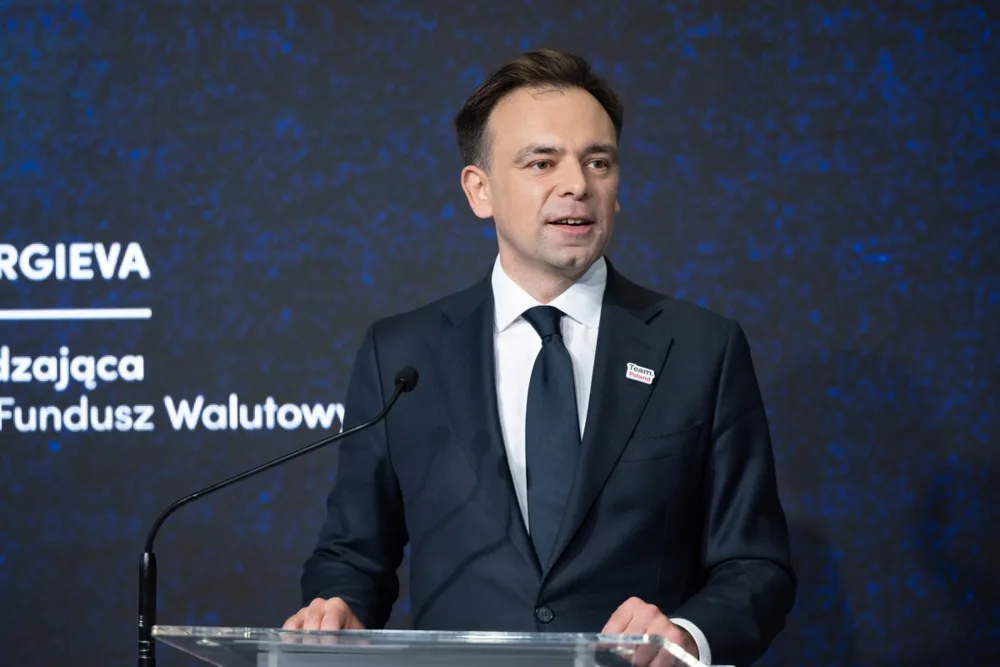
Finance minister Andrzej Domański said the decision announced by Moody’s was not a cause for alarm.
“We treat this decision seriously, but calmly. The Polish economy is growing fast, and its fundamentals remain strong,” Domański wrote on social media platform X. He added that strengthening public finances would “require cooperation from all state institutions, including the President”.
The finance minister was alluding to the conflict between the centre-left government led by Prime Minister Donald Tusk and President Karol Nawrocki, who is aligned with the right-wing opposition. The stand-off has seen the head of state use his power of veto to stop some fiscal measures designed to raise revenue, such as taxes on alcohol and sugar and windfall levies on fuel companies.
Nawrocki’s head of cabinet, Paweł Szefernaker, though, blamed the situation on the government. “They steal, they lie and they burden our homeland with debt. Unfortunately, we Poles will have to pay for it all,” he wrote on X.
Nawrocki and the opposition argue that the government has failed to improve the fiscal situation by tightening up on tax avoidance and VAT fraud.
In its analysis, Moody’s also pointed to political constraints such as the stand-off between Nawrocki and the Tusk administration. It added that the parliamentary elections due in November 2027 were likely to delay any significant fiscal correction.
The decision to downgrade Poland’s credit rating came as little surprise to financial markets, according to Polish economists, who say investors had already been factoring in the country’s deteriorating fiscal position.
Rafał Benecki, chief economist at ING Bank Śląski, told Poland’s state news agency PAP on September 19 that the decision had not come as a surprise to investors, either foreign or domestic.
“Markets have for some time been pricing in a deterioration in Poland’s budgetary position,” he said, adding that the trend could be seen in a range of market indicators.
Benecki pointed to the relatively low share of foreign investors in Poland, arguing that they tend to favour markets they consider relatively safe.
The economist argued that the country’s fiscal deterioration was not a new phenomenon but the result of a trend that had been developing for years.
“The deficit remains high regardless of whether the economy is performing well or poorly,” Benecki said.
Despite the downgrade, Moody’s growth forecasts remain solid: 3.7 per cent GDP growth in 2026 and 3.2 per cent in 2027, following 3.6 per cent in 2025.
The agency also expects debt to stabilise at 70-75 per cent of GDP by the late 2020s if the authorities eventually stick to national fiscal rules and tighten public spending after the 2027 election.
If that happens, a future upgrade in the rating would be likely. Equally, a downgrade could take place if debt climbs well past 75 per cent of GDP, if a severe economic shock hits growth or if regional security deteriorates sharply as a result of a major spillover of Russia’s war in Ukraine.
The security situation, which is causing Poland to spend almost 5 per cent of its GDP on defence, is a huge cause of concern for Warsaw. On September 17, Tusk raised yet another alarm about Russia planning drone and missile strikes on NATO’s eastern flank.
Speaking in the Sejm, the lower house of the Polish parliament, Tusk said intelligence assessments indicated that Russia is planning a major escalation in the coming months against countries, such as Poland, which have supported Ukraine.
“Russia’s plan, according to intelligence, includes hybrid drone and missile strikes against countries supporting Ukraine, including Poland. These possibilities have been discussed for some time. This information is now very consistent and, unfortunately, convincing,” he said.
The Polish PM said the aim of the aggression would be to weaken NATO resolve and sow confusion through a narrative of the attacks being incidental and therefore not warranting a NATO response.
Poland has already suffered such incidents: Around 20 Russian drones entered its airspace on September 9-10, 2025, suspected Russian operatives attempted to blow up railway tracks in eastern Poland in November 2025 and a Russian Kh-101 cruise missile crashed near the village of Tarnawa-Kolonia, Lublin province, eastern Poland, on July 30.
Polish fighter planes are regularly on alert and up in the air during Russian air attacks on western Ukraine. On September 13, a Russian drone hit the locomotive of a Kyiv-Warsaw passenger train some 2km from the Polish border, while another struck a petrol station near the Dorohusk-Yahodyn border crossing.
Polish decision-makers fear that any significant increase in Russian activity aimed at their country in order to disrupt the supply of arms and energy to Ukraine could lead to major disruptions in air travel and investor flight.
Investors and visitors may, though, rest easier after US President Donald Trump announced on September 17 major progress towards establishing a permanent US Army base in Poland, a step that would increase the significance of Poland in the European security architecture.
In his announcement, Trump praised Nawrocki’s efforts with regard to securing a permanent base. The date marked the anniversary of the Soviet invasion of Poland in 1939 during the Second World War.
This contrasted markedly with former US president Barack Obama, who on September 17, 2009, during his reset with Russia, announced that he was scrapping plans to place an anti-missile shield in Poland.
Nawrocki has succeeded in building a good relationship with Trump and Washington’s relations with the Polish government remain positive despite past derogatory comments about Trump made by both Tusk and foreign minister Radosław Sikorski.
The announcement of a permanent base in Poland, though, will be tempered by reports from US broadcaster NBC News that the Pentagon is considering withdrawing at least 25,000 of the roughly 80,000 US troops stationed in Europe, mainly from Germany, Italy and Spain. Poland is reportedly to be excluded from those reductions.
The location of the base has not been confirmed. Polish news portal Onet has reported that Polish officers initially favoured sites in western Poland, while Marcin Przydacz, head of Nawrocki’s international policy office, has said two locations are under consideration.
Details about the financing of the base have yet to be revealed but Poland has in the past indicated that it is ready to fund the costs in order to enhance its own security.
The concerns expressed by the rating agencies and Poland being placed under the EU’s excessive deficit procedure nevertheless show that there are economic and financial threats associated with high defence spending.