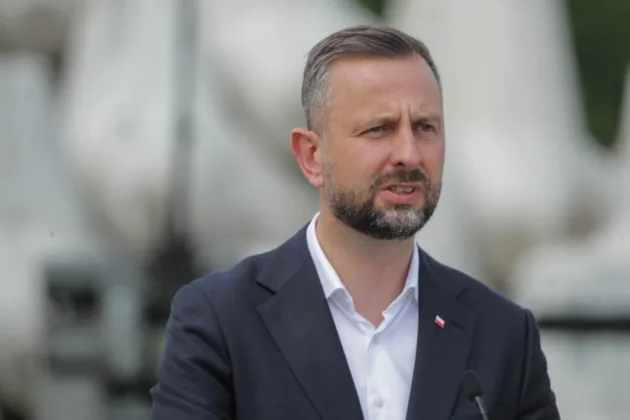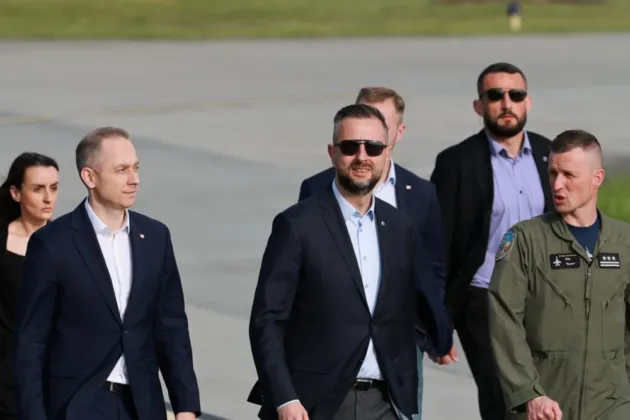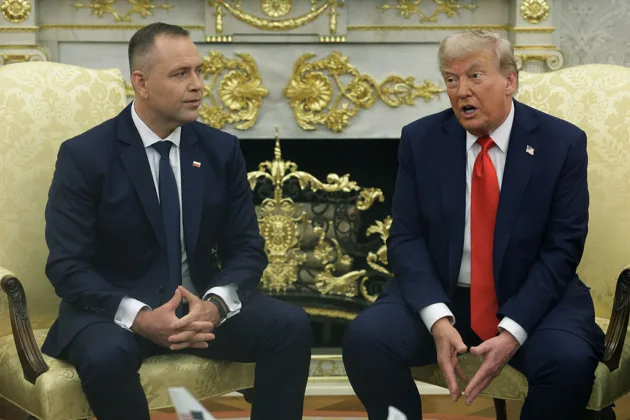


Polish President Karol Nawrocki has said that the establishment of a permanent US military base, which he called “Fort Trump” in honour of US President Donald Trump, was “just a matter of time”.
Nawrocki has cultivated close ties with Trump, who endorsed him during Poland’s 2025 presidential campaign, and has never criticised Trump over either the Iran war or the US head of state’s campaign for the US to take over Greenland.
The US has long been Poland’s most important security partner. In 2023, under then-president Joe Biden, it established its first permanent military garrison in Poland at Camp Kościuszko in Poznań, west-central Poland, and in the following year a US missile defence base opened at Redzikowo on Poland’s northern Baltic coast.
Trump himself declared on September 17 that “major progress” was being made towards establishing the base, saying it was thanks to the “bold leadership of my friend, Karol Nawrocki”, who is a conservative ally of the US president.
Poland’s centre-left government, which regularly clashes with the right-wing opposition-aligned Nawrocki and whose Prime Minister Donald Tusk has in the past called Trump a “Russian asset”, has not commented on the idea of naming the new base after the US president.
In a sign that it would not raise any hackles, though, deputy defence minister Stanisław Wziątek expressed confidence on September 21 that the new base would soon be confirmed. He told RMF24 that it could see the number of US troops stationed in Poland rise to around 15,000.
Poland, which borders Russia’s Kaliningrad exclave, Belarus and Ukraine, sees a permanent US presence as an important deterrent against Russia.
The country has over the past year faced encroachments by Russian drones into its airspace, a rocket crashing in eastern Poland, explosions near the border and attempts to sabotage the railway tracks leading to the Rzeszów-Jasionka hub, southeast Poland, through which 95 per cent of military aid to Ukraine from the West flows.
“We are in the midst of a hybrid war. Russian provocations are on the one hand shaping the future battlefield, but on the other hand, they’re testing the resilience of NATO. For sure the situation is serious,” Nawrocki told Bloomberg.
Poland’s President, interviewed by Bloomberg Television during his visit to the UN General Assembly in New York on September 22, said he hoped the permanent base would be built before Trump leaves office in 2029 and that it would be called “Fort Trump”.
“When the work is finished by the US administration, by both governments, I think then President Trump will personally be able to participate in the inauguration of Fort Trump,” added Nawrocki.
The location of the new permanent base has not yet been announced. According to Polish media reports, the shortlist is down to three locations in western Poland: One near the northwest city of Szczecin, one near Poznań and, the favourite, a location near the southwest city of Wrocław. Wziątek has said only that it would be in the west of the country, for security and logistical reasons.
The Polish President said “administrative and financial issues” for a potential US army base still had to be resolved but that they were not going to be an obstacle to progress.
When asked about the cost to Poland of establishing the new permanent US base, Wziątek said it would exceed 15 billion zloty (€3.5 billion) but that this would depend on the level of involvement of the United States. Defence minister Władysław Kosiniak-Kamysz has put the Polish share at 15 billion to 17 billion zloty (€3.5 billion to €3.9 billion).
Poland’s defence build-up is taking place alongside mounting fiscal pressure. This was evident on September 18, when Moody’s cut Poland’s credit rating from A2 to A3, the agency’s first downgrade of the country, and warned that the country was struggling to contain its budget deficit.
Both Nawrocki and the government view security spending as the top priority, though, and Moody’s expects the Polish economy to grow by 3.7 per cent this year.
As for the timing of the US permanent base, there was no concrete target date set.
“It’s hard for me to give specific dates, but I think that this matter is for sure confirmed because President Trump is famous for keeping his word,” said Nawrocki.
Trump has kept his word to Poland about inviting it to the G20 summit due in Florida, bringing in visa-free travel to the US for Poles, exporting liquefied natural gas and backing Poland’s first nuclear power station, which is to be completed in the mid-2030s.
The US President is also happy with Poland for having abandoned Russian gas and oil, as well as for its military spending, which at 4.5 per cent of GDP in 2025 was the highest in NATO, according to the alliance, and for Poland’s readiness to pay for any US base on Polish soil.
Nawrocki confirmed to Bloomberg that Poland would bear the costs, saying: “Poland pays for its security. We also cover the costs of American soldiers staying in Poland.”
The ever-closer relations are also evident in Poland’s purchases of US weapons. Between 2021 and 2025, 44 per cent of Poland’s arms imports came from the US, according to the Stockholm International Peace Research Institute (SIPRI), second only to South Korea with 47 per cent. US purchases have included F-35 fighter planes, Patriot air defence batteries, HIMARS rocket artillery, Black Hawk helicopters and Abrams tanks.
Poland has been pushing for a permanent US military presence since former president Andrzej Duda, who like Nawrocki was aligned with the previous Law and Justice (PiS) government, first proposed the idea in 2018, even offering to contribute more than $2 billion (€1.7 billion) toward the project, which he suggested could be called “Fort Trump”.
That plan did not come to fruition, due in no small measure to the fact that Trump lost power for four years to Democrat Joe Biden, but the presence of US troops in Poland has been increasing on a rotational basis and amounts to nearly 10,000 at present.
But momentum towards achieving such a permanent base has increased in recent weeks, with Trump revealing on September 17 that there was “major progress” toward establishing a base and that its location could be announced soon.
The issue has come to the fore as Washington reviews the roughly 80,000 US troops stationed in Europe, with reports that the Americans are considering reducing that number by 20,000 to 25,000 as they expect Europe to take more responsibility for its defence. Congress has barred troop levels in Europe from falling below 76,000 unless certain conditions are met, according to Reuters.
This does not seem to apply to Poland, though. When Secretary of War Pete Hegseth’s Pentagon halted the deployment of some 4,000 US troops to the country in May, raising anxiety in Poland, Trump stepped in on May 21, promising to send an additional 5,000 troops rather than cut troop deployment.
Nawrocki in turn said Poland would be prepared to receive US troops if Washington reduces its presence in Germany, even though the Tusk government has said that it did not want to see the US decreasing its military presence in Germany and the rest of Europe.
The tensions between Tusk, during his first term as PM from 2007 to 2014, and the then PiS-allied president Lech Kaczyński, the twin brother of the party leader Jarosław, were far greater with regard to foreign and defence policy than they are today.
Back then Tusk backed the reset with Russia and, in anticipation of Barack Obama’s arrival in office, delayed Polish progress on a missile shield base to be constructed in northern Poland.
The original idea of the base was abandoned by Obama, who on September 17, 2009, the anniversary of the Soviet invasion of Poland during the Second World War, announced the base would not be going ahead.
It will have pleased Nawrocki no end that it was on the very same day, September 17 of this year, that Trump made his announcement that the permanent US base in Poland would be going ahead.
The Tusk government, though, was keen to make sure that Nawrocki’s success might be overshadowed by allegations, which surfaced in liberal pro-government media, that the President’s entourage had been selling access to the President for cash.
The allegation, published on September 20 by Newsweek and Radio Zet, was that the Centre for Development Strategies, the organiser of a Polish-US Economic Summit in New York, was offering sponsorship packages worth up to $100,000 (€86,700), guaranteeing even one-to-one meetings with the President, and that there was collusion with members of the head of state’s office on the matter.
The foundation denied this, saying no company had bought the top package and that none of its sponsorship agreements provided for a meeting with the President. Nawrocki himself dismissed the report as false, saying that he alone decides whom to meet and when. Politicians from Tusk’s Civic Coalition (KO) have said they would notify prosecutors.
Nawrocki has in the past faced allegations that he has been influenced into resisting legislation on cryptocurrency assets by a failed cryptocurrency exchange. During his election campaign he faced allegations of unethical property dealings, of having been involved in procuring ladies of the night for guests when he served as a security guard in his student days and of participating in fights between football fans in his youth.
He has sued the media outlet that published stories about his work as a security guard and has been cleared of any illegality with regard to property dealing. He remains by far and away Poland’s most popular politician according to opinion surveys.
This week has shown that Nawrocki continues to be popular with President Trump, who seems to view Poland in a very different light to most other European states.