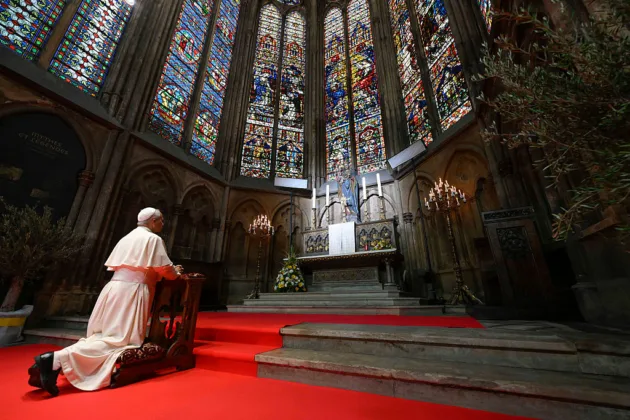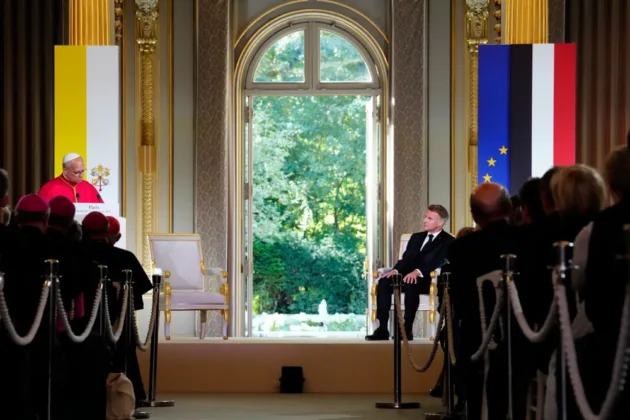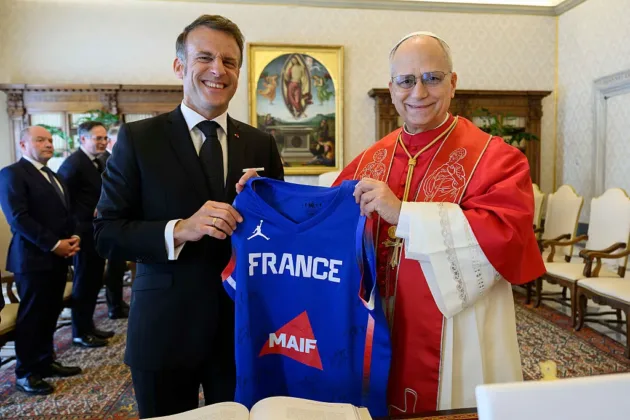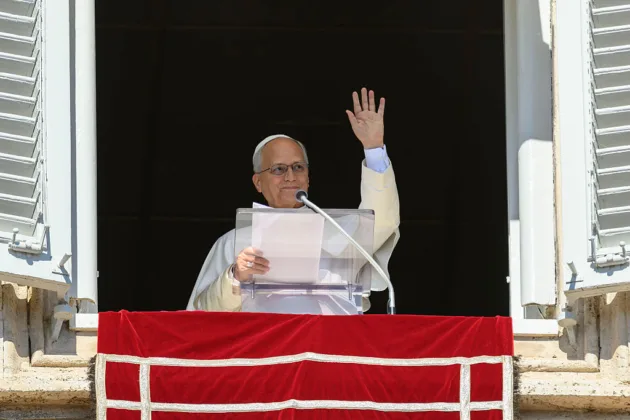
Pope Leo XIV’s programme in France, which runs until September 28, is built around three audiences: the Republic, a French Church marked by both renewal and scandal, and the leaders of the European Union.
Holy See spokesman Matteo Bruni has said the Pope intends to engage “with French society, its people, its culture, its history”.
The trip comes seven months before a presidential election in which the incumbent cannot stand. President Emmanuel Macron is to greet the Pope at Orly airport and receive him at the Élysée, though he will attend none of the three papal Masses. He is to be represented at the open-air celebration on Place de la Concorde on September 26 by Prime Minister Sébastien Lecornu and by the President’s wife, Brigitte Macron.
Macron’s attendance at Pope Francis’s Mass in Marseille in September 2023 drew accusations from the Left that he had breached laïcité, France’s strict separation of Church and State. Ahead of this trip, the Élysée insisted the principle “is not at all a negation of religion”.
The Élysée address offers Leo the stage on which Benedict XVI, in September 2008, praised the “positive secularism” championed by then-president Nicolas Sarkozy.
Bioethics is a likely point of friction. France legalised assisted dying this summer: Parliament gave final approval on July 15 and the Constitutional Council upheld the law on August 14. In 2024 it became the first country to write abortion into its constitution.
Leo has made the defence of human life from conception to natural death a constant of his pontificate, most recently before Spain’s parliament in June.
On defence and security, the Holy See’s position diverges from its host’s. The Vatican was among the first states to ratify the 2017 Treaty on the Prohibition of Nuclear Weapons, and Pope Francis declared the very possession of such arms immoral.
At the Île Longue submarine base on March 2, Macron ordered an increase in France’s stock of nuclear weapons, estimated at about 290 warheads, and said the figure would no longer be published. He also unveiled a “forward deterrence” plan involving eight European countries, including Germany and Poland.
The Concorde Mass, for which about 600,000 people have registered, is set to provide the political image of the trip. Marine Le Pen and Jordan Bardella of the National Rally (RN), formerly the National Front (FN), have said they will attend, as have Édouard Philippe, Gabriel Attal, Bruno Retailleau and Éric Zemmour, according to Public Sénat. Socialist leader Olivier Faure and the Greens’ Marine Tondelier will stay away.
Hours earlier, the Pope is due at Maison Bakhita, an archdiocesan centre in northern Paris that has welcomed about 2,800 migrants since 2021.
The stop brings immigration, one of the defining issues of the 2027 campaign, into the programme. In April, Leo said a state had the right to regulate its borders.
For the French Church, the programme includes vespers on September 25 at Notre-Dame, the first papal liturgy in the cathedral since the 2019 fire, and a meeting with members of its synodal assembly at the Institut Catholique the following morning.
The figures pull in different directions. Some 13,000 adults were baptised in France at Easter 2026, according to the Vatican. Yet only 25 per cent of French 18- to 49-year-olds identify as Catholic, down from 43 per cent a decade earlier, according to Reuters.
In Lourdes on September 27, Leo is to address the French bishops, celebrate Mass and meet seven victims of abuse in private. The 2021 report of the independent commission known as CIASE estimated that 216,000 minors had been abused by clergy between 1950 and 2020, a figure that rose to 330,000 including lay Church workers.
In a joint statement, the seven said that “to be received does not mean to renounce our demands”. A collective of former pupils of Notre-Dame de Bétharram, a Catholic school near Lourdes at the centre of a separate abuse scandal, called the exclusion of victims’ groups “institutional contempt”.
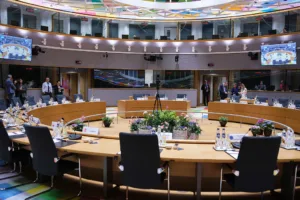
The final day in Metz turns to Europe. At the Robert Schuman congress centre, Leo is to deliver a speech entitled “To the roots of Europe for peace and unity”, entirely in English, after Macron opens with remarks on European integration as a model of peace.
Macron has invited the leaders of the 26 other EU member states and of the EU institutions. Ukrainian President Volodymyr Zelensky is not on the list, with the Élysée saying a European format had been preferred.
Schuman, born in Luxembourg in 1886, sat as a deputy for Moselle and is buried at Scy-Chazelles, outside Metz. Pope Francis declared him Venerable in 2021.
With the Ukraine War in its fifth year, an interreligious meeting in Metz is also due to produce a declaration for peace and fraternity signed with representatives of six faiths.
On his first day, Leo is also due at UNESCO to speak on artificial intelligence, the theme of his first encyclical, Magnifica Humanitas. It is the first papal visit to its headquarters since John Paul II in 1980.
On that journey, John Paul II asked a crowd at Le Bourget whether France, “eldest daughter of the Church”, had been faithful to the promises of its baptism. His successor arrives with the country’s answer still unsettled.