
Pope Leo XIV has become the first pope to address Spain’s parliament, using a historic speech in Madrid to call for greater respect for human life and immigrants and to warn against what he cast as the country’s corrosive political polarisation.
Speaking on June 8 to a joint session of the Congress of Deputies and the Senate, the American pontiff delivered what he described as “a calm and firm word” to those who bear “the grave responsibility” of ordering how a society lives together. Lawmakers answered with a seven-minute standing ovation.
Although the speech was delivered in Madrid, it was widely read as aimed well beyond Spain.
Much of the address turned on the defence of human life, which Leo XIV said was threatened by a “throwaway culture”, echoing his predecessor Pope Francis. He asked whether a community that “casts into the shadows” the unborn, the elderly and the sick could be considered fully just.
The Pope argued that the moral greatness of a nation lay in its capacity to protect its most fragile members. He framed the protection of life not as a “partial question” or a “confessional interest” but as a goal of civilisation.
On immigration, Leo XIV called for respect for migrants’ rights and for international law. The theme is expected to dominate the closing leg of his trip in the Canary Islands, off the coast of northwest Africa and a main entry point for arrivals from the continent.
THE LIMITS OF POWER
The Pontiff reserved some of his sharpest words for Spain’s combative politics, warning that political plurality “should not degenerate into permanent disqualification of the adversary”. He urged deputies to “disarm” their language, saying that firmness did not demand contempt and that disagreement did not require humiliation.
The message landed in a deeply divided chamber. Spain’s minority Socialist Government, led by Prime Minister Pedro Sánchez, is locked in near-permanent confrontation with a right-wing opposition, with immigration among the most contested issues.
Leo XIV also spoke of the moral limits of power and of a “just delimitation” of public authority, and touched on the ethics of artificial intelligence in warfare. He invoked the 16th-century School of Salamanca, the Spanish intellectual tradition credited with shaping early ideas of international law and human rights.
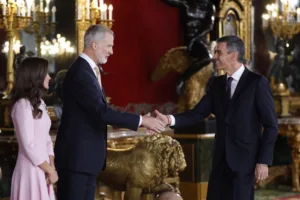
The Pope had pressed a similar theme on the first day of his visit. Receiving a welcome at the Royal Palace before the King and Queen, Sánchez and opposition leader Alberto Núñez Feijóo, Leo XIV urged Spaniards to set aside division in favour of “reconciliation”.
CHRISTIAN ROOTS
The visit has also given the Pope a platform to reassert the place of Christianity in Europe’s identity. At a gathering with figures from culture, business and sport at Madrid’s Movistar Arena, he revived the call of John Paul II to “open wide the doors to Christ”, arguing that Europe could not be understood without the mark of its faith.
That theme is set to continue in Barcelona, where Leo XIV is due to inaugurate a tower of the Sagrada Família basilica, designed by Antoni Gaudí, whose path towards possible sainthood advanced in 2025.
ABUSE CALLED A ‘PLAGUE’
After the parliamentary address, the Pope met about 80 bishops at the headquarters of the Spanish Episcopal Conference, where he turned to clerical sexual abuse. He said the Church owed those harmed by its own clergy “listening”, “truth”, “justice” and “reparation”, describing such abuse as a “plague”.
The meeting followed an agreement, strongly backed by the Vatican, under which Spain’s bishops accepted that the State ombudsman would have the final say on compensation for victims.
The Madrid leg has also mixed institutional events with mass public devotion. On June 7, Leo XIV presided over a Corpus Christi Mass at the Plaza de Cibeles that organisers expected to draw up to 1.5 million people, while a vigil the previous evening at the Plaza de Lima gathered hundreds of thousands of young people, whom the Pope urged to become “protagonists of change”.
The trip is Leo XIV’s first to Spain as pope and the first papal visit to the country in 15 years. It comes a little over a year after the Chicago-born Augustinian, born Robert Prevost, was elected to succeed Francis in May 2025.