








The breakthrough by Alternative for Germany (AfD) in the Saxony-Anhalt election on September 6 has produced a state of alarm in Germany that probably exceeds anything since the depths of the Cold War and the frequent murder by East German border guards of people trying to escape from East Berlin to the West. On the basis of the Alternative’s official policy and the utterances of its principal leaders, it is very difficult to justify the conduct of the Federal Office for the Protection of the Constitution that has consistently declared the Alternative to be an extremist organisation, a classification the Administrative Court of Cologne suspended on February 26 pending a full ruling. It is true that a few of its members occasionally utter phrases that are annoyingly reminiscent of echoes of the Third Reich, but there is no evidence of an ambition in the Alternative to curtail democracy, discriminate against minorities or revive any notion of German belligerency.
The leaders of the traditional parties appear to have been hoisted on their own petard: In order to stifle the Alternative, they announced a “firewall” to avoid any collaboration with or the legitimisation of the Alternative. But they have so mismanaged government under successive coalitions that the Alternative is on the brink of crashing through the barrier, where it has to be included in government. In Saxony-Anhalt it will surely lead the government since it has almost won a legislative majority on its own, with 39 of the 83 seats in the state parliament on 43.8 per cent of the vote. In order to steal that party’s thunder and take the radical reforming steps necessary to retain the credibility of the Christian Democrats (CDU) at least, it may be impossible to continue coalitions with the Social Democrats as they retard progress of the profound nature that seems to be necessary to recover public confidence for the traditional parties.
And now those parties appear to have reached the point where the once great Social Democrats of Willy Brandt and Helmut Schmidt and Gerhard Schröder will struggle just to qualify for representation in the Bundestag and the Christian Democrats are apt to end up as the junior partner to the Alternative and in no position to exact any conditions for its entry into government.
Saxony-Anhalt is a state of only two million people and has a comparatively low standard of living; it is in the bowels of the old communist East Germany. It is telling that the Office for the Protection of the Constitution, which accuses the Alternative of being extreme, has taken no such position in reference to the Left, which effectively continues the egregious failure of the old communist satellite, the so-called German Democratic Republic.
It appears at this point that in order to take a strong enough stance on immigration, the rollback of excessive climate change restraints on the economy and a tax programme that can stimulate Germany’s almost stagnant economy, the federal Christian Democratic government may have to get rid of the Social Democrats who are now a lead weight around its ankle and there is no one to replace them except the Alternative. If such a step is not taken soon, if long entrenched trends continue, the Alternative will pass the CDU as the largest party in Germany.
Despite all the wailing and gnashing of teeth that such a thought generates, the only aspect of the Alternative’s programme that is seriously disturbing the West is that it inexplicably hears the forest murmurs of Russia and imagines that Germany might make a better deal with the stumbling and stagnant and corrupt dictatorship of Vladimir Putin than it can with the American-led West. It is this discordant note of ancient Teutonic delusional Eastern fantasies that disquiets foreigners.
Russia is now almost a failed state: It has virtually been defeated by Ukraine in its aggressive war yet the Alternative appears to sympathise with Russia, and Russia is now an importer of fuel because of the success of Ukrainian drone attacks on Russia’s refining capacity. It has a GDP barely larger than Canada’s and an army chiefly composed of mercenaries and incarcerated criminals who in a war that has now lasted longer than that between Hitler and Stalin, has been unable to subdue a former province with one quarter of Russia’s population.
The Alternative has been effectively pursuing a parallel track of the very successful Brothers of Italy led by Premier Giorgia Meloni, and what is now the National Rally in France, which has been quite thoroughly housetrained and appears fit to govern. Britain’s Reform UK seems to be foundering and is in a three-way dead heat in the polls with the traditional Labour and Conservative parties. There is a general recognition in Western Europe that there will have to be changes to ecological preoccupations that shut down nuclear power in Germany and overregulated industry and has been partly responsible for the European Union’s chronically uncompetitive economic performance vis-à-vis the United States.
The Christian Democrats will have either to steal the Alternative Party’s platform or adopt the less controversial aspects of it and bring it into the federal coalition, or continue their accelerating slide towards a crushing defeat. The other German political parties, the Greens, the Left, the Free Democrats and the Social Democrats all appear to be headed to the junkyard of the past. The rise of the Alternative Party will be a positive development to the extent that it moves Germany towards the responsible exercise of its position as the leading power of Europe, for the first time since the man-child emperor Wilhelm II fired the unifier of Germany, Bismarck, in 1890.
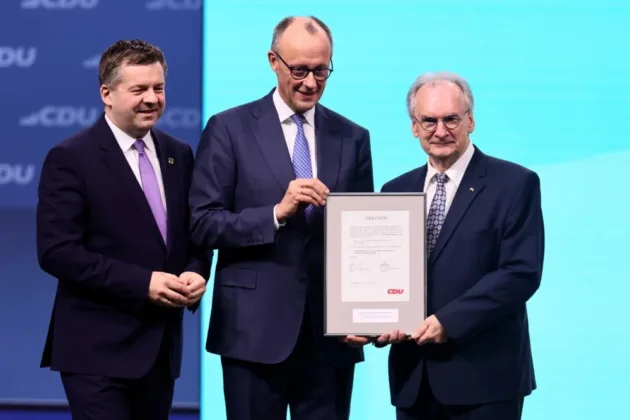
It is now clear that Chancellor Friedrich Merz would have been a much better Christian Democratic leader than the prolonged disappointment of Angela Merkel. He still has a chance to revive the Christian Democrats and be an outstanding figure in the tradition of Konrad Adenauer and Helmut Kohl, but he will have to be agile, or he will be more like Keir Starmer, pitched by his own party after two years (or less). On balance, the rise of the Alternative is a positive development though it is not without its worrisome aspects. It is time for Germany to show its political maturity at last.
For the entire history of the Federal Republic, which was founded in 1949, it has been sheltering under the benign guidance of the United States. Europe needs Germany’s leadership but cannot afford another failure of German leadership, although there is no conceivable possibility that such a failure could, as it did in the 20th century, plunge Europe into war twice. Incitement of fears that the Alternative has Nazi tendencies is just defamatory nonsense.