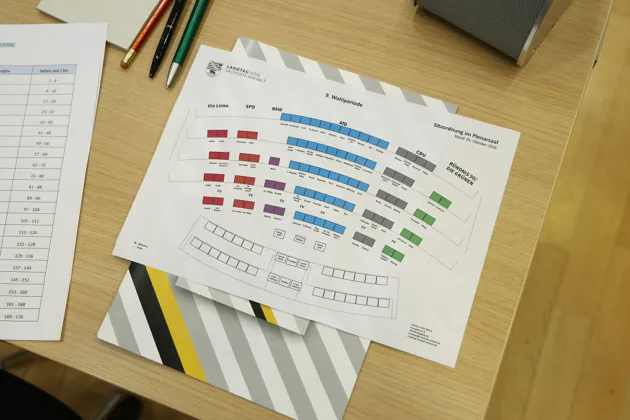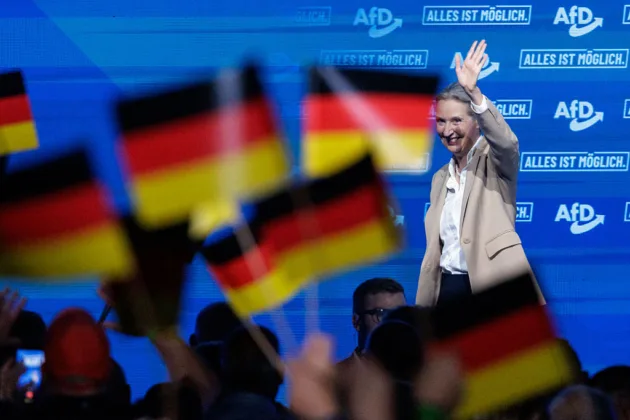










The Saxony-Anhalt elections on September 6, and the Alternative for Germany’s (AfD) crushing win with 43.8 per cent of the vote, brought forth many hot takes and much posting. Included in that deluge of posts was one from arguably the most famous poster in the world: American President Donald Trump. His commentary, though, was relatively straightforward. It contained no words, just a simple image of the election results in German.
Out of context, Trump posting the image is almost unfathomable. Saxony-Anhalt is the 11th-most populous state of Germany, out of 16. Proportionally, it would be the equivalent of German Chancellor Friedrich Merz posting the results of a Kansas gubernatorial election – virtually unimaginable. But the posting stemmed from the Trump administration’s interest in the AfD’s success, and Saxony-Anhalt was its biggest win, and the first chance for it to feasibly form a government.
Some sceptics, including some nominally and supposedly on the Right, have been perplexed by the administration’s support for the AfD, accusing it of being “anti-American”. The Wall Street Journal, writing days after the election, described the party as “anti-immigrant, anti-America, pro-Russia and pro-China”. This was a descriptor used by others as well, all of whom were befuddled.
This has been a consistent theme. Administration interaction with European nationalist parties has oftentimes garnered the response that the parties in question were anti-American – why would America therefore work with them?
The issue is that they are not anti-American. They are nationalists – which means they wish to make their own countries great again and to put their people first – and as such are fundamentally opposed to the liberal international order, for which America was the linchpin for decades.
This is an important distinction that many of the flabbergasted critics often overlook. The AfD is a new party, only formed at the beginning of the 2010s. At the time, the Obama administration was showing no real signs of seeking to alter the contours of the post-Cold War era. Then-president Barack Obama did nudge former German chancellor Angela Merkel to raise defence spending, and in 2016 did critique Europe as “complacent”, but that criticism came in the context of Trump’s first campaign and the impending Brexit vote.
But Obama was not alone. The 2012 presidential election saw Republicans nominate Mitt Romney, a Russia hawk who would have made no moves whatsoever to limit America’s presence in Europe and, if anything, would have increased it. Obama’s presidency, of course, followed George W. Bush’s, which expanded NATO into the former Eastern bloc and pushed Germany to promise Ukraine and Georgia future membership.
Essentially, the entirety of the American governing class was devoted towards extending the post-Cold War era as long as possible. There were no figures, absent smaller marginal actors, who were calling for a significant change.
President Trump of course changed all of this, redirecting the GOP towards demanding more of NATO. This resulted in the administration’s NATO 3.0 policy, which is being vigorously pursued by the Department of War.
But back in 2013, this was a long way off. The parties that emerged across Europe – many of whom are now knocking on the door of power – emerged as opposition to the governing liberal international order. They had no sign that in three years American politics would fundamentally change. As such, they ran against those who upheld the order – be it Merkel in Berlin, or the uniparty in Washington.
Those who argue that Washington should not support such parties are either misunderstanding why the parties were sceptical of the United States or are purposefully misinterpreting the situation so as to seek to weaken support for the AfD. This is likely because those individuals and organisations – including papers like the Wall Street Journal – are seeking to extend the post-Cold War era far past its expiry date, and would prefer America to remain as active in NATO as it was in the 1990s.
This is the same reasoning for the accusation of the party being “pro” Russia. President Trump has weathered similar accusations (the Russiagate hoax continued throughout his first presidency and even into the Biden interregnum), as have other nationalist parties. This is because a nationalist party is not going to be inherently anti-Russia. They will not necessarily be actively pro-Russia; they will simply act in their national interests. And it is perfectly reasonable for a German party to wish for a détente of sorts with Russia, instead of constantly poor relations. This is not to defend all of the AfD’s Russia outreach; it is simply to say that, just as President Trump’s desiring of positive relations with Russia did not make him pro-Russia, nor does the AfD’s.
By supporting groups like AfD, the Trump administration pursues a variety of goals. It weakens the parties that are desperate to keep the 1990s going forever. It weakens the liberal international order, which itself effectively consists of just a handful of Western European capitals. And it strengthens ideological allies abroad, normalising nationalism, which in turn makes it easier for the Trump administration to take action back home.
The question to ask, therefore, isn’t why the Trump administration would support the AfD. It’s: Why wouldn’t it?