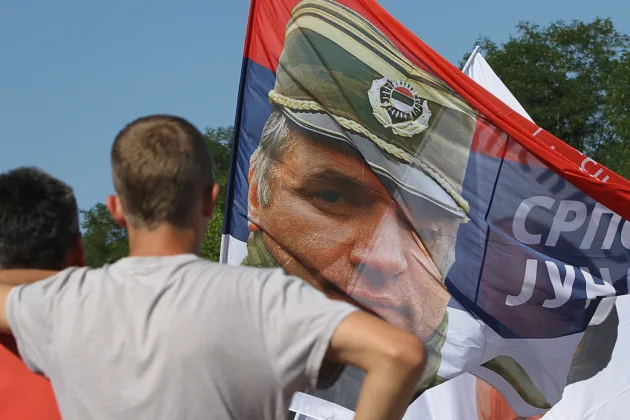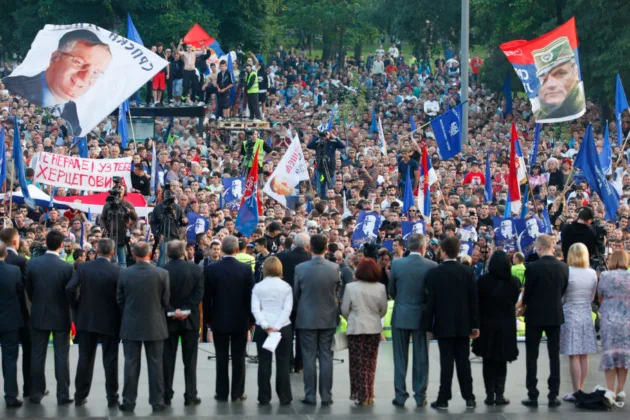


The European Union has said that any glorification of war criminals has no place in countries seeking to join the bloc, as former Bosnian Serb commander Ratko Mladić was buried in Belgrade on September 7.
In a statement released as mourners gathered in the Serbian capital, the European External Action Service (EEAS) said glorification, genocide denial and revisionism contradicted the most fundamental European values and had “no place in the EU or in EU candidate countries”.
The bloc’s diplomatic service said reconciliation and good neighbourly relations in the Western Balkans remained central to building a shared future. It described the armed conflicts of the 1990s as among the darkest moments in Europe’s recent history.
Mladić commanded the Bosnian Serb army during the 1992-95 war in Bosnia and Herzegovina. He was sentenced to life imprisonment in 2017 by the International Criminal Tribunal for the former Yugoslavia (ICTY) for genocide, crimes against humanity and war crimes.
His conviction covered the killing of more than 8,000 Bosniak men and boys at Srebrenica in July 1995 and the siege of Sarajevo, which lasted almost four years. He died on August 27 at the age of 84 in the United Nations detention unit in The Hague.
His body lay in state on Monday morning at the Church of St Luke in the Belgrade district of Vidikovac, where thousands queued to pay their respects. Serbian Patriarch Porfirije led the funeral service before the burial at Topčider cemetery, beside the grave of Mladić’s daughter Ana.
Organisers of the ceremony said an honour guard would escort the coffin to the graveside, followed by a gun salute. Serbia’s Justice Minister Nenad Vujić said after the death that the protocols applying to a general would be respected.
President Aleksandar Vučić later said the arrangements were a matter for the family. He did not attend, citing a state visit by his Uzbek counterpart.
Asked in Brussels whether the European Commission would take action against Serbia, its chief spokeswoman Paula Pinho said the EU position was clear and that any decision remained to be seen.
European Commissioner for Enlargement Marta Kos cancelled a planned visit to Serbia on September 4, saying the glorification around the death was “incompatible with the values on which the EU path is built”. Vučić dismissed her explanation as stupid.
Serbia has been an EU candidate since 2012, though accession talks have made little progress as Brussels presses Belgrade over media freedom, electoral conditions and the rule of law. Vučić has called early parliamentary elections for October.