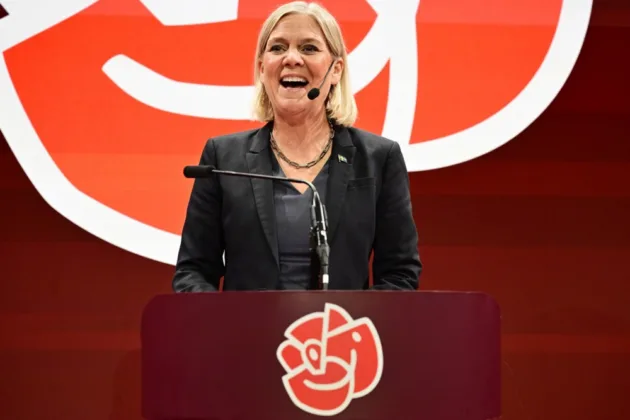












Sweden’s opposition bloc has taken a narrow lead in the count that followed the September 13 election, with the Sweden Democrats losing ground after four years of setting the Government’s immigration and crime policy from outside it. The result will be read as a verdict on the Tidö experiment. The more durable story is arithmetical, and it has little to do with voters changing their minds.
On the terms the outgoing government set itself, it delivered. Police recorded 158 shootings in 2025, the lowest figure since comparable records began in 2017 and down from 296 in 2024, with 39 in the first half of 2026 against 205 in the same period of 2022. The Swedish National Council for Crime Prevention (Brå) counted 84 cases of lethal violence in 2025, the fewest since 2012 and well below the 2020 peak of 124, though it noted that the Örebro school shooting of February 2025, which was not gang-related, accounted for nearly a quarter of that year’s firearm deaths.
That record did not protect the parties responsible. Previously unpublished figures from Novus’s August barometer put the Social Democrats on 61.6 per cent among respondents identifying as Muslim, the Left Party on 18.7 and the Greens on 4.9, or about 85 per cent between them. The three governing parties took 3.8 per cent combined, less than the Sweden Democrats’ 10.4. Muslims made up 2.6 per cent of the survey’s 5,617 respondents, so the subsample is small.
The wider pattern is the same. Statistics Sweden’s party sympathy survey for May 2026 put the three red-green parties on 44.9 per cent among people of Swedish background, against 46.3 per cent for the four Tidö parties, a tie within the margin of error. Among people of foreign background it put the red-greens on 65.1 per cent and the Tidö parties on 28.4 per cent, with the Social Democrats alone on 45.8.
More than one in six eligible voters was born outside Sweden going into this election, about 1.33 million of some 7.78 million resident citizens of voting age, and the category Statistics Sweden uses is wider again. Two electorates of that size pulling that far apart do not produce a national swing. They produce a country in which each bloc’s ceiling is set as much by demography as by campaigning.
Brakes apply, and the researchers closest to the data insist on them. Henrik Ekengren Oscarsson, professor of political science at the University of Gothenburg, attributes the left-wing lean mainly to class and socio-economic position rather than to religion, and dismisses the suggestion that the Social Democrats have courted immigration for electoral gain, pointing out that turnout among the non-European-born is low and that the group divides roughly two-thirds to one-third between the blocs in his own programme’s measurements. About 89 per cent of the native-born voted in 2022 against 67 per cent of the foreign-born. Sweden Democrat support among foreign-born respondents has held at about 12 per cent since 2022. He also expects convergence as groups settle and age.
Set against that is the direction of travel. The University of Gothenburg’s own 2021 study put the Social Democrats on 58.7 per cent among self-identified Muslims and the Left Party on 8.3. On the Novus figures the gap has widened, not closed, and foreign policy is part of why: at the 2024 European elections the Left Party reached 20 per cent among voters of non-European background after campaigning on Gaza.
The pattern is not confined to Sweden. Ifop put 69 per cent of Muslim voters in France behind Jean-Luc Mélenchon in the first round of the 2022 presidential election and 62 per cent behind La France Insoumise at the 2024 European elections. In Brussels, Team Fouad Ahidar took 14.63 per cent in Molenbeek at the municipal elections of October 2024, less than a year after it was founded. Labour lost five safe British seats to independents standing on Gaza in July 2024.
What gives the divide its weight is the ledger beneath it. Joakim Ruist of the University of Gothenburg put the net fiscal redistribution to Sweden’s refugee population and their families at 1 per cent of GDP in 2007, rising to about 1.35 per cent by 2015, four-fifths of it from lower revenues per head rather than higher spending. Employment decides that: in January 2026 unemployment stood at 12.2 per cent among the foreign-born and 3.6 per cent among the Swedish-born. Jan Ekberg found the average immigrant to be a net contributor until the mid-1980s, when labour migration dominated the inflow, and a net recipient thereafter, as refugee and family migration took over.
Which is where both blocs are stuck. If the Swedish-born second generation reaches employment rates near the native average, Ekengren Oscarsson’s convergence follows and the divide loses its edge. If it does not, Sweden will keep holding elections on a question its labour market has already answered.