The local community in the south-eastern Polish town of Jarosław has been left in shock after a Ukrainian man went on a knife rampage at a Benedictine abbey, killing one priest and injuring four other people.
Police have detained a 31-year-old Ukrainian, identified by prosecutors as Ihor M., responsible for the attack of September 24 and have not thus far revealed any motive for the brutal attack.
After they arrived at the scene of the morning attack they found four men, three of whom were priests, and one woman suffering from knife wounds.
All five were taken to hospital with one of the priests, Father Stanisław Zbojnowicz, later dying of his injuries. On September 25, prosecutors said the four surviving victims were in a stable condition and their lives were not in danger.
The Ukrainian man was detained at the scene of the crime and the knife secured. Prosecutors later briefed reporters that he had arrived in Poland from Germany overnight and had headed for the Korczowa crossing on the Polish-Ukrainian border, just 30 kilometres from the site of the attack, but did not cross it.
“Preliminary findings indicate that a dozen or so minutes earlier, he stabbed four men and a woman. All of the victims were taken to hospital, including three men with serious injuries,” local police said in a statement.
Prosecutors said that doctors would assess the suspect’s condition before he was interrogated. Blood samples were also taken to be tested for the presence of narcotics and alcohol. A breathalyser test proved negative, they added.
Prosecutors have since drafted charges of murder, attempted murder and causing grievous bodily harm, for which the suspect faces life imprisonment. They have not yet been formally presented to him as he remains in hospital.
The attack took place at a retreat centre within the 17th-century abbey complex. According to a nun interviewed by the media, the man entered the abbey through an open gate after a group of young people had left and then attacked people at random.
The superior of the Benedictine sisters, Barbara Dendor, told Polish news website Wirtualna Polska: “The man who barged in with a knife simply started killing.
“It was a random man. We don’t know him. He looked like a madman, in shorts and a short-sleeved shirt, even though it was cold today,” she added.
No children visiting the abbey or attending a kindergarten on the grounds of the complex were injured.
Dendor also told news website Interia that the priest who was killed had been in a confessional when the attack began. He rushed out to attempt to close the gates and protect other people, but was stabbed by the assailant before he could do so.
Wirtualna Polska reported that the Ukrainian who carried out the attack had earlier in the day knocked on the abbey’s gates and asked for money but was turned away on suspicion of being drunk and under the influence of drugs and told to return later.
According to unnamed witnesses the man “flew into a rage when he didn’t get help and allegedly threatened priests”.
Local authorities informed schools, public offices and parishes about the incident and advised them to pay particular attention to people entering their buildings. They also set up a crisis management team to handle the aftermath of the incident. The town has declared a period of mourning until the end of the week.
Polish President Karol Nawrocki expressed his condolences and called on the authorities to “quickly and thoroughly clarify all the circumstances of this tragedy”.
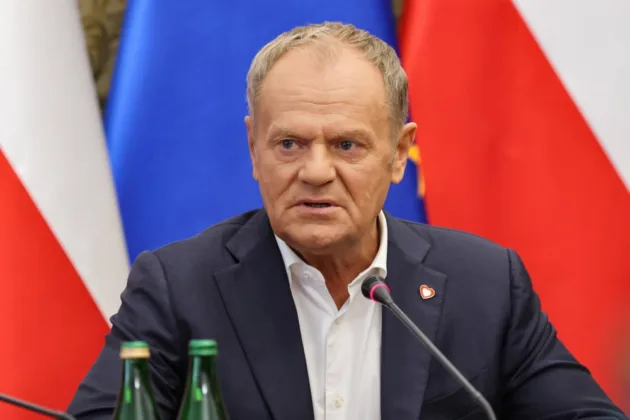
Prime Minister Donald Tusk expressed his sympathy for the loved ones of the victims of the attack and pledged that the perpetrator “will be punished with the full severity of Polish law”.
Ukrainian President Volodymyr Zelensky has expressed his horror at the knife attack and in condolences expressed in a social media post published in Polish he wrote “We are shocked by this evil”, adding that “the perpetrator of this evil must bear the full responsibility in accordance with applicable law”.
Earlier, the Ukrainian embassy in Warsaw had “condemned the brutal attack” in Jarosław but appealed for people “not to allow pain to turn into hatred or further violence”, saying that “accountability for the crime must be based solely on the law”.
Their reaction was likely influenced by fears of Ukrainian organisations operating in Poland. One of them, the Folkowisko foundation, has claimed that the tragedy is already being exploited on social media. Marcin Piotrowski, a member of its board, told the daily Rzeczpospolita: “We are almost on the verge of a lynch-mob mood.”
This fear was echoed by the Polish Catholic Church. Primate of Poland Archbishop Wojciech Polak urged the faithful not to let “the criminal act of a specific man give rise to hatred in our hearts”.
Polish-Ukrainian relations have deteriorated of late amid resentment of allegedly preferential treatment of Ukrainian refugees to that available to the Polish population. There is also resentment about Zelensky and the Ukrainian authorities continuing to refuse to recognise the Second World War massacre of some 100,000 Polish civilians in Volhynia and eastern Galicia as genocide. The Ukrainians celebrate the nationalist movement, the Organisation of Ukrainian Nationalists (OUN), and its military wing, the Ukrainian Insurgent Army (UPA), who were behind the ethnic cleansing, as heroes.
The increased reporting of criminal gangs from Ukraine operating in Poland and continuing questioning why a considerable number of young Ukrainian men have been allowed to live in Poland in order to avoid the draft into the Ukrainian army, which is fighting against the Russian invasion which began in 2022, has also impacted on the social mood.
It is also a fact that individuals who are Ukrainian citizens have in several cases been cited as perpetrators of allegedly Russian-inspired and funded acts of sabotage such as arson or attempts to damage infrastructure.
There has of late been a rise in reported incidents of harassment and violence by Poles against Ukrainians but also instances of Ukrainians attacking Poles.
The tragedy that led to the death of the Polish priest, though, is the first instance of a physical attack on the Polish Catholic Church by a Ukrainian.
Attacks on the Catholic Church have been increasing in Poland as a whole, but have been perpetrated by Poles, often as a result of ideological hostility to the institution. These intensified after the Church was blamed by women’s rights and left-wing activists for being behind the 2020 Constitutional Tribunal ruling that tightened restrictions on abortion.
During communist times several priests who were linked to the opponents of the regime were murdered or died in unexplained circumstances.
The most famous instance was the murder of Solidarity’s chaplain Father Jerzy Popiełuszko in 1984 by officers from the communist secret police. The perpetrators were convicted of the crime soon after with the authorities claiming that the individuals concerned had taken the action without any authorisation. Several other instances involving less well-known priests, though, were never solved.
After the collapse of communism and return to democracy and independence, relations between state and church became close with Poland signing a Concordat with the Vatican during the reign of the Polish Pope, Saint John Paul II. That Concordat allowed for church weddings to have civil effect, for Catholic catechism to be taught in schools and for the protection of Church property rights and welfare rights of priests.
The Polish Catholic Church’s stance on axiomatic issues such as abortion and same-sex marriage, though, has led to political conflict between the Church and the liberal Left. The Church was successful in restricting legal abortion rights, and the Polish Constitution defines marriage exclusively as a union of man and woman.
That conflict has led to calls for defunding the Catholic Church, the taxing of the Church’s fundraising efforts and for Poland to withdraw from its Concordat agreement with the Vatican.
Church attendances have fallen in Poland, especially during the time of the pandemic, and never returned to previous levels. According to the Institute for Catholic Church Statistics (ISKK), the share of Catholics attending Sunday Mass fell from 36.9 per cent in 2019 to 28.3 per cent in 2021. The secularisation of Polish society is a trend familiar to virtually all affluent western societies.
In the case of the Catholic Church it may have also been accelerated by reports of sexual abuse of minors by priests and the lack of reaction to it within the institution, reminiscent of similar controversies in Ireland and North America where the Church was severely affected by such revelations.
In addition, some clergy in Poland have been reported to enjoy lavish lifestyles, some to have broken their vows of chastity and some to have been informers of the former Polish communist security police but whose identity was protected by the state.
The Church has, naturally enough given its views on abortion and same-sex marriage, been supportive of conservative politicians, especially those from the former ruling Law and Justice (PiS) party. It is less close to Confederation (Konfederacja), which draws its support from the more secular young, and is wary of the radical nature of the pro-Catholic nationalist Confederation of the Polish Crown party led by MEP Grzegorz Braun.
The tragic death of a priest at the hands of the Ukrainian assailant is likely to increase calls for more to be done on protecting places of worship as potential targets for terrorist attacks and hate crimes.
Such calls may not be altogether welcome to the present centre-left government led by Tusk, which has been manoeuvring for the cooling of relations between church and state in order to appeal to the secular electorate, parts of which have become hostile to the Polish Catholic Church.