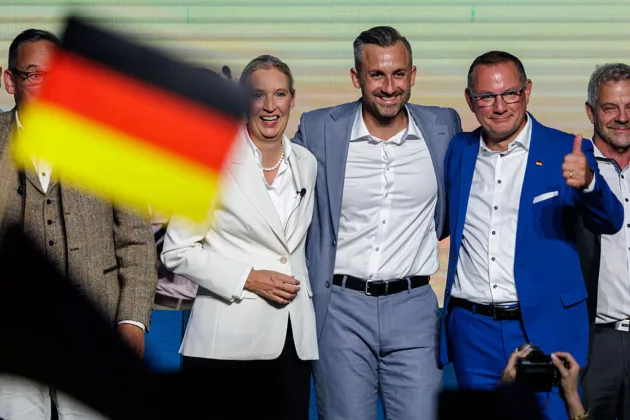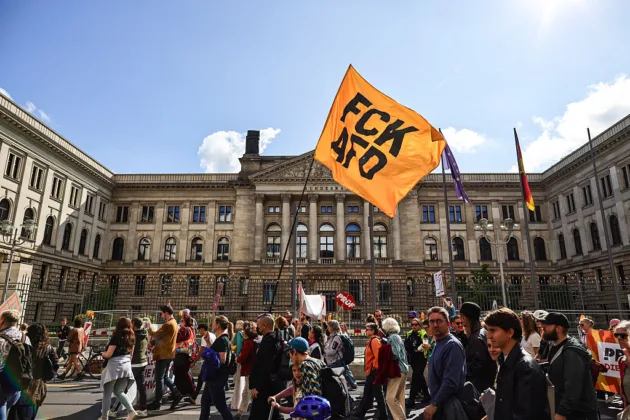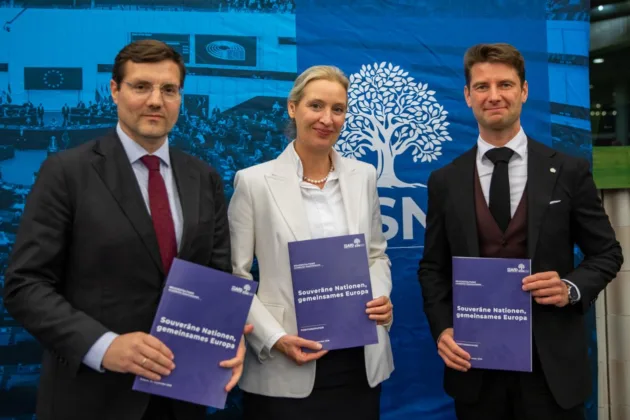



The AfD’s stunning victory in Saxony-Anhalt, eastern Germany, where it took 43.8 per cent of the vote on September 6, has sent a jolt of fear through the EU. A previously fringe party succeeded by challenging the pet orthodoxies peddled by the ruling clique in Brussels: Open-ended support for Ukraine, an embrace of migrants as useful labour and the ongoing centralisation of power in the European Commission. The EU saw off similar heresies in Hungary and Poland with legalisms and threats to withhold desperately needed cash. But this is Germany, the largest net payer into EU coffers and thus largely invulnerable to political ransom notes from Brussels. The rise of the AfD there is a possible prelude to the quaking nightmare of Euro-federalists, a President Le Pen taking office in 2027.
Not very many years ago, the guardians of the great European project anticipated that member states would be eclipsed by the immense majesty and greater administrative competence of the EU. Polite expressions of national affinity might emerge during the World Cup or the Eurovision Song Contest, but never again would European states wield the fully sovereign powers that had dragged the continent into two cataclysmic wars. National pride and a preference for one’s native tongue and countrymen would be displaced by a generic pan-European loyalty, instilled with the help of generous EU grants and clever marketing campaigns. This new Europe would marshal the collective resources of its members and take its place among the world’s other great powers.
Sadly for those anticipating the demise of the European nation state, the old monster is back, and in rude health. Centrist parties that placed loyalty to Brussels on par with allegiance to their countrymen have witnessed steep declines in popularity. The old duopolies of centre right and centre left that dominated the politics of the great European states for decades are in terminal decline, beset by rising populists to their left and right. The AfD won in Saxony-Anhalt with a calculated assault on the shibboleths espoused by the German establishment: Immigration is good, multiculturalism is better, more Europe is best, but patriotism is proximate to fascism. It took 39 of the 83 seats in the Magdeburg Landtag, three short of an absolute majority. France faces the real prospect in April 2027 of a presidential run-off between right-populist Marine Le Pen and left-populist Jean-Luc Mélenchon. Polling by Toluna Harris Interactive on September 8-10 put Le Pen on 33 to 36 per cent in the first round, with Mélenchon reaching the run-off in most scenarios tested. They agree on little but their desire to repatriate power and money from Brussels and restore the sovereign right of France to act without deference to the budget harridans in Brussels.
The deeper fear in Brussels is that the AfD is the harbinger of populist movements demanding their governments give their citizens priority over recent arrivals, Ukrainians, and the financial pleas of the Commission. Voters drifting away from the centre are dismayed by the failure of the old mass parties to restore prosperity and manage migration, but also question the use of their taxes for projects of little immediate benefit to them. Common wage earners may not be persuaded by arcane appeals to European solidarity, but they can do basic arithmetic. Some €220 billion in aid to Ukraine, the figure the Commission puts on EU and member state support since 2022, on top of comparable amounts spent on migrants and foreign aid are monies unavailable for their pensions, health care and social assistance. They see their economies and salaries stagnating while their governments contemplate reductions in their benefits. Austerity at home so that EU grandees can indulge in moral hauteur abroad suggests that these commoners are the losers in a zero-sum budget contest. Le Pen and Mélenchon ask whether Paris should remit vast sums to be filtered through the designs of an overstaffed and overcompensated army of Eurocrats, before a mere fraction is returned to France.
Why not simply keep the money at home? Because retaining national contributions would kill the European project dead as beef. The EU still has no independent taxing authority and depends on cash subventions from its members, meaning adverse votes in member states pose a direct threat to the EU finances. Should a Le Pen precedent induce other net contributors to claw back substantial funds, Euro-federalism fails when the cheques begin to bounce.
Le Pen would dearly love to see the EU reduced to a common market governed by its member states, with none of the aspirations to sovereign power that so vexed Charles de Gaulle. Mélenchon would go a step further with his call to solve France’s dire national debt problem by abrogating those debts held by the European Central Bank, “setting them on fire”, a pledge he repeated at his campaign launch in Lille on September 5, which would to his mind have the equally salutary effect of collapsing the common currency. A revived, weak franc would ensure cost competitiveness for French industry, while wiping out old debts would free funds now devoted to onerous interest payments on French bonds. That this plan would be economically catastrophic doesn’t necessarily preclude its appeal to French voters accustomed to state largesse and fearful of neoliberal plots against their pensions.
The biggest net contributor has always been Germany, but even here a crippled Bundeskanzler fights to keep more of his money at home. Friedrich Merz demands cuts of “several hundred billion euros” from the €2 trillion EU budget for 2028-2034 mooted by the Commission, a demand he restated on September 9 alongside European Council President António Costa. He is facing a looming pension crisis, and has already limited new debt spending to infrastructure and rearmament. The proposed 60 per cent increase in EU outlays, which he calls “simply unaffordable”, would reduce funds he needs at home: Subsidies to offset high energy costs, modernisation of his analog economy, retraining workers suffering the onslaught of Chinese imports, reversing the decline in German educational standards. Germany can no longer afford to treat the EU as a charitable endeavour that bought her post-war redemption, and younger Germans see no need to.
After the dire result in Saxony-Anhalt, where his CDU fell to a record low of 17.2 per cent, Merz has his political back to the wall. The billions devoted to Ukraine, migrant support and lunatic environmental policies are unavailable to maintain Germany’s lavish social welfare system. Voters long accustomed to state munificence fear a fiscal cold shower that will sacrifice their benefits for the pet projects of the political elites. And so they voted for the party most likely to torment those elites.
The AfD’s benign attitude toward Russia causes great dismay among those struggling to preserve European support for Kyiv, not least because the party offers it as part of a persuasive appeal to German industrial workers. If Germany is to revive its high-wage export economy, it needs cheap energy. This means gas piped from Russia on long-term contracts, insulated from the wild swings in the spot market for liquefied natural gas. Money currently devoted to arming Ukraine, reequipping the Bundeswehr and importing gas from Texas could more usefully serve to recapitalize German factories and support the research and development needed to compete with China and the United States. Russia could again be the natural market for German manufactures and machine tools. Try explaining to a Magdeburg machinist made redundant because of high energy costs why the liberation of Donetsk is more important than his working career. Euro-elites regard all this as a treasonous assault on their righteous support for Kyiv, but fail to understand the dire impact of their policies on the industrial substrate of European prosperity. This ignorance puts at risk their grandest foreign policy achievement, the defence of Ukraine.
The coming renationalisation of Europe reveals a hidden class struggle at the heart of the European project. Not between owners and proles, but between those protected from bad policies and those harmed by them. European integration was always an elite program, vesting power in a cadre of unelected administrators charged with the creation of a governing apparatus above national governments. The decisions of these experts would be invariably superior to those made after tawdry bargaining in national parliaments. The evidence suggests this was a bad bet. A poorly constructed common currency led to massive taxpayer bailouts. The Schengen Agreement allowed millions of migrants to go shopping across Europe for the best benefits and easiest asylum policies. Covid vaccine procurement was a Brussels-led shambles.
The EU immunised itself from these serial failures by inculcating a loyalty among party functionaries, civil servants, and NGO activists that came at the expense of their domestic constituents. The prospect of a fat EU grant or a cozy sinecure in Brussels was far more appealing than being hectored in yet another contentious town hall meeting. While none of these luminaries ever lost a paycheck due to misconceived EU policies, their less fortunate countrymen have suffered the high energy costs of the net-zero campaign, irregular migration that brought violent crime to once safe streets, and onerous regulatory structures that stifle business formation and divert company funds from wages to compliance. The emergence of the AfD is nothing less than a bellow of discontent from the unprotected, a demand that their government give them precedence over the rarefied designs of the Euro-elites. Cutting the EU’s budget is just the first battle in a war to renationalize Europe. A true European union recedes into distant fantasy.