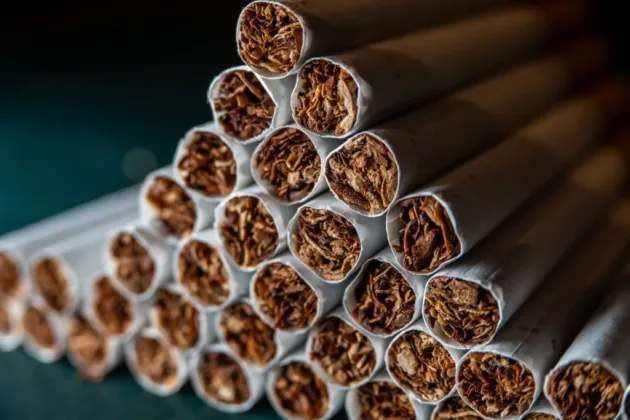





Just 25km from Brussels, an apparently ordinary industrial warehouse was producing up to 1.3 million counterfeit cigarettes a day.
While the European institutions tighten taxes and regulations on legal companies in the sector, a parallel industry is manufacturing tobacco illegally within the single market itself.
The factory was located in Ninove, East Flanders, a town with direct connections to Brussels. When 62 officers, 45 of them from customs, entered the building on September 9, they found industrial machinery, tobacco, filters and counterfeit packs of Marlboro, Prince and Richmond.
Eleven workers, four Poles and seven Ukrainians, were arrested. Some of them were living inside the premises.
It was not the first time something like this had happened. It was the 12th illegal factory dismantled by Belgian customs this year, already matching the previous annual record, set in 2024.
The pattern matters because Brussels is simultaneously strengthening its policy against legal tobacco. In 2025, the Commission proposed a revision of the Tobacco Taxation Directive to raise minimum rates, extend taxation to e-cigarettes, heated tobacco and nicotine pouches, and subject raw tobacco to tighter controls. Its stated objective is to help reduce tobacco use among Europeans to below 5 per cent by 2040.
Neither member states nor the European Parliament has backed the plan. It needs unanimity in the Council, which has yet to reach a general approach, and the Parliament rejected it on June 17 by 439 votes to 181, calling on the Commission to withdraw it in its entirety.
Regardless of whether that objective is considered justified, the problem is that there is another tobacco industry on which those rules have a very different effect: The one that does not comply with them. And, as is usually the case, when the rules do not apply equally to everyone, the game is rigged.
According to the European Court of Auditors (ECA), almost one in ten cigarettes on the European market is either produced illegally or smuggled into the bloc. The resulting loss in tax revenue amounts to around €13 billion a year, a Commission estimate the auditors caution is not backed by independent EU data.
More importantly, auditors concluded in a special report on September 8 that the European response remains fragmented, cooperation between member states is uneven, and the EU strategy lacks sufficiently clear priorities and an adequate assessment of its results.
“The EU cannot afford to let its fight against the scourge of illicit tobacco go up in smoke,” said ECA member Petri Sarvamaa, who led the audit.
The Commission itself also acknowledges that a substantial share of illicit tobacco is now manufactured within the European Union. Europe has gone from importing counterfeit tobacco to producing it under the very authorities that aim to eliminate consumption.
The greater the cost difference between the two markets, the greater the potential profit margin available to criminal networks. The ECA itself identifies differences in taxation and prices as factors that create opportunities for illicit trade. A pack of cigarettes in Belgium costs between €11 and €13, depending on the brand, while an illegal pack sells for about €4.
That does not mean taxation is the sole cause of the black market, nor that raising taxes automatically turns consumers into buyers of illegal products. It does mean that any policy that makes the legal market more expensive requires an equivalent capacity to control the illicit one. And on that front, the results are far less convincing.
Belgium provides a particularly clear example. Its position as a logistics hub, close to high-tax markets such as France and the United Kingdom, has made it an attractive centre for these networks.
Belgian customs administrator-general Kristian Vanderwaeren acknowledges that the business offers substantial profits while carrying comparatively lower criminal penalties than drug trafficking.