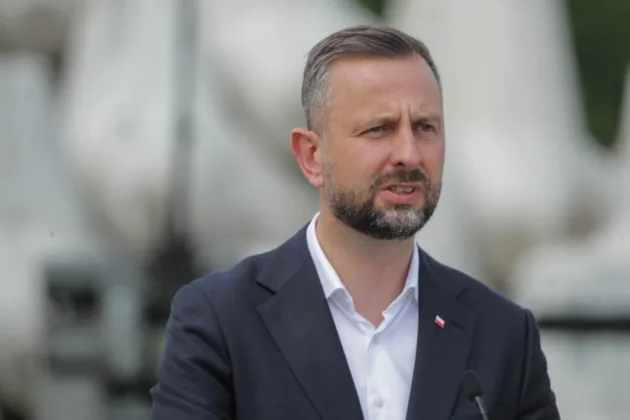




Polish President Karol Nawrocki has used the UN General Assembly to make an unfashionable argument: that falling birth rates are a cultural problem as well as an economic one.
In 1968, Paul and Anne Ehrlich’s The Population Bomb warned that hundreds of millions would starve as population growth outstripped food production. For decades, the fear of too many people shaped international population policy. At the UN’s International Conference on Population and Development in Cairo in 1994, the UN formally moved away from demographic targets and adopted a new language of “reproductive health” and “reproductive rights”. The fear faded; the vocabulary did not.
On September 23, Nawrocki took the podium at the General Assembly and set out the opposite problem. “Ageing societies, falling fertility and the erosion of social bonds are weakening the foundations of our states,” he said. Then came the line that made headlines in Warsaw: “Let us do everything, ladies and gentlemen, so that culture and the media promote births rather than abortions.”
The population bomb, it turns out, is ticking in the other direction.
It would be tempting to call this a first. It would also be wrong. On September 24, 2019, Donald Trump told the same General Assembly that “Americans will also never tire of defending innocent life”. He accused “many United Nations projects” of trying “to assert a global right to taxpayer-funded abortion on demand, right up until the moment of delivery”, and declared that “every child – born and unborn – is a sacred gift from God”.
The dispute predates Trump. At Cairo itself, the Holy See lodged a formal reservation against any reading of “reproductive rights” that included abortion. The Cairo programme did not create a right to abortion: it said abortion should “in no case” be promoted as a method of family planning and left abortion law to national governments. On September 24, 2025, in his first address to the General Assembly, Nawrocki himself spoke at the UN of “the right to life of the defenceless, from conception to natural death”.
Nor is this merely a theological dispute. On December 17, 2025, the European Parliament voted 358 to 202, with 79 abstentions, for a voluntary mechanism to fund access to legal abortion, as sought by the “My Voice, My Choice” citizens’ initiative. On February 26, 2026, the European Commission declined to create one, but confirmed that member states could use the European Social Fund Plus (ESF+) for the purpose, including, according to Equality Commissioner Hadja Lahbib, to help women who need to travel. The ESF+, worth €142.7 billion over the 2021-2027 budget period, is funded from the EU budget, to which Poland contributes. Trump’s complaint about taxpayer-funded abortion is no longer abstract in Europe.
Trump’s argument was, at heart, about sovereignty: international bodies should keep out of matters that nations decide for themselves. His point was defensive.
Nawrocki made a different case. His remark about abortion came in the middle of a broader demographic argument. The family, he said, deserves “protection and appreciation”; parenthood must regain its social standing; and “the family, the mother and the father, and recognition of their role, are the starting point for overcoming the demographic crisis”. Then came migration: “Illegal migration cannot be the answer to demographic challenges. It brings misery, tension and anxiety. That is not the way forward.”
Taken together, the point was clear: family, parenthood and births were part of the answer to demographic decline; illegal migration was not. Pro-life arguments are hardly new at the UN. What is less common is a head of state placing abortion so explicitly within a demographic argument during the general debate.
He did not call for tighter abortion laws. His subject was culture and the media, not legislation. And he said “illegal” migration, twice. Poland still hosts roughly a million Ukrainians who fled the war; it can hardly be said to reject refugees as such.
Why would a Polish president, speaking on the same day as Volodymyr Zelensky, Masoud Pezeshkian and Ahmad al-Sharaa, devote part of his limited time to babies? Because the numbers at home make the subject difficult to avoid.
Poland recorded roughly 402,000 births in 2017. In 2025, it recorded 238,300, 5.4 per cent fewer than in 2024 and a fall of about 41 per cent in eight years. This happened despite a large child-benefit scheme introduced in 2016, made universal in 2019 and raised to 800 złoty (€183) a month for each child in 2024. The total fertility rate in 2025 was 1.068, down from 1.099 the year before. Replacement level is about 2.1.
This is the quieter side of Poland’s economic rise. The country has been catching up with western Europe and is building one of the continent’s largest land forces, while births continue to fall. Security can be bought with tanks and howitzers. A new generation cannot.
For a quarter of a century, European and UN policymakers have treated immigration as one tool for cushioning the effects of population decline and labour shortages. In 2000, the UN Population Division devoted a report to the question: Replacement Migration: Is It a Solution to Declining and Ageing Populations? The UN stressed that this was scenario modelling, not a “demographic recipe”. Even so, “replacement migration” entered the policy vocabulary. The European Commission’s demography toolbox now lists legal migration alongside family policy, housing and measures to bring more people into work.
The political appeal is easy to see. Labour migration can change the size of the workforce within a single parliamentary term. A child born this year will not enter the workforce for roughly two decades. The next election may be four years away.
Nawrocki’s speech pushed against that logic. Can a nation be run as a labour market with a flag? Does a country facing chronically low fertility solve the problem with immigration, or merely defer part of it? He also suggested that the UN “can be an organisation in which we work together to find ways of gradually overcoming the demographic crisis”, an unusual sentence to hear in an institution whose population work was long dominated by fears of rapid growth.
The Ehrlichs’ bomb did not go off as advertised. There were famines in Bangladesh, Cambodia and Ethiopia, but not the global catastrophe of food production failing to keep pace with population growth. Food supply per head rose.
The new demographic anxiety is quieter: fewer children, smaller classrooms, villages with a church and no christenings. Poland knows it well. More than half of the world’s countries and territories now have fertility below replacement level.
Europe has no shortage of policies for managing the consequences of low fertility. The harder question is what, if anything, would persuade its citizens to have more children.
In 1968, the Ehrlichs feared the cradle would overflow. They were wrong about the direction. Demography, inconveniently, still matters.