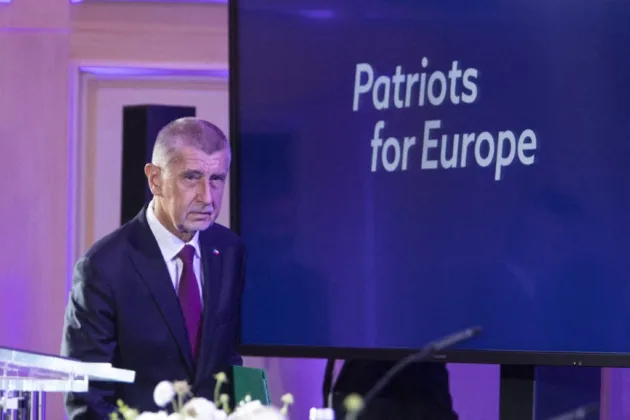




Patriots.eu, the European political party connected to the similarly named group, is fighting the European Parliament in court over withholding of funds and is accusing Brussels of blatant double standards and politicised decision making in offering of grants.
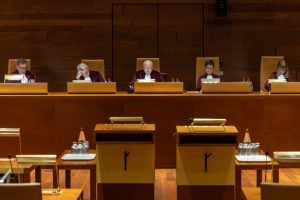
On Tuesday, judges at the Court of Justice of the European Union (CJEU) held hearings on a high-stakes financing dispute involving a controversial billboard and poster campaign in Czechia.
At the heart of the legal battle is a €228,776.71 repayment order issued by the European Parliament’s Bureau.
The case, originally rooted in actions taken by the former Identity and Democracy (ID) faction, has been inherited by its political successor, the Patriots.eu party.
The Parliament asserts that public EU party allocations were improperly redirected into domestic political advertising targeting the EU’s Green Deal, explicitly benefiting localised political entities rather than pan-European initiatives.
This is being rejected by the Patriots, who note that the Green Deal is an obvious EU related policy and that the logo of their European fraction was clearly visible on the advertising.
According to the EU Parliament, the logo was too small to see and some billboards also featured national politicians, which, they claim, would be in breach with EU regulations.
It claims that there is insufficient distinction between a national campaign and the European one, since it featured a local politician.
The Patriots highlighted other campaigns from left-leaning parties that proved their campaign was well within the bounds of what is custom, and that others were held to the same standards, they would need to be fined as well, if not more.
The party has pointed in particular to the 2024 “Renew Europe Now” campaign, run by the Alliance of Liberals and Democrats for Europe (ALDE) and the European Democratic Party (EDP).
According to the Patriots, its branding closely resembled both the Renew Europe group in Parliament and the French association Renew Europe France, potentially raising the same question of whether European-level funds were being used to support a campaign with a national political dimension.
The Patriots have argued that, if their Czech campaign is considered indirect financing of a national party, the same standard should apply to Renew Europe Now.
The dispute has also raised questions about how the Parliament handled the Patriots’ attempts to present these comparisons.
A letter from the party’s financial adviser challenging the non-reimbursement of more than €250,000 reportedly contained arguments about comparable cases involving other political parties.
The Patriots say crucial parts of the correspondence were redacted before it reached the Bureau, limiting the extent to which its claims of unequal treatment could be considered.
They further say that a request for a meeting with the Bureau was rejected, although the Parliament attributed this to scheduling and availability issues.
The optics inside the Luxembourg courtroom underscored the highly charged nature of the proceedings.
The European Parliament deployed a large presence, with a delegation consisting of 12 representatives commanding the institutional side of the chamber. Two female lawyers and 10 EP administrators.
Despite their numerical dominance, the parliamentary delegation remained notably tight-lipped.
Following the session, representatives from the European Parliament side declined to comment or react to specific arguments raised during the proceedings, maintaining strict silence outside the courtroom.
Opposing them were just one lawyer and one administrator for the Patriots.eu European political party.
In court, they described the European Parliament’s decision-making process in this matter as arbitrary, claiming that the initial penalisation lacks structural neutrality.
After the hearing, they did talk with Brussels Signal in Luxembourg, noting that the Parliament’s actions argue that the enforcement mechanisms governing party spending contain a troubling degree of randomness.
They contend that the strict interpretation applied to the anti-Green Deal posters in Czechia reflects political whimsy rather than objective administrative oversight, noting that mainstream Europhile factions rarely face similar retroactive crackdowns for domestic public-awareness campaigns.
The European Parliament maintains that its Directorate-General for Finance acts purely on financial compliance, pointing to broader investigations into right-wing party expenditures as evidence of a necessary protection of taxpayer funds.
Some factions have continuously called for stringent penalties and recoveries on any expenditures deemed outside explicit EU parliamentary guidelines.
However, the General Court’s willingness to previously review and annul procedural elements of these fines suggests that Brussels’ administrative machinery is not entirely immune to judicial correction.
Just a year prior to the current hearings, the EU General Court explicitly overturned a major institutional penalty targeted at the same Patriots.eu European political party.
The Authority for European Political Parties and European Political Foundations (APPF) had fined the party with almost €50,000 for allegedly “intentionally providing incorrect information”.
According to the Patriots, they are being systematically targeted by the administration of the European Parliament, for political reasons.
As the judges in Luxembourg deliberate on this latest chapter, the verdict will likely set a precedent for how European political parties can deploy their budgets across member states ahead of a shifting political landscape.
The European Parliament has voted to ask the independent Authority for European Political Parties and European Political Foundations (APPF) to verify whether the Europe of Sovereign Nations (ESN) party complies with the EU’s core values required for registration and funding.…
— Brussels Signal (@brusselssignal) July 7, 2026