The European Commission has told Brussels Signal it is aware of a new study showing that Syria’s post-Assad national school curriculum promotes jihad, martyrdom and anti-Semitic stereotypes, and said it would continue to raise the issue with the transitional authorities.
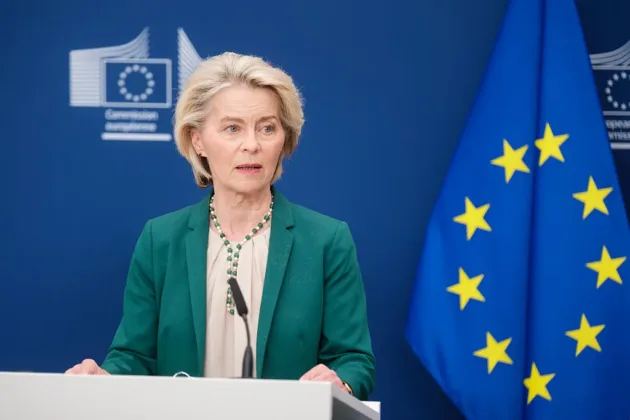
A Commission spokesperson told Brussels Signal that the EU remains “in regular contact with the Syrian transitional authorities and with international partners on issues related to the transition, including respect for inclusiveness and fundamental rights and will continue to raise concerns where appropriate”.
The spokesperson added that education “has a central role” in building a “resilient, genuinely inclusive, open and pluralistic society”, and that “school curricula should promote tolerance, coexistence, critical thinking and respect for all communities”.
Non-humanitarian EU assistance, the spokesperson said, is subject to “strict implementation parameters and extensive monitoring”. The Commission did not say whether the findings would have any bearing on that support.
The statement follows the publication on October 19 of a report by the Institute for Monitoring Peace and Cultural Tolerance in School Education (IMPACT-se), an Israel-based body that reviews schoolbooks against UNESCO standards.
The study examined 130 textbooks for grades one to 12, used in the 2025-2026 school year under President Ahmed al-Sharaa and compared them with Assad-era materials published between 2011 and 2023. The same books have been kept for the current 2026-2027 school year, the report said.
It found a clear shift from the previous pan-Arab nationalist framework to an Islamist worldview.
Syria’s new post-Assad textbooks reframe the Great Arab Revolt of 1916-1918, no longer presenting it as a popular liberation struggle against Ottoman occupation but instead as a mere “rebellion” aimed at breaking away from the Ottoman state, while softening references from “Ottoman occupation” to “Ottoman rule” in line with warmer ties to Turkey.
According to the report, textbooks for primary-school pupils now frame jihad and martyrdom in religious terms.
Rather than framing Syria’s claim to the Golan Heights as merely a matter of national sovereignty, the textbooks depict the territory, captured by Israel in 1967 and annexed in 1981, as part of a wider fight over “occupied Muslim lands”.
A Grade 4 Islamic Education text teaches that “the believer draws closer to God Almighty through righteous deeds, foremost among them jihad and resistance”.
A Grade 8 Arabic Language textbook states that “the heroes asked Allah for martyrdom… They gave their souls, watered its soil with pure blood”.
Sacrifice once described as defence of “the homeland” is now described as sacrifice “for the sake of Allah”.
Jews are repeatedly associated with betrayal, hostility and dishonesty.
One Grade 6 lesson states that “treason and backstabbing are among the traits of the Jews”.
Syrian Jewish history is omitted.
Israel is routinely labelled the “Zionist entity”, “enemy” or “thieving”, and appears on maps as “Palestine”.
Palestinian violence, including attacks on civilians, is presented as legitimate resistance and martyrdom.
Figures such as Dalal al-Mughrabi, who led the 1978 Coastal Road massacre near Tel Aviv that killed 38 Israelis, including 13 children, appear in positive terms.
The curriculum also reduces content on minorities including Kurds, Druze and Turkmen, diminishes the public role of women and removes or alters scientific material on evolution and the Big Bang, replacing naturalistic explanations with references to divine will.
The revised curriculum increasingly presents women through traditional Islamic gender norms, emphasising modest appearance (including hijabs), family roles, limited public visibility, conditional participation and male family leadership, the report finds.
References to Bashar al-Assad and his family have been stripped out, while Iran and Hezbollah, once cast as allies of Damascus, are now treated critically, according to the study.
IMPACT-se CEO Marcus Sheff described the changes as “a very concerning shift from one damaging ideological framework to another”, warning that they risk shaping a generation further from tolerance and peaceful coexistence.
“This report should raise serious concerns among international leaders who hope to see Syria emerge as a partner in building a peaceful and prosperous Middle East,” Sheff warned.
The organisation has urged Western governments engaging with Damascus to make clear that any partnership must be reflected in what Syrian children are taught.
When the Assad regime fell in December 2024, the European Union moved rapidly to embrace Ahmed al-Sharaa’s transitional government, lifting its economic sanctions, bar those imposed on security grounds, on May 28, 2025, restoring full application of the 1977 Cooperation Agreement on May 11, 2026 and launching a new political partnership that includes high-level dialogues.
On January 9, 2026, Commission President Ursula von der Leyen and European Council President António Costa visited Damascus, the highest-level EU trip since Assad’s fall.
Von der Leyen declared that “Europe will do everything it can to support Syria’s recovery and reconstruction” and announced a €620 million package for 2026-2027 covering humanitarian aid, early recovery and bilateral support.
This forms part of broader EU and member state pledges of around €2.5 billion for 2025-2026, alongside efforts to resume European Investment Bank activity and reintegrate Syria into Euro-Mediterranean cooperation. The EU and its member states say they have mobilised more than €41 billion for Syrians since 2011.
EU Commissioner Hadja Lahbib has met with HTS leader Ahmed al-Sharaa in Damascus, pledging €235 million in humanitarian aid for Syrians in 2025, with €142.5 million allocated for projects within the country. https://t.co/3DqWXRNfHi
— Brussels Signal (@brusselssignal) January 20, 2025