


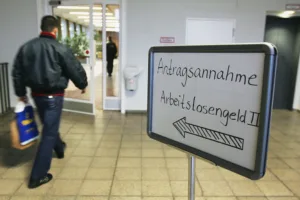




Newly disclosed government figures have revealed that nearly 40 per cent of all long-term welfare recipients in Germany are foreign nationals, raising questions over the sustainability of the country’s immigration policies and social safety net.
Data compiled by the Federal Employment Agency (Bundesagentur für Arbeit) shows that 1.4 million people have been continuously dependent on basic state support, formerly known as Bürgergeld (“citizen’s income”), for at least five consecutive years.
This chronic demographic accounts for roughly two in five of all employable welfare beneficiaries nationwide.
Non-German citizens make up 37.8 per cent of this multi-year bracket, placing them overrepresented compared to their share of the overall population, which stood at about 15 per cent at the end of 2025 according to the Federal Statistical Office (Destatis).
Their share among all recipients of basic support is higher, at about 46 per cent, according to employment agency statistics for January.
The statistical disclosure, triggered by a parliamentary inquiry from the right-wing Alternative for Germany (AfD) party, also highlighted regional disparities across the country.
The concentration of long-term dependency is most acute in metropolitan city-states. At the close of 2025, chronic claimants made up about 45 per cent of all welfare recipients in Berlin and 43 per cent in Bremen, northwest Germany.
Additionally, the figures revealed that 199,229 of those in the five-year welfare bracket are under the age of 25.
The figures have drawn criticism from the AfD, the largest opposition party in the German parliament.
AfD employment spokesperson René Springer said it could not be that so many people drew benefits at taxpayers’ expense although they could go to work.
Springer reiterated his party’s demands for the introduction of mandatory community service (Bürgerarbeit) of 15 hours per week for employable claimants who have received benefits for more than six months. Those who refuse would receive only benefits in kind or, as a last resort, nothing.
Peter Aumer, social policy spokesman for the governing Christian Social Union (CSU), rejected the proposal. He said the basic promise of the welfare system was that anyone who needed help must receive it.
The Institute for Employment Research (IAB) noted that long-term recipients often face placement barriers such as low formal qualifications or health limitations.
Unemployment in Germany has risen since 2023 amid the economic downturn and long-term unemployment has risen again since 2024.
The IAB noted that more than one million people had been unemployed for at least a year in 2025, up from about 700,000 in 2019.
Long-term unemployment is not the same as long-term receipt of basic benefits, as employed persons with low incomes can also receive state support.
The German Government has introduced stricter obligations to cooperate and benefit cuts, in order to end abuse and get more people to work. The reform, passed by parliament on March 5, dropped the Bürgergeld name and has been phased in since July 1.
Germany’s coalition government has agreed a sweeping package of welfare cuts worth €38.3 billion by 2030, stripping back the country’s health system and pension guarantees to free up funds for military spending. https://t.co/8XLgvDLJTs
— Brussels Signal (@brusselssignal) April 29, 2026