




French authorities have blocked a high-profile gathering dedicated to the concept of “remigration”, issuing blanket bans on a weekend symposium and a street demonstration in the Paris region.
The intervention was spearheaded by Minister of the Interior Laurent Nuñez, targeting events organised by the Objectif Remigration (Objective Remigration) collective and the Polémia think tank.
The bans were issued on October 29 by the prefect of Hauts-de-Seine and the Paris police prefecture, which said it had acted at the minister’s request.
Officials cited acute risks to public order, referencing local security concerns and widespread tensions following recent incidents, notably the October 23 attack in Trappes and La Verrière, in the Yvelines department west of Paris.
One man, Pengo Bossio Wangi, was killed and seven people were injured in the shooting. French media have reported that the suspect, identified as Kevin T., admitted to targeting Muslims and Africans.
According to Bondy Blog, the Hauts-de-Seine order also stated that the concept of remigration seriously undermined human dignity and cited past convictions of several speakers for hate speech offences.
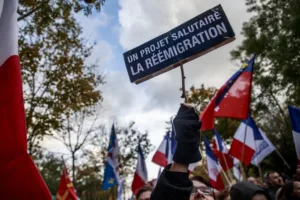
The weekend agenda was set to feature a colloquium titled “Remigration: Let’s open the debate” on October 31 at the Maison des Arts in Le Plessis-Robinson, Hauts-de-Seine, alongside a planned nationalist protest in the capital on November 1.
Prominent figures associated with the European identitarian movement — including French essayist Renaud Camus, former National Front MEP Jean-Yves Le Gallou and high-profile Austrian activist Martin Sellner — were slated to speak or host book-signing sessions.
Le Figaro reported that Reconquête party leader Éric Zemmour was also expected to take part. Sellner, author of the book Remigration, had been due to sign copies at a bookshop in Paris’ 7th arrondissement on October 30.
Instead, local prefectural decrees barred the gatherings and Sellner was stopped on arrival at Beauvais-Tillé airport, in the Oise department north of Paris, on October 29 and served with an administrative ban from French territory.
Critics were quick to point out the irony of the situation as a movement explicitly built around campaigning for the mass expulsion and repatriation of foreign nationals found a leading international figure locked out at the border and its organisers grounded by state decree.
Something European governments often claim is impossible to do with illegal migrants turns out to be very easy to use against nationalists, they argued.
The swift executive clampdown drew sharp rebukes from the event organisers, who announced their intention to challenge the prefectural bans in court, denouncing what they termed an infringement on freedom of assembly and speech.
Le Gallou, president of Polémia, took to X to denounce what he termed a “government in disarray” and a “liberticidal delusion”.
He announced that they had instructed lawyer Jérôme Triomphe to file an emergency fast-track legal challenge (référé-liberté) to overturn the prohibitions. The administrative court in Cergy-Pontoise was due to hear the case at 2pm today.
Objectif Remigration spokesman Stanislas Tyl said the collective would lodge its own urgent appeal against the ban on the Paris march.
“You can stop people but not ideas,” Sellner wrote on X, announcing what he described as his arrest. “Remigration will happen in spite of that.” He said he expected to be sent back to Austria today.
I was stopped at the airport in France.
I will be deported tomorrow.
Soon they will also take my phone.You can stop people but not ideas.
Remigration will happen in spite of that.If you want to fight this injustice join us @SaveEuropeAct
Bon courage a patriotes francais.… pic.twitter.com/cDqrM7kEso
— Martin Sellner (@MartinSellner_) October 29, 2026
Fellow activist and Dutch commentator Eva Vlaardingerbroek argued that Sellner broke no law and was persecuted for political reasons. She added that he was travelling as an Austrian citizen within the Schengen zone, meaning there should not even be border checks.
In May 2024, an administrative court in Potsdam blocked a German entry ban on Sellner, ruling the city had failed to show he posed a sufficiently serious threat to justify restricting his EU free movement rights.
In November 2025, Switzerland’s Federal Administrative Court declared unlawful a separate 18-day entry ban imposed on him by the country’s federal police.
Figures from La France Insoumise (LFI) had lobbied for the shutdown. LFI parliamentary group leader Mathilde Panot posted on X ahead of the ban, declaring: “After the tragedy in Trappes, authorising an event inciting racial hatred is unacceptable and dangerous. Racists must be neutralised. The gathering planned for Saturday in Le Plessis-Robinson must be banned quickly.”
She celebrated the actions of the French Government.
Victoire !
Conformément à notre demande, le rassemblement et la manifestation de néonazis prévus ce week-end au Plessis-Robinson et à Paris sont interdits.
Nous ne laisserons rien passer. pic.twitter.com/v28ftuVMjt
— Mathilde Panot (@MathildePanot) October 29, 2026