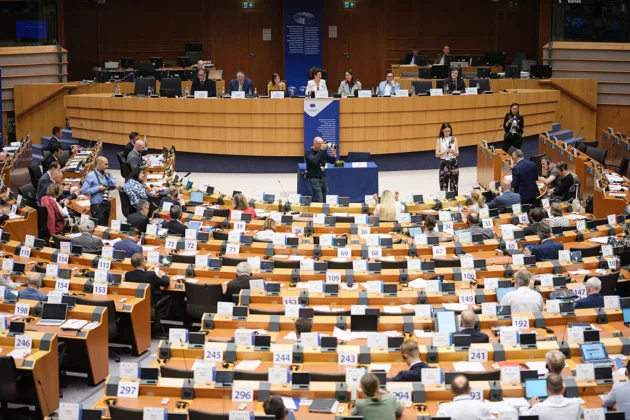



On October 8, the European Parliament adopted a resolution on “the need for an EU strategy to counter Islamist entryism and the influence of the Muslim Brotherhood network”. The text, tabled on September 30 by French MEP Céline Imart on behalf of the European People’s Party (EPP), passed by 381 votes to 167, with 15 abstentions, of 563 MEPs voting. Entryism, in this context, means the infiltration of various institutions by extremists and their takeover from within.
Before the vote, the Renew Europe group tried to slip something else into the text. Its amendment 24, tabled on October 2 by the group’s negotiator on the file, former French Europe minister Nathalie Loiseau, who chairs the European Parliament’s special committee on the European Democracy Shield, would have added the following recital: “whereas religious entryism is by no means limited to Islamism, as exemplified by the ultra-conservative Catholic organisation Ordo Iuris actively lobbying EU institutions and conducting actions against EU fundamental values”. The same reference to Ordo Iuris appeared in recital E of Renew’s own competing motion for a resolution.
As the communications director of the Ordo Iuris Institute for Legal Culture, I can report that neither text made it. Renew’s motion fell when the EPP text was adopted, and the final resolution does not mention Ordo Iuris.
The adopted text describes the Muslim Brotherhood as “the archetype of these transnational Islamist networks” and recalls that Hamas “historically originates from the Muslim Brotherhood movement”. Citing the French Ministry of the Interior, it describes the Council of European Muslims as the “cornerstone of the European structuring” of the Muslim Brotherhood. Among the possible markers of ideological radicalisation or Islamist influence, it lists separatist narratives, systematic victimhood, anti-Semitism, anti-Christian hatred and the contestation of equality between women and men.
The resolution also deals with public money. It names the Forum of European Muslim Youth and Student Organisations (FEMYSO), the European Network Against Racism, Al Sharq Forum, Islamic Relief Worldwide and the University of Gaziantep as entities that “have received, or have been associated with projects receiving, EU funding” despite serious questions about their links with Brotherhood networks. It asks the European Commission for a full overview of such funding, traceability down to final recipients and full use of the EU’s early detection and exclusion system. It calls for organisations linked to the Council of European Muslims, such as FEMYSO, to be denied access to the EU institutions and removed from the EU Transparency Register.
MEPs further invite the Council of the European Union to place entities and individuals linked to the Muslim Brotherhood on the EU terrorist list where the legal criteria are met. They support national bans on full-face coverings in public, call for an EU list of hate preachers, tighter checks on visas and on foreign funding, notably from Qatar and Turkey, and closer cooperation with Europol and Eurojust. As Brussels Signal noted, the resolution itself designates nobody: Listing requires a national authority’s decision and unanimity in the Council.
Yet Renew did not leave empty-handed. The EPP draft’s first paragraph condemned “Islamist entryism strategies”. Through a Renew amendment, reported by Agence Europe, the adopted paragraph now “condemns religious and, in particular, Islamist entryism strategies”. It adds that “religious entryism spearheads efforts to roll back women’s rights and gender equality, sexual health and reproductive rights, LGBTIQ+ rights”, among other things. Loiseau called the result “a well-deserved victory” for her group. In other words, while the group failed to put what it calls “ultra-conservative” Catholics on a par with Islamists, and Ordo Iuris on a par with the Muslim Brotherhood, it succeeded in turning a resolution about Islamism into one about religion in general.
In the European Parliament’s vocabulary, sexual and reproductive health and rights include access to abortion, as its resolution of June 24, 2021 on the subject made clear.
The final vote followed a clear left-right line, according to the roll-call data. The Left voted against: The Progressive Alliance of Socialists and Democrats (S&D) by 84 votes to two, with one abstention; the Greens/European Free Alliance by 40 to one, with one abstention; and The Left by 35 to one. The left-wing groups had refused to take part in the negotiations on the EPP draft. The centre and the Right voted in favour: the EPP by 143 to one, the European Conservatives and Reformists by 72 to nil, Patriots for Europe by 67 to nil, Europe of Sovereign Nations by 25 to nil with one abstention, and Renew by 62 to three, with two abstentions. Non-attached MEPs were split, with eight votes in favour, four against and 10 abstentions. As reported by Brussels Signal, Renew Europe “negotiated wording making clear the resolution was not aimed at Muslims in general”, while the left-wing groups argued that the language of entryism casts suspicion on ordinary Muslim civic activity.
Ordo Iuris is no stranger to this kind of treatment in Strasbourg. In its resolution of November 26, 2020 on abortion in Poland, the European Parliament described our institute as a fundamentalist organisation and as a driving force behind campaigns undermining human rights and gender equality, citing attempts to ban abortion, referring to our work in defence of the most fundamental of all human rights: The right to life. Renew voted for that text by 95 votes to nil, with three abstentions. The resolution of November 11, 2021 repeated the accusation almost word for word. Our crime, in other words, was to defend the right to life from conception.
The attempts to silence us have not stopped there. In November 2020, 38 MEPs demanded that we be struck off the EU Transparency Register, where we remain listed. In 2023, Renew MEPs asked the European Parliament to withdraw the accreditation of Ordo Iuris and other conservative NGOs, while ILGA, Planned Parenthood and the Center for Reproductive Rights urged the Commission to exclude us from the committee monitoring EU funds in Poland. Our opponents would also like to see us lose our consultative status with ECOSOC, the United Nations Economic and Social Council. At the UN, we are usually the only conservative, pro-life European NGO present, so wouldn’t it be wonderful to have none?
The Ordo Iuris Institute for Legal Culture is a pro-life, pro-family, pro-liberty and pro-sovereignty legal think tank. Its litigation department defends, before the courts, people whose fundamental rights have been violated, be it their parental rights or their freedom of expression and assembly. Within our organisation, the Centre for Life and Family organises dozens of marches for life and family across Poland every year and co-organises the National March for Life in Warsaw.
This is the organisation, with some fifty lawyers and other paid staff, that Renew wanted to place in the dock alongside a brotherhood with international ramifications whose motto, according to the report published by the French government in May 2025, proclaims that “the Koran is our constitution”. That report devotes an entire section to the Brotherhood’s strategy of entryism into the European institutions. It says nothing about Catholic entryism. Its bibliography even includes a book by Loiseau.
This is not an isolated case. In Belgium, the federal Institute for the Equality of Women and Men published a Report on Anti-Gender Campaigns in Belgium in 2024. It was directed by David Paternotte of the Université libre de Bruxelles and co-authored by Alexandra Ana, Archibald Gustin and Neil Datta of the European Parliamentary Forum for Sexual and Reproductive Rights. Its first table, listing the main anti-gender organisations at European level, places Ordo Iuris alongside France’s Manif pour Tous and the Commission of the Bishops’ Conferences of the European Union (COMECE), among others. There is not a single Muslim organisation on the list. The report presents “anti-gender” campaigns as having been born as a Catholic project, while describing Muslim religious groups as rarely involved.
From the centre to the Left, the method is the same: Whenever Islamism has to be named, a Christian equivalent must be found, preferably a Catholic one.