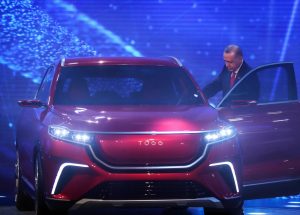



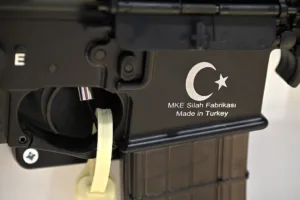

Turkey is not developing its defence industry solely to equip its armed forces. It is systematically transforming the sector into an instrument of economic power, diplomatic reach and strategic influence. Every export contract, co-production agreement and new technological partnership expands a network of states and companies with an interest in maintaining productive relations with Ankara.
This is the dimension that directly concerns Greece. The growth of Turkey’s defence industry is altering not only the military balance but also the diplomatic environment in which Athens must defend its sovereign rights and secure international support in the event of a crisis.
In 2025, exports by Turkey’s defence and aerospace industry reached $10.05 billion (€8.95 billion), an increase of approximately 48 per cent over the previous year. In the first nine months of 2026, they had already risen to $6.93 billion, up 15.6 per cent year on year. On a rolling 12-month basis, exports had reached $10.94 billion by September 2026, according to Turkish Exporters Assembly and trade ministry figures.
This acceleration is also reflected in new orders. According to Haluk Görgün, head of Turkey’s Presidency of Defence Industries (SSB), the sector had signed $15 billion in new contracts during 2026, with a target of $20 billion by the end of the year.
This figure includes both domestic and export contracts and should therefore not be equated with completed exports. Completed exports, new export contracts, government orders placed with Turkish industry and Turkey’s purchases of foreign weapons systems are distinct economic categories. Examining them separately shows that Turkey is simultaneously expanding its exports, domestic production and international industrial links.
This development is broadening both Turkey’s production base and the political influence that flows from it.
Major companies such as ASELSAN, Baykar, Turkish Aerospace, ROKETSAN, STM and Otokar are no longer confined to meeting domestic demand. They compete for international contracts, establish joint ventures, enter European supply chains and offer integrated packages that include training, technical support, spare parts and future upgrades.
At the same time, Turkey uses domestic orders to sustain serial production, expand its industrial base and give companies greater predictability. Major air-defence contracts awarded to ASELSAN, together with its cooperation with ROKETSAN on the supply of subsystems, illustrate an industrial ecosystem strengthened by both domestic demand and exports.
Even more consequential for Greece is the geographical reach of Ankara’s international partnerships.
In Canada, the strategic partnership announced on October 22, 2026, provides for closer cooperation between the two countries’ defence industries. The move is politically significant because it demonstrates Turkey’s ability to move beyond periods of tension and restrictions and build new institutional and industrial ties. Ottawa had suspended arms export permits to Turkey in 2020 over the use of Canadian-made drone optics in Nagorno-Karabakh and dropped those controls only in January 2024.
In Italy, Leonardo and Baykar are cooperating on the development, production and maintenance of unmanned aircraft. This relationship goes far beyond an ordinary commercial transaction. It links a major European defence company to Turkey’s industrial and technological base and embeds Baykar in a broader European defence ecosystem. Baykar also completed the purchase of Piaggio Aerospace in 2025, and the joint venture it formed with Leonardo, LBA Systems, began production in July 2026 — giving a Turkish manufacturer both a factory and a partner inside the European Union.
In Spain, cooperation on the HÜRJET trainer aircraft links Turkish Aerospace with Airbus and the Spanish Air and Space Force’s training programme. Madrid authorised the acquisition of up to 45 aircraft for €3.12 billion in October 2025 and signed for an initial 30 in December, with Airbus Defence and Space leading the programme and the aircraft due to enter Spanish service as the Saeta II, replacing the F-5. In Portugal, STM has undertaken the construction of two support and replenishment vessels for the Portuguese Navy, the first of them laid down in Turkey in November 2025. Poland has received 24 Bayraktar TB2 unmanned aircraft, while Romania has procured 18 aircraft of the same type, together with training and support services.
These agreements create relationships that endure long after the initial delivery. Maintenance, spare parts, personnel training, software upgrades and operational support can bind supplier and customer for years. A commercial agreement can therefore evolve into a long-term political and strategic relationship.
Turkey’s relationship with Germany and the United Kingdom is particularly significant. The agreement to procure 20 Eurofighter Typhoon aircraft, worth up to £8 billion (€9.5 billion), was signed with London on October 27, 2025, after Berlin dropped its objection to the export, and integrates Ankara into a multinational European network of defence-industrial and political interests.
Its political significance is distinct and potentially deeper. The agreement connects the Turkish Air Force to a European industrial system involving the United Kingdom, Germany, Italy and Spain. Training, weapons, technical support and future maintenance create an enduring relationship, with first deliveries expected in 2030. At the same time, the programme supports employment and industrial activity in the countries participating in the European consortium.
This is Ankara’s broader advantage. Turkey is simultaneously becoming a supplier, buyer, industrial partner and co-production hub. It offers more than weapons systems: it offers market access, joint production, technological cooperation and geopolitical utility.
The same applies to its relationship with the United States. Ankara remains dependent on US technology for critical programmes while seeking to restore and expand its defence ties with Washington. Turkey’s KAAN fighter remains reliant on the US-made F110 engine, at least until a reliable indigenous alternative becomes available.
US approval for the sale of F110 engines, granted in July 2026 in a package worth around $700 million (€624 million) despite the unresolved dispute over Ankara’s purchase of the Russian S-400 air-defence system, substantially strengthens the prospects of the KAAN programme, enabling Turkey to proceed with flight testing and initial production before its domestically developed engine becomes available. It also reconnects US-Turkish defence cooperation with a critical Turkish programme, giving Ankara greater scope for strategic bargaining with Washington. Turkey also continues to seek renewed participation in the F-35 programme and further upgrades to its F-16 fleet.
Beyond the West, Ankara is developing a second network of relationships with Saudi Arabia, Qatar, Pakistan, Azerbaijan and Indonesia. In several of these partnerships, the total financial value has not been disclosed. The absence of a specific valuation does not, though, diminish their strategic importance. Joint production, research, technological development and training create a web of relationships that extends Turkey’s presence beyond traditional arms markets.
The political consequence is clear: by creating an increasingly dense network of strategic, economic and technological interests around Ankara, Turkey’s defence industry is tightening the squeeze on Greek foreign policy.
This does not mean that countries cooperating with Turkey will automatically adopt Ankara’s positions at Greece’s expense. It does mean, though, that they gain additional reasons to avoid a rupture with Turkey. When governments, armed forces and major companies link jobs, production lines, technological programmes and security requirements to the country, the political cost of a decisive confrontation with Ankara rises.
This narrows Athens’ ability to secure coordinated, timely and effective international pressure. Greece may have strong arguments under international law. International law remains a fundamental instrument of Greek foreign policy, but it does not operate in a political vacuum and cannot override the economic, industrial and geopolitical interests of other states.
The European Union affirms its commitment to the sovereign rights of its member states while also seeking to maintain functional relations with Turkey. These two objectives are not always easy to reconcile. As Turkey’s importance to European security, defence production, migration, energy and regional stability grows, European governments become more inclined to manage Greek-Turkish tensions than to confront Ankara decisively.
Greece therefore cannot base its strategy on the expectation that Europe will open a new front with Turkey on its behalf when the need arises. In a serious crisis, the European response may prove inadequate or delayed, particularly if powerful states and companies seek to protect their economic and defence ties with Ankara.
The answer cannot be a timid or passive Greek foreign policy. Nor is invoking European solidarity sufficient. Athens needs to build its own network of strategic interests by linking foreign policy more effectively with the defence industry, energy, shipping, infrastructure, technology and European production.
Greek defence procurement should be treated not merely as the purchase of weapons systems but as an opportunity for co-production, technology transfer, the participation of Greek companies in international supply chains and the creation of long-term industrial ties. Greece should not simply purchase security. It should give other states a tangible stake in Greek security.
This is the lesson Turkey has already understood. A defence industry does not produce only weapons systems. It also creates jobs, technological dependencies, political relationships and diplomatic influence.
Unless Greece responds with an equally coherent, long-term strategy, the room for manoeuvre available to its foreign policy will continue to be constrained by the international network of interests that Ankara is building with speed and consistency.
That is where the real danger lies: European and international action may come only after facts have already been established on the ground, rather than helping to prevent them promptly and decisively.