









About 700 prisoners have walked out of jails in England and Wales today under the first wave of the government’s expanded early-release scheme, and several of them thanked the Prime Minister by name.
A man leaving HMP Durham, in northeast England, holding his belongings in a bin bag, told reporters: “Justice system, what justice system? Thank you Andy Burnham.”
Outside HMP Cardiff, in south Wales, a prisoner asked for a message to the Prime Minister said: “Thank you very much and don’t get me back here again, bro.”
At HMP Forest Bank in Salford, northwest England, a man who gave his name as Dean said people inside “don’t even know who Andy Burnham was” and that he thought the Prime Minister was “getting things done”.
At Wandsworth, in south London, Michael Bogle, 38, a former bus driver jailed five times for 100 shoplifting convictions, said: “Keep the early release going. It’s good.”
Another man released after eight days for breaching a conditional sentence said there was not enough space in the jails, and thanked Burnham.
The releases are the first under the Sentencing Act 2026, which lets ministers move the release point for certain fixed-term prisoners from 40 per cent of the sentence to a third. For those serving four years or more for some offences, the point moves from two-thirds to half.
About 5,000 are due out in stages over the next year, down from 6,000 after ministers excluded rapists and the most serious child-sex offenders. The releases are staged across ten tranches running to June 2027.
The first eligible group are those jailed for up to 19 months. From November the threshold rises to three years and two months.
By next June, prisoners on fixed terms of more than 12 years become eligible. Many of them had expected to serve two-thirds.
About 2,000, including some convicted of domestic abuse and violent offences, are due out over the next month. Those released remain on licence for the rest of the sentence, under probation supervision and electronic tagging, and can be recalled if they breach the conditions.
Manslaughter is excluded, so the men convicted over the killing of PC Andrew Harper in 2019, Albert Bowers and Jessie Cole, will not qualify. Harper, a Thames Valley Police officer, was dragged to his death behind a car in Berkshire, southern England, after responding to a burglary.
Burnham intervened over the summer to keep two of them inside after a public outcry, and said he wanted to exclude more categories but that overcrowding would not allow it. Ministers widened the exemptions on August 30 to cover all forms of manslaughter, death by dangerous driving and indecent assault.
Justice secretary Alex Norris apologised in August to families who had spent the summer unsure whether the people who had harmed them would be freed.
Ministers say the alternative is a full estate and courts that stop sending people down. Adult men’s jails have been running at about 98 per cent of capacity.
The prison population has risen by more than 1,700 in three months, to 87,499 on September 28, and stands about 1,000 below the record of 88,521 set on September 6, 2024.
The government still projects about 100,000 by 2030, and has promised a £7 billion (€8.2 billion) building programme for 14,000 extra cells by 2031.
The scheme applies in England and Wales only. Scotland and Northern Ireland run separate prison systems, and Scottish ministers passed their own early-release law in 2025.
Shadow justice secretary Nick Timothy said the public would “pay the price” and that the decision would encourage more crime.
A separate Conservative scheme freed 13,325 prisoners between October 17, 2023 and September 9, 2024.
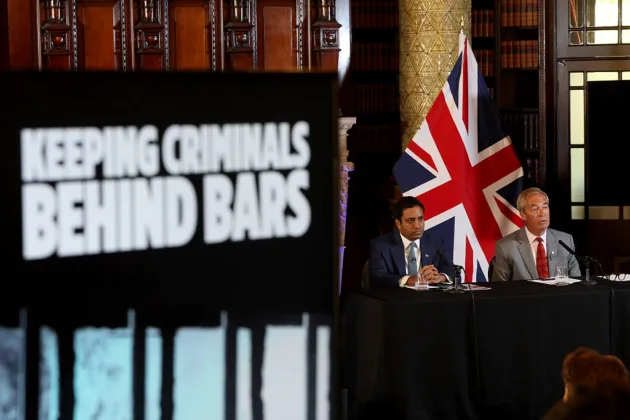
Reform UK’s London mayoral candidate, Laila Cunningham, a former prosecutor, speaking outside Wandsworth, said that if she were Burnham she would “hang my head in shame”, and told him to look domestic abuse victims in the eye.
Not every man at the gate was grateful. Tom, 32, released from Cardiff after a burglary sentence and 17 years in and out of jail, said he would happily have served his time and expected to be back within a month or two.
David Elliott told The Telegraph he would soon be back behind bars, claiming that the early release scheme was “setting prisoners up to fail”.
“I’m 50. I’ve been in and out of jail all my life. I’ve got 360 convictions [ … ] I’ve got an addiction to stealing,” Elliott said.
🇬🇧 More than 9,000 domestic abusers could be eligible for early release under the UK’s revised prison scheme, according to Conservative analysis of Ministry of Justice data.
The government says the measures are needed to prevent prison overcrowding, while critics warn of risks…
— Brussels Signal (@brusselssignal) August 6, 2026