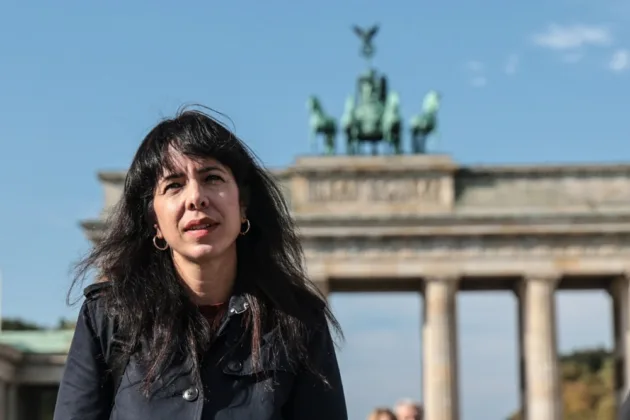




Germany’s left-wing Die Linke party in Berlin has expelled controversial lawmaker Vanessa Emde from its parliamentary group in the Berlin House of Representatives, clearing a major obstacle to coalition talks with the Social Democrats (SPD) and the Greens while triggering an immediate revolt from the party’s radical grassroots.
Following hours of heated debate on November 24, 33 of Die Linke’s 44 state lawmakers voted in a secret ballot to oust the 45-year-old Neukölln representative, surpassing the required two-thirds majority of 30 votes, with six voting against, four abstaining and one ballot declared invalid.
The expulsion motion was tabled on November 17 by parliamentary group co-chairs Elif Eralp and Tobias Schulze after Emde withdrew her support from a joint party declaration affirming Israel’s right to exist and condemning anti-Semitism, which she had signed before distancing herself from it a day later.
Emde has repeatedly argued that, under international law, only people, not states, possess a right to exist, a stance critics have condemned as anti-Semitic.
The decision has exposed deep ideological fractures within the Berlin branch of Die Linke, where Emde remains a popular figure among pro-Palestinian activists after winning 46.2 per cent of the direct vote in Neukölln at the September 20 state election.
The party’s Neukölln district association swiftly condemned the expulsion as “a serious political mistake”.
Addressing supporters after the vote, Emde vowed to retain her seat as an independent lawmaker and accused her former colleagues of capitulating to political pressure. She remains a member of the party.
“The decision is a watershed moment for Die Linke and has shown that the media smear campaign has had its effect and that my parliamentary group, my former parliamentary group, has obviously caved under pressure from the SPD and Die Grünen,” she said, urging disillusioned activists who were considering quitting the party to remain and organise internally.
The expulsion immediately triggered a wave of online hostility and violent imagery from Emde’s supporters directed at Die Linke’s Berlin leadership.
According to Tagesspiegel, social media posts heavily abused senior state party figures while circulating an apparently AI-generated image depicting the Karl-Liebknecht-Haus — Die Linke’s headquarters near Alexanderplatz — engulfed in flames.
The image of the burning party seat was shared on Instagram by Jason Osterhagen, a Die Linke official and spokesperson for the party’s Federal Working Group on Palestine Solidarity (Bundesarbeitsgemeinschaft Palästinasolidarität), who captioned it: “Btw my wallpaper and a motivation.”
Osterhagen, a former CDU member who joined Die Linke in 2024 and ran unsuccessfully for the Bundestag in North Rhine-Westphalia in 2025, had waited outside the Berlin House of Representatives on November 24 alongside other activists to show solidarity with Emde.
Also present was Thies Kehmeier, a fellow board member of the Palestine Solidarity working group, who directed an expletive-laden, later-deleted post at parliamentary co-chair Tobias Schulze.
“Fuck all MPs who made themselves complicit in the smear campaign against our comrades. Fuck Tobias Schulze. Fuck German Staatsräson. Free Palestine,” Kehmeier wrote.
Following the vote, Osterhagen and activist Hannah Bruns, who herself faces ongoing party expulsion proceedings, urged radical activists not to quit Die Linke, vowing to continue organising internally and insisting that “Palestine solidarity” would not be forced out of the party.
The internal friction comes amid ongoing concerns over radicalisation within the Berlin party’s ranks.
At the Berlin party congress on October 31, lead mayoral candidate Elif Eralp was placed under police protection after groups including Die Linke’s own Berlin working group on Palestine solidarity announced protests. Emde joined a rally against the party leadership on the sidelines of the same congress.
Following the vote, parliamentary co-chair Tobias Schulze acknowledged the difficulty of the move, stating that while many lawmakers found the step painful, cooperation with Emde had become untenable. “We did not take this step lightly,” he said.
Both the SPD and the Greens had briefly halted exploratory talks in October over concerns regarding anti-Semitism within Die Linke, with Berlin SPD co-chairs Steffen Krach and Bettina König welcoming Emde’s removal.
“She significantly hampered the coalition negotiations, and it’s good that Die Linke has now provided clarity,” they said in a joint statement.
Krach had made a resolution of the Emde case a condition for recommending the coalition agreement to SPD members, who are due to vote on it in January.
Even with Emde’s departure reducing Die Linke’s faction to 43 seats, a prospective coalition with the SPD and the Greens would still command a 12-seat majority in the Berlin House of Representatives, holding 89 of its 153 seats.
However, the episode has drawn scepticism from the centre-right opposition, with Berlin’s Christian Democratic Union (CDU) warning that removing a single lawmaker does little to resolve what it described as a structural anti-Semitism problem within Die Linke.
Senior Die Linke figures face growing pressure after photos resurfaced of visits to a Neukölln mosque association banned on November 17 over alleged Hezbollah financing and promotion. https://t.co/FFe1LdBFJy
— Brussels Signal (@brusselssignal) November 24, 2026