
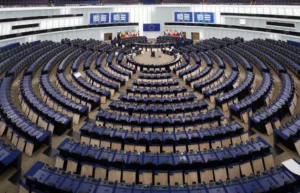



The European People’s Party (EPP) has once again broken ranks with its traditional left-leaning allies, joining forces with right-wing groups in the European Parliament to back changes to the European Union’s environmental permitting rules and push for a formal revision of the bloc’s flagship nature protection laws.
In a plenary vote in Strasbourg on November 25, MEPs adopted the Parliament’s negotiating position on the Regulation on speeding up environmental assessments, part of the European Commission’s Omnibus VIII simplification package, by 367 votes to 268, with 25 abstentions.
The vote had been postponed by a day at the EPP’s request after centrist groups failed to reach a compromise on November 24.
The decisive shift centred on Amendment 103, tabled on behalf of the European Conservatives and Reformists (ECR) by Swedish MEP Beatrice Timgren of the Sweden Democrats alongside Dutch MEPs Sander Smit and Jessika van Leeuwen of the BoerBurgerBeweging (BBB), which sits in the EPP group. It passed by 357 votes to 284, with 21 abstentions.
The amendment inserts a new Article 15b requiring the European Commission to conduct a comprehensive review of the 1979 Birds Directive and the 1992 Habitats Directive, drawing on its ongoing “stress test” of both laws, and to present a legislative proposal to revise both within 12 months of the regulation entering into force.
Additional amendments backed by the right-wing majority would exempt certain agricultural, livestock, flood-prevention and forestry projects from environmental impact screenings altogether.
The text also caps the full environmental assessment process, including screening, at 300 days, extendable by up to 60 days in exceptional cases.
The right-wing alliance triggered an immediate collapse of establishment party talks, leaving the Progressive Alliance of Socialists and Democrats (S&D) and Renew Europe furious.
EPP group leader Manfred Weber defended the move by stating that his party had to support the ECR amendment because it reflected the EPP’s own policy position.
Prior to the vote, 80 MEPs spanning The Left, the Greens/European Free Alliance (Greens/EFA), the S&D and Renew—whose Swedish MEP Emma Ytterell served as the Parliament’s rapporteur on the file—had signed a joint letter urging the Commission not to touch the Birds and Habitats Directives while its official “stress test” of the legislation remains unfinished.
The S&D Group ultimately voted against the final report, declaring that a red line had been crossed.
S&D negotiator Annalisa Corrado accused the EPP of breaking a hard-won compromise that had focused on tackling administrative bottlenecks by better resourcing national authorities.
“Simplification should make administration more efficient, not serve as a pretext for dismantling environmental protection,” Corrado said, warning that her group would fight to strip the nature-law revision out of the text during upcoming negotiations with EU member states.
Environmental campaigners echoed that outrage, with the Hands Off Nature coalition —made up of BirdLife Europe, ClientEarth, the European Environmental Bureau and WWF EU— condemning the vote as an ideological rollback.
A coalition spokesperson accused Weber’s EPP of “ignoring science and betraying the 1.25 million citizens who demanded that EU nature laws be protected, not put on the chopping block.”
With the Parliament’s position now locked in, trilogue negotiations with the Council of the European Union are expected to begin under the Irish EU Presidency, with a provisional agreement anticipated in early 2027.
Member states agreed their own negotiating mandate on September 30. The Irish Presidency, which ends on December 31, had aimed for a deal by the end of this year.
For the ECR, the vote represented a landmark triumph for the so-called “Giorgia majority”—a working alliance bringing together the EPP, the ECR and Patriots for Europe.
Carlo Fidanza, head of the Fratelli d’Italia (Brothers of Italy) delegation in the ECR, hailed the outcome as proof that this alignment is “the only political platform capable of delivering tangible results towards genuine simplification that meets the needs of regions, citizens and businesses.”
Dismissing what he termed the “hysterical reaction of the Socialists and Renew,” Fidanza argued that “the parliamentary arithmetic has now changed, and the left no longer holds the political initiative,” urging the three right-of-centre groups to maintain their cooperation ahead of upcoming votes on the Emissions Trading System (ETS), the automotive sector and the Industrial Accelerator Act.
ECR shadow rapporteur Beatrice Timgren described the adoption of Amendment 103 as a “political breakthrough” that addresses the root causes of permitting delays rather than merely their symptoms.
Arguing that decades of restrictive legal interpretations have paralysed farmers and developers, she stressed that Europe “must be able to build factories, expand our electricity grids, invest in industrial capacity and ensure food security without spending years going from one courtroom to another.”
Patriots for Europe similarly celebrated the vote as a major political and substantive victory that shattered the traditional cordon sanitaire in Brussels.
Vlaams Belang MEP and delegation leader Tom Vandendriessche said that direct negotiations between Patriots for Europe and the EPP ensured his group’s priorities, including faster permitting for housing, water infrastructure and farm modernisation, were embedded in the final text.
Fellow Vlaams Belang MEP Barbara Bonte added that the vote opens the door to making the Habitats Directive workable for farmers and entrepreneurs, proving the group is executing its agenda of “less red tape and more room to build, do business and invest.”
The fallout from the vote has immediately thrown the European Parliament’s centrist coalition into disarray, jeopardising negotiations aimed at securing a third term for Parliament President Roberta Metsola in the mid-term reshuffle in January 2027.
Both the S&D and Renew Europe, whose decision to freeze discussions was confirmed by a spokesperson for Renew chair Valérie Hayer, have suspended formal coalition talks with the EPP.
The three groups had been working to finalise a written political pact that would break the deadlock over the presidency, offering the Socialists policy guarantees in exchange for backing Metsola’s re-election rather than insisting on their customary claim to the top post.
Both factions are now demanding binding safeguards to stop the EPP from repeatedly relying on right-wing majorities before returning to the table, yet EPP leader Manfred Weber has shown little willingness to yield, reminding reporters on November 24 that “there is no exclusivity” when it comes to working with his party.