








A coalition of five European countries has announced plans to establish a “return hub” in Rwanda, where rejected asylum-seekers could be deported as early as 2027.
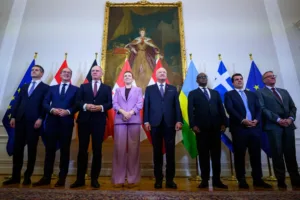
The initiative, driven by Austria, Denmark, Germany, Greece and the Netherlands, was unveiled at a press conference during the Vienna Migration Conference on November 16.
It marks an escalation in the European Union’s broader efforts to curb irregular migration and break the business models of human smuggling networks.
It builds on the EU’s new Return Regulation, which allows member states to set up return hubs outside the EU. The European Parliament backed the regulation in June and member states gave it final approval in October.
Expected to open in 2027, the return hub would initially operate as a pilot project hosting around 100 people, about 20 from each participating country, according to officials. Minors are excluded from the scheme.
The new project differs from the UK-Rwanda scheme, which the UK Supreme Court ruled unlawful in 2023 and a new Labour government scrapped in 2024. That plan sought to process pending asylum claims offshore.
By contrast, this new European project is strictly targeted at migrants who have already exhausted the asylum process and have no legal right to remain in Europe, but who cannot be returned to their countries of origin.
Austrian Chancellor Christian Stocker and Danish Prime Minister Mette Frederiksen emphasised the initiative’s goal of deterrence. Stocker spoke of a “historic paradigm shift” in European migration policy.
“I think this will be a game changer, making us able to confront the massive challenges of illegal migration,” Frederiksen told reporters in Vienna.
“We will break down the business model of human smugglers. We will take back control of our borders and we will remove the incentives for illegal migration.”
Frederiksen underscored that the ultimate success of the programme would be measured by people choosing not to attempt the crossing.
“The most important number is the number that we will never see because hopefully they will not start their journey to Europe,” she said. “So this is a milestone.”
Frederiksen said the aim is to send a “signal … that you can no longer enter the European Union illegally and think that you can just stay around.”
Danish immigration and integration minister Morten Bødskov, who noted the participating nations have been working toward this for years, added that the group expects to have a fully negotiated agreement with Rwanda “within the next few months.” No deal has yet been signed.
Rwandan interior minister Vincent Biruta, who attended the conference in Vienna, defended the partnership and outlined how the African nation plans to handle the arrivals.
Biruta framed the deportation hub as offering a “second chance” to individuals who cannot stay in Europe.
He stated that those transferred to the centre would not be held in closed detention facilities and would get a residence permit in his country.
Those rejected by the five countries could either voluntarily return to their home countries, integrate into Rwandan society or relocate to another destination where they have a legal right to reside.
Vocational training and language courses would be offered to them. Biruta said Rwanda was not seeking payment, with the partner countries covering the costs of relocation and integration.
Addressing raised concerns regarding human rights, Biruta promised international oversight.
“There will be an independent monitoring mechanism,” he said, noting that Rwanda intends to involve organisations such as the UN refugee agency (UNHCR) and the International Organization for Migration (IOM) in the implementation process.
Neither agency has yet agreed to implement the arrangement. The IOM said it does not negotiate “state-to-state removal arrangements”.
Biruta stressed that Rwanda already hosts large numbers of refugees. UNHCR puts the figure at nearly 140,000, mainly from the Democratic Republic of Congo and Burundi.
The country also runs, with UNHCR and the African Union, an Emergency Transit Mechanism for migrants evacuated from Libya. Since 2019 it has taken in more than 3,000 asylum-seekers, of whom over 2,600 have been resettled in countries that agreed to receive them.
Despite Biruta’s assurances, the announcement immediately drew condemnation from human rights organisations, who argue the scheme leaves vulnerable people at risk of abuse and shirks Europe’s humanitarian responsibilities.
A joint statement by 47 aid, trade union and rights groups, including the International Rescue Committee and the Dutch Council for Refugees, urged the five countries to drop the plan.
Scepticism also exists within some academic and policy communities regarding the actual efficacy of the plan.
Gerald Knaus, an Austrian migration researcher and architect of the 2016 EU-Turkey migration deal, criticised the initiative’s scale and potential impact.
“I fear that what is being presented today is only a small solution,” Knaus stated following the announcement. “It is clear that this small solution will achieve nothing.”
Knaus backs third-country schemes in principle but has argued they should cover all irregular arrivals, not only rejected asylum-seekers.
Spanish Prime Minister Pedro Sánchez also criticised the plan in a television interview on November 16, ahead of Spain’s general election on November 29. His government launched an extraordinary regularisation this year expected to benefit some 500,000 irregular migrants.
Sánchez said he does not see any future or humanity in the approach and insisted it is not the solution to Europe’s migration challenges.
European Union member states have begun scouting up to a dozen countries — among them Rwanda, Uganda and Uzbekistan — as potential hosts for “return hubs” where rejected asylum seekers could be held while awaiting deportation. https://t.co/qvHxMN7Iyq
— Brussels Signal (@brusselssignal) June 24, 2026