






On November 10 on these pages Karl Pfefferkorn wrote that serving voters and obeying Brussels had come apart: “No longer are the two seamlessly compatible.” In May Henry Olsen supplied the other half of the argument: “Just give the people what they want and need,” and they will elect you. He applied that rule to Viktor Orbán too, who lost after four years of stagnation. Both describe the present. Poland’s last two decades show that it was once otherwise, and that what voters wanted and what the Union offered could be the same thing.
In February 2004, three months before accession, 60 per cent of Poles supported European Union membership, according to pollster CBOS. In June 2022, four months after Russia’s full-scale invasion of Ukraine, it reached 92 per cent. The war helped drive support to its peak. The long climb before it had another cause. Over those years Poland’s GDP per head, measured at purchasing-power parity, went from around half of the EU average to 81 per cent of it in 2025. It has been one of the fastest-growing economies in the Union since it joined. Average pay rose by more than 180 per cent in 22 years, and unemployment fell from 19 per cent to 3.
The single market and the cohesion funds needed no campaign to defend them. They needed motorways, export orders and pay packets. Support now stands at 82 per cent, and opposition has almost tripled, from 5 to 14 per cent. Poles have grown more sceptical of what Brussels has offered since. Before blaming them, Brussels might ask why policies that once won broad support no longer do.
Take three questions. Would Europeans refuse electric cars if they were clearly cheaper than petrol ones? Would Poles and Czechs turn down the euro if they were sure it would make them richer? Would anyone march against migration if it brought growth instead of conflict? I do not think so. Each has an answer the Union could give and has not yet delivered.
An electric car is a machine for turning electricity into kilometres. Brussels chose regulation before affordability: From 2035, new cars were to emit no CO2 at all. Meanwhile electricity stayed dear. According to the International Energy Agency, power for energy-intensive industry in the EU cost more than twice as much as in the United States in 2025 and nearly half as much again as in China. Measured in purchasing-power terms, Polish households paid the second-highest price in the Union in the first half of this year, and taxes and levies make up a larger share of their bills than anywhere else in the bloc. The average battery-electric car sold in the EU in 2025 cost €42,700, according to campaign group Transport & Environment.
In December 2025 the Commission proposed to soften the 2035 target. In July it began to talk about electrification as a way to cut costs and dependence on imports. That is the right argument. What is missing is the bill that proves it.
Delivery would start there. Cut what governments themselves load on to a kilowatt-hour before taxing a litre of petrol further. Stop pricing domestic power out of the market faster than it can be replaced. The EU imports 96.6 per cent of its oil, and this year the Strait of Hormuz reminded every driver what that means. Petrol keeps Europe tied to imported crude, whether it comes by tanker or by pipeline. A grid can be built on what a country has: Its own coal for now, its own reactors, wind and sun later. The price of a kilowatt-hour does not have to follow the price of a barrel. Drivers in Łódź and Lyon will not buy a car to save the polar bear. They will buy one that is cheaper to run, on power that is made at home.
The euro has been next door for a quarter of a century. This spring 43 per cent of Poles and 42 per cent of Czechs wanted it. The standard reply is that the treaties oblige them to join. An obligation is not an argument.
Poland became one of the Union’s growth leaders with the zloty in its pocket. The Commission’s autumn forecast, published on November 17, expects Poland to grow by 3.5 per cent this year and the euro area by 1.2 per cent, with euro-area inflation at 3.2 per cent. That is better than Brussels feared in the spring, and Economy Commissioner Valdis Dombrovskis said the task now was to turn Europe’s resilience into real dynamism. Growth rates alone do not settle the currency question. An economy that is catching up ought to grow faster. But they explain why Poles see no hurry. And in Hungary, after years of forint inflation, 80 per cent want the euro. Voters weigh what they see, and change their minds when it changes.
So change it. Mario Draghi listed the repairs in September 2024, and by July 15.7 per cent of his 383 recommendations had been fully carried out, according to the European Policy Innovation Council’s tracker. Finish the capital market that would let a Polish firm raise money as cheaply as a Dutch one. Bulgaria joined in January: Make it the showcase. When the euro area outgrows its neighbours, the 43 per cent will take care of itself.
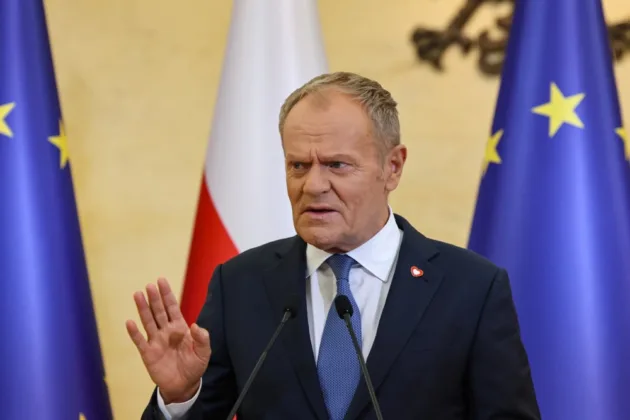
The Polish comparison has a longer history, too. Poland’s four fastest years of growth since accession, 2006, 2007, 2018 and 2021, all came under conservative governments. A global boom and a rebound from the pandemic helped. What has gone wrong since lies in the treasury, and the currency has nothing to do with it. The conservatives left office in 2023 with a deficit of 5.2 per cent of GDP, already too high. Under Donald Tusk, a former president of the European Council and, by Brussels’ reckoning, a safe pair of hands, it reached 7.2 per cent in 2025, the second-highest in the Union. Defence accounts for only part of the deterioration. Higher public-sector pay and social benefits have also pushed spending up. Tusk’s party sits with Ursula von der Leyen’s in the European People’s Party. Warsaw is now governed by the same school as Brussels, and it shows the same habit: Spending grows faster than results.
Poland is supposed to be the country that hates migrants. More than 850,000 Ukrainians live there under temporary protection, with the right to work from the first day. According to the UN refugee agency and Deloitte, 76 per cent of refugees of working age had jobs in 2025, slightly above the rate for Poles in comparable surveys, and they added 2.4 per cent to GDP. There have been tensions. There has been no revolt.
In the United Arab Emirates about nine residents in ten are not citizens. The Emirates do not put such questions to voters, so they cannot tell us what voters would choose. What they show is how a coherent system of labour migration works: The state decides who comes, and those who come, come to work. Abu Dhabi treats migration as labour-market policy rather than a moral argument. Its sponsorship system is controversial, but the principle is simple.
The two cases are very different, and they point the same way: Work makes newcomers easier to accept. Europe has too often arranged the opposite. People arrive without permission, wait months before they are allowed to work, and become the subject of a quarrel among governments about who must take them. The same Poles who live calmly beside hundreds of thousands of working Ukrainians reject the result of that quarrel. What they object to, for the most part, is the way migration is run. A Union that put newcomers to work at once, opened proper channels for the workers its economies need and defended its border by default would find the consent it now struggles to obtain.
What happens when the policies are not repaired, readers of this site know. Two fresh examples will do.
In Poland the government and the President disagree about who sits on the Constitutional Tribunal, and each side calls the other’s moves unlawful. On October 30 people elected to the court by the governing majority entered the building behind a police cordon, and one of them, Anna Korwin-Piotrowska, declared its president, Bogdan Święczkowski, suspended. The Supreme Court has since set that order aside, though she does not accept its ruling. There are now two claimants to run the court, and on November 16 the central bank, which keeps its account, stopped the tribunal’s payments because it holds two contradictory sets of signatures. A member state’s constitutional court cannot pay its bills.
In Hungary Péter Magyar won in April partly on the promise that Brussels would release frozen funds to his government and to no other. “That argument worked because Brussels had made it true,” as Antonio O’Mullony put it here in May. The new government has since taken over the assets of Mathias Corvinus Collegium, the Orbán-era foundation that financed, among much else, The European Conservative. The takeover contributed to the magazine’s collapse. It ceased publication in September.
Pfefferkorn ends by telling national leaders it is time to choose. The same choice lies in Brussels. It can go on managing its customers, or it can go back to what it did in Poland after 2004, when it made a sceptical country richer and won it over.
That would mean cheaper electricity before deadlines, a euro area that outgrows its neighbours before it asks them to join, and migration built around work. None of it needs a treaty change or a police cordon. It needs only the admission that when the customers walk out, the first place to look is the shelf.