





Spain’s opposition leader Alberto Núñez Feijóo has overwhelmed Prime Minister Pedro Sánchez in the only head-to-head debate of the general election campaign, a result conceded even by one of the Government’s own parliamentary allies.
The People’s Party (PP) leader did so without stepping outside the terms set by his rival. On pensions, wages and public services, the two men argued over who would run the existing system better, not over the system itself.
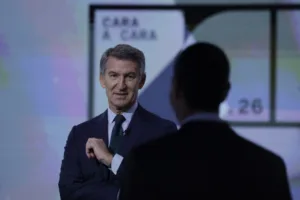
The debate took place on November 19, ten days before the November 29 vote that Sánchez called after Congress rejected two housing decrees. It was organised by Spain’s Television Academy and held at a studio in Tres Cantos, north of Madrid.
It drew an average of 9,985,000 viewers and a 69.7 per cent audience share across the channels that carried it. The 2023 debate between the same two candidates drew 5.9 million.
Feijóo attacked from the first block. He said household purchasing power had fallen and that a shopping basket costing €100 in 2018 now cost more than €143.
Sánchez answered with growth and employment figures. Feijóo replied that GDP could not be eaten.
On housing, Sánchez said a million homes had been built under his governments. Feijóo said there were more flats in the corruption case files than the Government had built.
“We have not yet managed to solve the housing problem,” Sánchez said. He twice told Feijóo he agreed with him in part.
The corruption block was the most one-sided. Feijóo listed the cases involving former transport minister José Luis Ábalos and former Spanish Socialist Workers’ Party (PSOE) organisation secretary Santos Cerdán.
He asked Sánchez who had paid for his party primary campaign. Sánchez did not answer.
The Prime Minister admitted he had trusted people he should not have. He said his was one of the cleanest governments in Spain’s history.
Sánchez kept his voice low throughout and did not interrupt, a reversal of his approach in 2023. Feijóo cut in on him in every block.
On migration, Feijóo called the Government’s policy irresponsible and a gift to trafficking mafias. He asked what the Prime Minister owed Morocco.
Sánchez also apologised to the victims of the rail accidents at Adamuz, southern Spain, and Urda, central Spain. The Urda collision killed 69 people on October 28.
Gabriel Rufián, lead candidate of the Republican Left of Catalonia (ERC), which has supported Sánchez in parliament, said afterwards that the Prime Minister had been badly prepared or badly advised.
The exchanges on policy ran differently. Feijóo promised to raise pensions in line with inflation whatever happened and to create a secretary of state for the elderly.
He said he would guarantee the pension system for younger generations. He did not explain how.
Sánchez offered him a cross-party State pact on pensions. Feijóo did not reject the idea of one. He asked how the Prime Minister could deliver it when he had been unable to pass a budget.
Sánchez asked Feijóo to commit to raising the minimum wage to 60 per cent of the average salary. The PP leader gave no commitment either way.
On housing, Feijóo’s main answer was to increase supply.
Taxes were the clearest dividing line. Feijóo said they had to come down and that Spain was among the EU member states where the tax burden had risen most.
In his closing minute he presented himself as a manager. “I do deliver,” he said, adding that he did not like politics as spectacle.
The PP is running under the slogan “The necessary change”.
Sánchez used the foreign policy block to warn of what he called a European ultra-right international. He closed by asking voters to mobilise against the powerful.
Both parties claimed victory afterwards. PSOE organisation secretary Rebeca Torró said Feijóo had spent the debate “muddying” it, while Feijóo told supporters his party had taken the three points.
Vox leader Santiago Abascal was not invited. Speaking in Benavente, northwest Spain, before the broadcast, he said: “I don’t really know what they are going to discuss tonight.”
He said the PP and the PSOE had pursued the same policies in Brussels on mass immigration, on regulation that had choked farming and industry, and on taxes. He also warned Feijóo against offering State pacts to Sánchez.
Vox has questioned the public character of the pension system during the campaign. Neither candidate did so on November 19.
Private polls have pointed to a PP victory short of a majority. A Sigma Dos survey published on November 9 gave the PP 131 seats, the PSOE 105 and Vox 68, with 176 needed to govern.
Feijóo would need Abascal’s seats to do so. The two are due to meet in a four-way debate on November 26, alongside Sánchez and Ada Colau of the left-wing Frente Amplio (Broad Front).